
Ecwid’s free plan is gone. Anyone still comparing plans expecting a $0 tier with a 5-product limit is working from outdated information, Ecwid retired that structure and now runs four paid tiers, starting at $5 a month.
This is the reality most existing pricing content has not caught up to.
What has not changed, and remains a real strength, is that none of the four current tiers charge a transaction fee.
Every dollar difference between plans comes from feature access and product limits, not a hidden cut on every sale.
Key Takeaways
- Ecwid’s free plan no longer exists. The current entry point is Starter at $5 a month, limited to 10 products.
- Zero transaction fees apply on every tier, Starter through Unlimited, confirmed directly on Ecwid’s own pricing page and FAQ.
- Digital product sales (e-goods) are not available on Starter, they begin at Venture, the second tier.
- Abandoned cart recovery, wholesale pricing groups, and multi-lingual stores all require Business, the third tier, not the entry plan.
- Annual billing saves roughly 17 to 25 percent across every paid tier compared to paying monthly.
- Starter and Unlimited are the two plans most stores should think twice about, one is missing features a real store needs, the other is overpaying for headroom most stores never use.
The Quick Verdict
Most stores land on Venture or Business. Starter is worth using only as a short, deliberate test. Unlimited is worth paying for only once you have actually hit Business’s limits, not before.
| If You Are… | Choose | Why |
|---|---|---|
| Testing an idea, unsure if it will work | Starter | Lowest possible cost while validating demand |
| Actually selling, need digital products or social channels | Venture | The realistic floor for a real small store |
| Losing sales to abandoned carts, need wholesale or marketplaces | Business | The tier where real conversion tools unlock |
| Already past 2,500 products or 2 staff accounts | Unlimited | Removes caps you have actually outgrown |
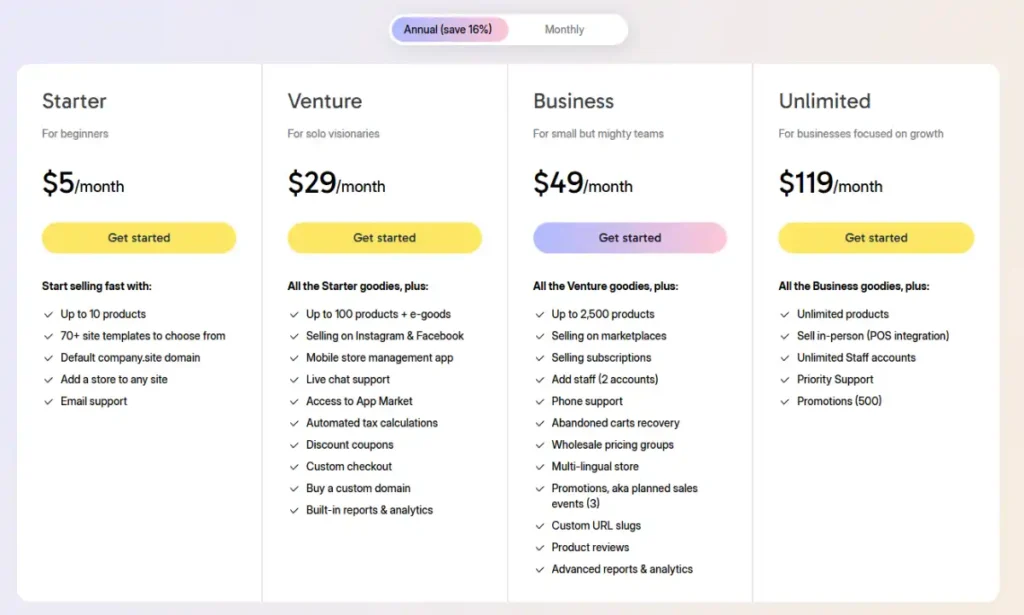
The Four Current Plans
| Starter | Venture | Business | Unlimited | |
|---|---|---|---|---|
| Monthly price (annual billing) | $5 | $29 | $49 | $119 |
| Monthly price (billed monthly) | $5 | $35 | $65 | $149 |
| Transaction fee | 0% | 0% | 0% | 0% |
| Product limit | 10 | 100 + digital goods | 2,500 | Unlimited |
| Staff accounts | 1 | 1 | 2 | Unlimited |
| Support | Live chat | Phone | Priority |
Which Plan Is For Whom, With the Real 1-Year Cost
Starter: $60 a Year
Who it’s for: a genuine test case, a very small catalog, someone validating whether their product sells before committing further.
Real 1-year cost: $60 on annual billing, no discount versus monthly since Starter’s price does not change between the two.
Why we recommend it:
- Costs less than $60 for a full year, well below a typical store startup budget
- Zero transaction fees apply even at this entry tier, no hidden cut on your first sale
- Ten products is enough room to test a real product-market fit question
- 70-plus site templates remove the design decision completely, no separate theme purchase
- No long-term commitment, month to month with no lock-in
- A live store within an hour for most sellers, no technical setup required
The real payoff:
- You learn whether the product actually sells before spending real money on inventory or a bigger platform commitment
- You keep the option to walk away with $5 lost, not $500
- You avoid over-building a store for a product that never finds demand
Venture: $348 a Year
Who it’s for: a small store actually selling, with a real catalog under 100 products, wanting digital product support, social selling, and a proper domain.
Real 1-year cost: $348 on annual billing, versus $420 if paid monthly, a $72 annual saving for committing upfront.
Why we recommend it:
- Digital product support unlocks a completely new revenue stream, ebooks, downloads, courses
- The store finally functions like a real small business tool rather than a limited trial
- Instagram and Facebook selling puts the store where customers already spend time
- Native Google Ads conversion tracking means ad spend can actually be measured, not guessed
- A custom domain replaces the company.site subdomain, a real trust signal at checkout
- Live chat support cuts response time significantly versus Starter’s email-only queue
- App Market access opens real customization without waiting on a future plan upgrade
- Automated tax calculations remove a manual, error-prone task from every order
The real payoff:
- The store looks and functions like a real business, not a test
- Marketing spend becomes something you can measure, not a guess
- Digital and physical products sell from the same single catalog
Business: $588 a Year
Who it’s for: a store with real order volume, where abandoned carts represent genuine lost revenue, or one expanding into wholesale or marketplace selling.
Real 1-year cost: $588 on annual billing, versus $780 if paid monthly, a $192 annual saving.
Why we recommend it:
- Abandoned cart recovery alone frequently pays for the entire Venture-to-Business gap within the first month
- Marketplace selling (Amazon, eBay, Walmart via third-party apps) multiplies reach without rebuilding anything
- Wholesale pricing groups let you serve B2B buyers from the same storefront
- A second staff account means you are no longer the only person who can run the store
- Phone support cuts resolution time on anything urgent, not just a chat queue
- Multi-lingual store support opens international customers without a second website
- Subscription selling adds recurring revenue on top of one-time purchases
The real payoff:
- Revenue you were quietly losing to abandoned carts starts coming back automatically
- The store can function without you personally handling every single order
- New sales channels, marketplaces, wholesale, international, open without new infrastructure
Unlimited: $1,428 a Year
Who it’s for: a store that has actually hit Business’s 2,500-product cap or needs more than two staff accounts, not a store anticipating it might someday.
Real 1-year cost: $1,428 on annual billing, versus $1,788 if paid monthly, a $360 annual saving.
Why we recommend it, cautiously:
- The product limit disappears completely, no more counting toward 2,500
- Unlimited staff accounts remove the two-person ceiling Business imposes
- Priority support moves you ahead in the queue when something breaks
- 500 scheduled promotions versus Business’s 3 supports a real, ongoing marketing calendar
- In-person POS integration extends the same catalog into physical retail
- Built for a business already operating at real scale, not one hoping to get there someday
The real payoff:
- None of Business’s caps can slow the store down again
- Physical and online inventory sync from a single system
- The $840 a year premium buys headroom, not new capability, worth paying only once that headroom is actually in use
Which Plan Is Not Worth It
Starter, for anyone who is not explicitly testing. The moment a store has real customers and real revenue, Starter’s missing features, digital goods, a real domain, any social selling, become a genuine drag on growth rather than a cost saving.
A store embedding Ecwid into an existing Squarespace site hits these limits especially fast, since the whole appeal is adding real commerce to an already-built site. Staying on Starter past the first few weeks of real trading is false economy.
Unlimited, for anyone below Business’s actual limits. Paying $840 a year more than Business for a product cap and staff account count you are not using is the clearest case of overpaying on this entire pricing page. Upgrade when the limit is hit, not before.
Why Zero Transaction Fees Actually Matters Here
Most platform pricing comparisons get complicated by a second, hidden cost layer, a platform-side transaction fee stacked on top of standard payment processing. Ecwid does not have one, confirmed directly: no setup or transaction fees on any plan, per Ecwid’s own FAQ.
This means Ecwid’s real cost at any revenue level is close to just the subscription price, plus whatever payment processor you connect (Ecwid supports over 70, including PayPal and Stripe, each carrying its own standard processing rate, typically around 2.9 percent plus $0.30 per transaction, a cost that exists regardless of platform).
Payment data itself runs through PCI DSS Level 1 infrastructure on every plan, the same standard regardless of which tier you choose.
Real Total Cost at Three Revenue Levels
Assuming a $32 average order value and standard third-party payment processing at roughly 2.9% plus $0.30 per transaction.
| Monthly Revenue | Recommended Plan | Plan Cost (Annual Billing) | Processing (~2.9% + $0.30) | Approximate Total |
|---|---|---|---|---|
| $1,000 | Venture | $29 | ~$32 | ~$61/month |
| $5,000 | Business | $49 | ~$157 | ~$206/month |
| $15,000 | Business or Unlimited | $49-119 | ~$465 | ~$514-584/month |
At every revenue level shown, standard payment processing, not the Ecwid plan itself, is the largest line item. This is the direct result of zero platform-side transaction fees, the plan price stays a fixed, predictable cost regardless of how much the store actually sells.
FAQ’s
Does Ecwid still have a free plan?
No. Ecwid discontinued its free plan. The current entry-level plan is Starter, at $5 a month on annual billing, limited to 10 products.
Does Ecwid charge transaction fees?
No, on any of its four current plans. Standard payment processor fees still apply, typically around 2.9 percent plus $0.30 per transaction through whichever processor is connected, but that is a processor cost, not an Ecwid-specific charge.
What is the cheapest way to sell digital products on Ecwid?
Venture, the second tier at $29 a month on annual billing. Digital product sales are not available on Starter, the entry-level plan.
Which Ecwid plan includes abandoned cart recovery?
Business, the third tier at $49 a month on annual billing. Starter and Venture do not include this feature.
How much does Ecwid actually cost for a small store doing $1,000 a month?
Around $61 a month total, roughly $29 for the Venture plan plus standard payment processing fees on that revenue. There is no Ecwid-side transaction fee added on top.
Is Ecwid cheaper than Shopify?
At the comparable entry tier, yes, Ecwid’s Venture plan runs $29 a month against Shopify Basic’s $39. Shopify includes abandoned cart recovery at that tier, which Ecwid does not unlock until its third tier, Business, a real trade-off worth weighing alongside whether Shopify fits your broader plans.