
Five questions about your own business, answered honestly, narrow sixteen real platforms down to the two that actually fit you.
Revenue stage, technical skill, product type, growth goal, and budget, in that order, do the real work of elimination.
The cost of guessing wrong here is not small. A store built on the wrong platform does not just feel awkward, it hits real limits: a product type the platform was never built to sell well, a technical setup only a developer can maintain, or a pricing structure that quietly gets more expensive as the business grows.
Fixing that later means a real migration, lost time, and often lost search rankings along the way.
This framework exists because picking a platform by popularity or a generic best-of list skips the part that actually matters, whether it fits your specific business.
Two stores selling the same kind of product can need two completely different platforms depending on their technical team, their budget, and where they expect to be in a year.
Answer the five questions below in order.
By the end, you will know which platform actually fits your business, not which one has the most features on paper.
Key Takeaways
- The right platform depends on five factors: revenue stage, technical skill, product type, growth goal, and budget, in that order of importance.
- Most small businesses starting out narrow correctly to Shopify, Wix, or Squarespace within the first two questions alone.
- Businesses with real technical capacity and a need for full control consistently land on WooCommerce, PrestaShop, or OpenCart.
- Digital-only sellers, print-on-demand creators, and service businesses often need a completely different shortlist than a physical product store.
- Enterprise-scale operations are the one case where the five-question framework points toward platforms most small business content never covers, Adobe Commerce or Salesforce Commerce Cloud.
- There is no single best platform. There is only the platform that fits your specific answers to these five questions.
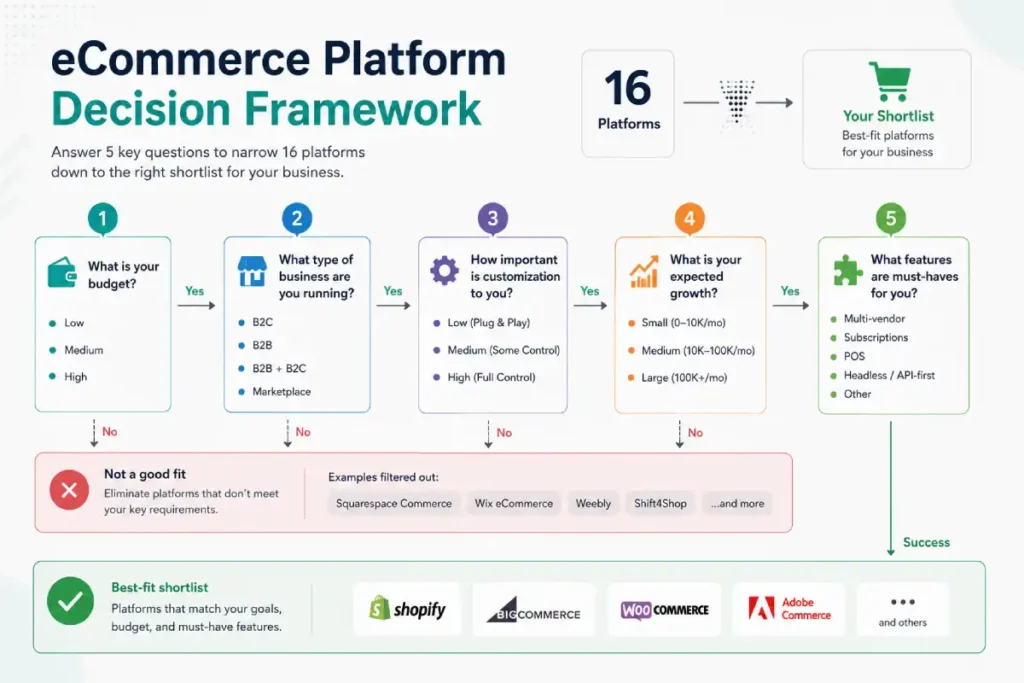
The Five Questions, In Order
Answer each one before moving to the next. Each question narrows your real options, skipping ahead produces a worse recommendation.
Question 1: What Is Your Revenue Stage?
- Pre-revenue or testing an idea: favor low-cost, fast-to-launch platforms, this is not the time for a platform requiring months of setup
- Under $10,000/month: ease of use and low starting cost matter more than deep customization
- $10,000 to $100,000/month: you can justify more platform cost if it removes real operational friction
- $100,000+/month: platform limitations start costing real money, this is where migration conversations usually begin
- $1M+/month or true enterprise scale: a completely different tier of platform, built for complexity most stores never reach
Question 2: What Is Your Technical Skill Level?
- No technical skill, no developer access: you need a platform where the default setup is actually usable
- Comfortable with basic customization, no coding: most mainstream platforms fit here
- Real development capability, in-house or contracted: open-source, self-hosted platforms become a real option, and often cheaper long-term
Question 3: What Type of Product Are You Selling?
- Physical products, standard retail: the majority of platforms are built for this case
- Digital products only: downloads, courses, memberships, some platforms handle this natively, others require an app
- Print-on-demand or dropshipping: integration depth with fulfillment partners matters more than general features
- Services or bookings alongside products: fewer platforms handle this well natively
Question 4: What Is Your Growth Goal?
- Stay small and simple, no ambition to scale dramatically: optimize for low cost and low maintenance
- Grow steadily, moderate scale: balance cost against room to grow without a forced migration
- Aggressive growth, multi-channel, possibly international: platform scalability and ecosystem depth matter more than starting price
Question 5: What Is Your Realistic Budget?
- Under $30/month: a real, viable tier, several platforms serve this honestly
- $30 to $300/month: the range most small and growing businesses actually operate in
- $300 to $2,000/month: where BigCommerce Enterprise, Shopify Plus, and serious self-hosted setups live
- $2,000+/month: enterprise territory, where implementation cost often dwarfs the monthly platform fee itself
The 16 Platforms at a Glance
Every platform covered in this guide, mapped against the five questions above.
| Platform | Best Revenue Stage | Technical Skill Needed | Best Product Type |
|---|---|---|---|
| Shopify | $0-$100K+/month | None to moderate | Physical, digital, dropshipping |
| WooCommerce | $0-$100K+/month | Moderate to high | Physical, digital, content-driven stores |
| BigCommerce | $10K-$1M+/month | None to moderate | Physical, B2B, large catalogs |
| Wix | $0-$10K/month | None | Physical, digital, service businesses |
| Squarespace | $0-$10K/month | None | Physical, digital, design-led brands |
| Ecwid | $0-$10K/month | None | Adding a store to an existing site |
| PrestaShop | $10K-$500K/month | High | Physical, international, self-hosted |
| OpenCart | $0-$100K/month | High | Physical, budget-conscious self-hosted |
| Joomla | $0-$50K/month | High | Content-first sites adding commerce |
| Adobe Commerce | $500K+/month | Very high | Enterprise, complex B2B |
| Webflow | $0-$50K/month | None to moderate | Design-led, content-heavy stores |
| Gumroad | $0-$50K/month | None | Digital products, creators |
| Big Cartel | $0-$10K/month | None | Independent artists, small catalogs |
| Volusion | $0-$50K/month | None to moderate | Small to mid-sized physical retail |
| Hostinger Website Builder | $0-$5K/month | None | Very small stores, budget-first |
| TikTok Shop | Any, as a channel | None | Social-first, video-driven selling |
Platform Profiles: What Each One Actually Fits
For Beginners With No Technical Skill
- Setup is actually usable without a developer, most stores go live in days, not weeks
- The app ecosystem covers most gaps in native functionality, so a missing feature rarely means a dead end
- The largest ecosystem of themes, apps, and support content of any platform on this list, useful when something goes wrong
- A strong fit for a business that wants a design-forward site with commerce added, not commerce as the whole site
- The drag-and-drop editor gives real visual control without touching code
- Native tools for blogs, bookings, and content sit alongside the store, useful for a business that is more than just a shop
- The same design-first appeal as Wix, with a template aesthetic many creative and lifestyle brands prefer
- Strong built-in blogging and content tools for a brand that sells through storytelling
- A more restrained editor than Wix, less flexible, but harder to make something look unpolished
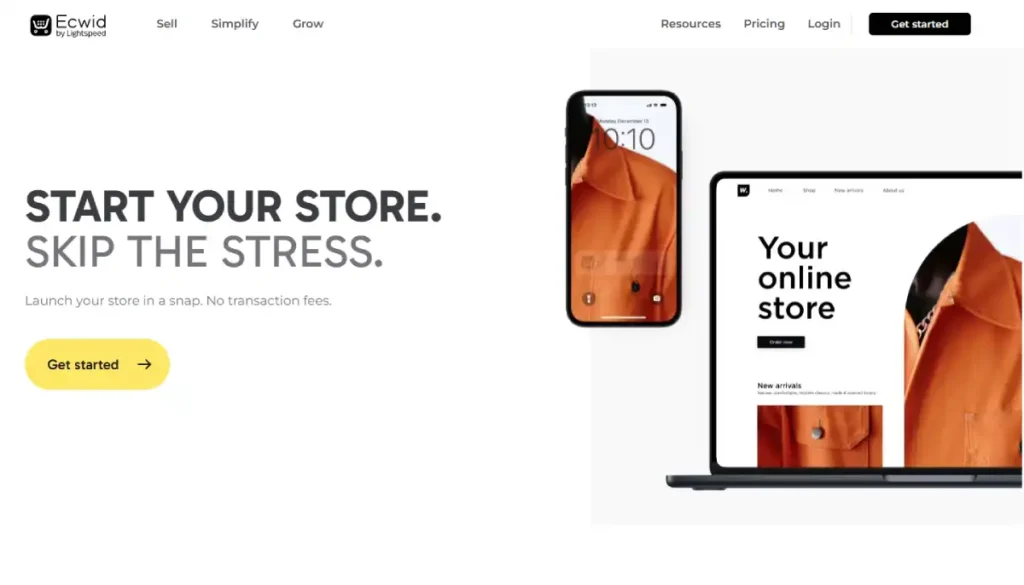
- The right answer for a narrower case, a business that already has a website and just wants to add selling, not rebuild
- Embeds into an existing site rather than replacing it, so nothing about the current design or content changes
- A real, lower-commitment way to test selling before deciding whether a full platform switch is worth it later
For Businesses With Real Technical Capacity
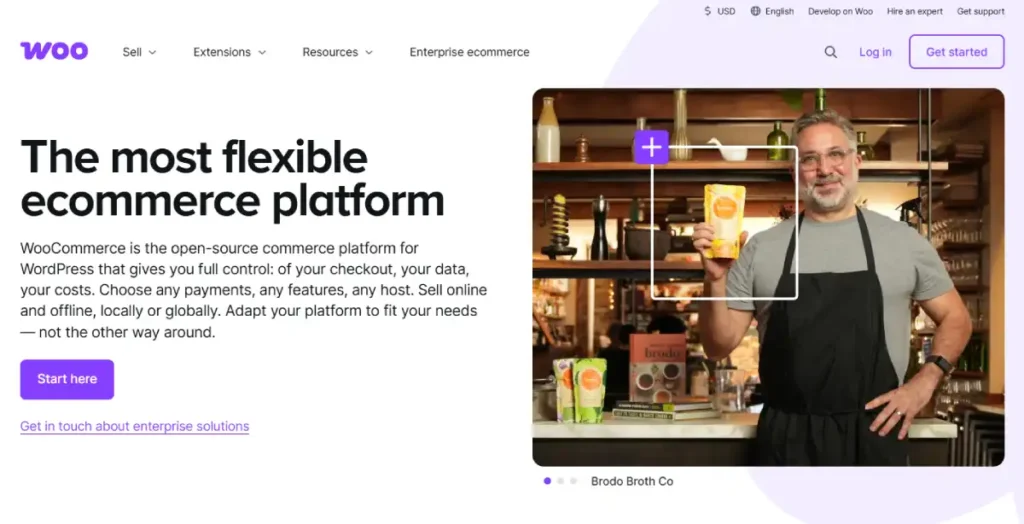
- The standard choice for a team comfortable with WordPress specifically
- You manage hosting and plugins yourself, trading setup complexity for long-term cost control and full ownership of the stack
- No platform-side transaction fee, a real, ongoing saving at meaningful sales volume
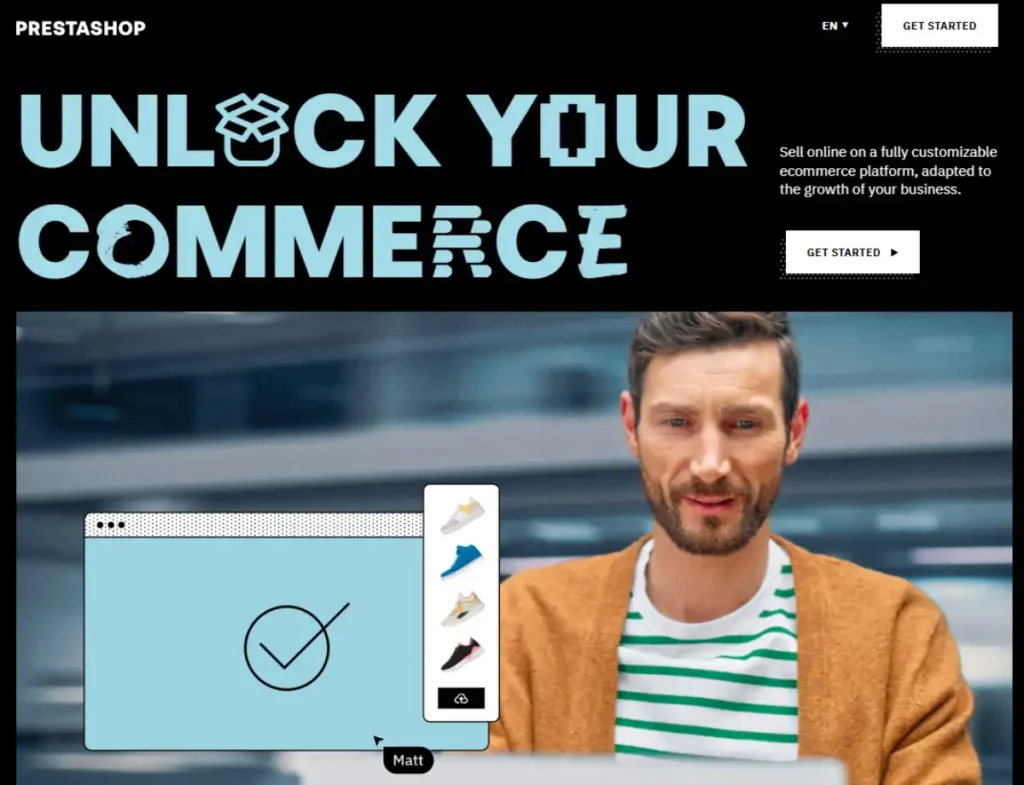
- Self-hosted and open-source like WooCommerce, with the same core trade-off of control for setup effort
- Leans specifically toward international and multi-language stores, strong native localization support
- A large European user base, worth knowing if that market is part of your growth plan
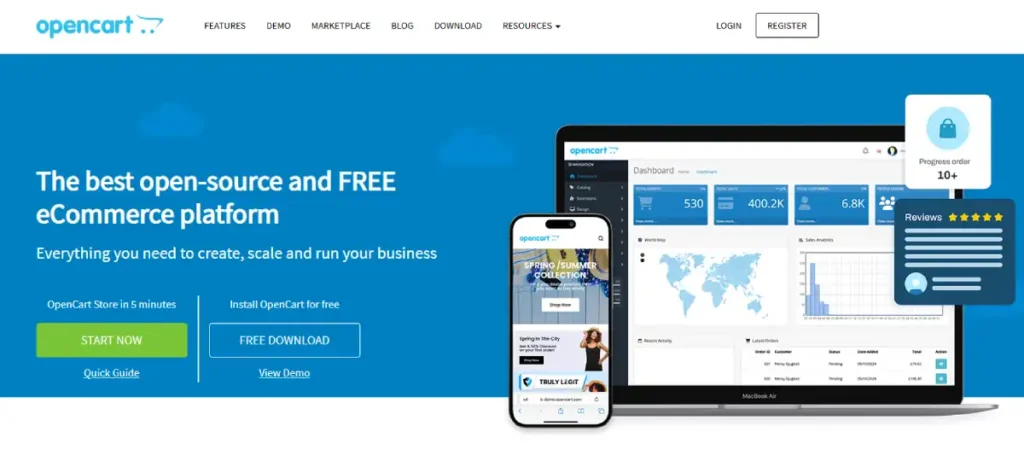
- The same self-hosted category as WooCommerce and PrestaShop, real control, real setup responsibility
- Leans toward budget-conscious builds, lighter resource requirements than some open-source alternatives
- A large plugin ecosystem covering most common extension needs without custom development
- A narrower fit than the other self-hosted platforms here, a content-heavy site that needs commerce added onto an existing CMS investment
- Makes the most sense if you already run Joomla for the site itself and do not want to migrate the whole thing to add a store
- Not the first choice for a store built from scratch with no existing CMS commitment
For Larger Catalogs and Growing Operations
- Built for large product catalogs without the performance strain some platforms show at scale
- Real native B2B functionality, customer groups and quote workflows, not bolted on through an app
- No platform-side transaction fees, a genuine cost advantage as sales volume grows
- A smaller-scale version of the BigCommerce idea, more structure than a pure beginner platform
- Fits a business that has outgrown Shopify or Wix but is not yet ready for BigCommerce or enterprise tooling
- Less commonly recommended than the platforms above it in this list, worth a closer look specifically if the others feel like the wrong fit
For Digital Products and Creators
- Purpose-built for creators selling digital downloads, memberships, and courses directly
- A simpler fee-per-sale model rather than a monthly subscription, low commitment for testing an idea
- Minimal setup, built specifically around getting a digital product listed and sellable fast

- A specific fit for independent artists with small, curated catalogs, not a general-purpose store
- Pricing scales with product count rather than sales volume, predictable for a small, stable catalog
- A simpler feature set than most platforms on this list, by design, for sellers who want exactly that
For Design-Led and Content-Driven Brands
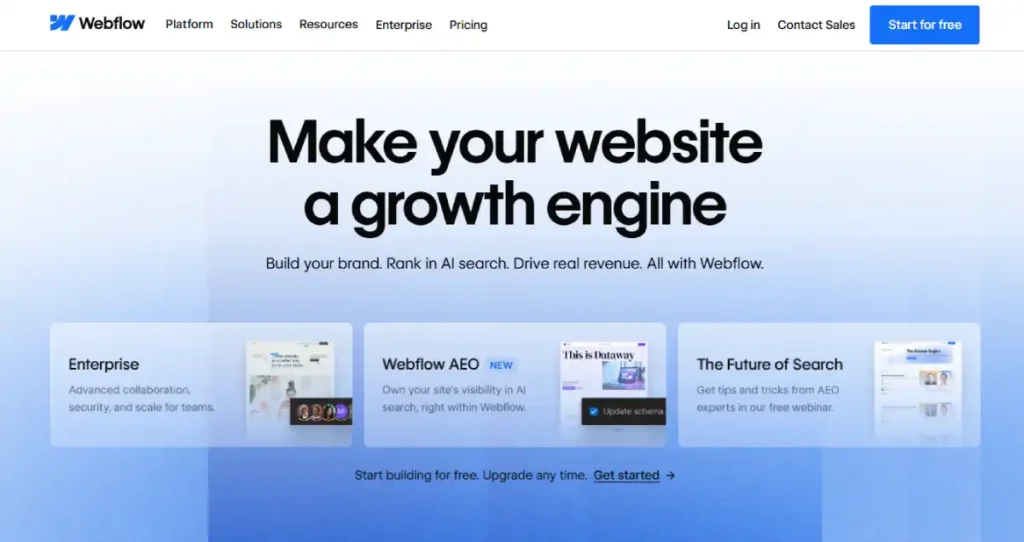
- Right when a site’s design and content are the primary differentiator, with commerce as a real but secondary layer
- Full visual control over layout and interaction design beyond what template-based platforms allow
- Best suited to a team with real design sensibility willing to invest time in the builder itself
For Very Small Budgets
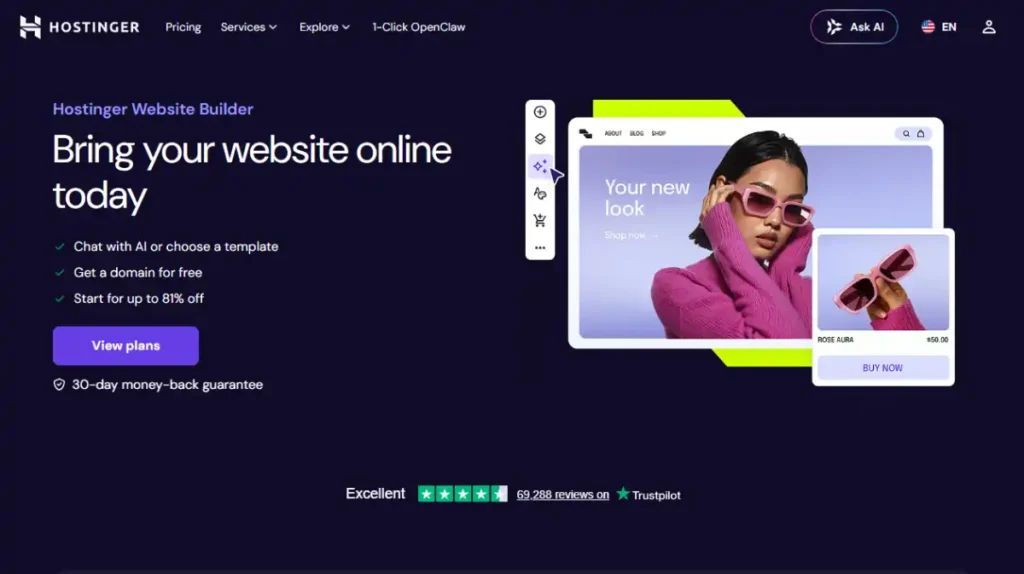
- For a store that needs to exist online at the lowest realistic monthly cost
- Not built for deep customization or a large catalog, and honest about that trade-off
- A sensible starting point for a genuine test, with room to migrate once the business outgrows it
For Enterprise Scale
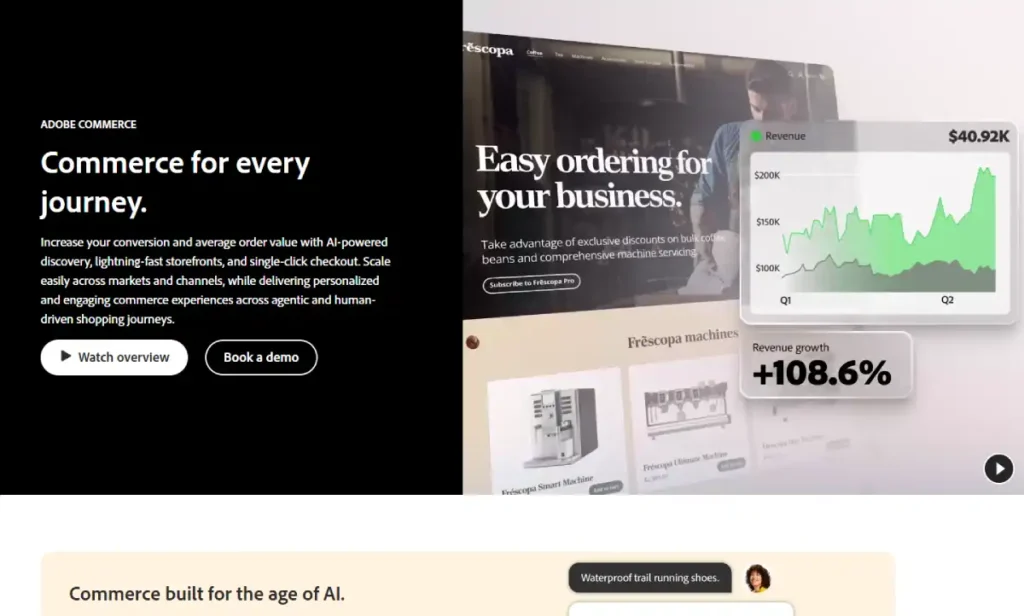
- Where the framework points once revenue, complexity, and technical capacity all scale together
- Real B2B depth and multi-brand architecture built natively, not assembled from third-party apps
- Requires the implementation budget to match, this is not a self-service setup at any scale
As a Sales Channel, Not a Standalone Platform

- Not a platform you build a store on, a channel you sell through
- Usually paired with one of the platforms above rather than used instead of one
- Makes the most sense for a brand whose audience is already spending real time on the app
Putting the Five Answers Together
Once you have honest answers to all five questions, most businesses land in one of these patterns.
| Your Profile | Where You Land |
|---|---|
| No tech skill, testing an idea, under $10K/month | Shopify, Wix |
| No tech skill, design-focused brand | Squarespace, Webflow |
| Real technical capacity, wants full control | WooCommerce, PrestaShop |
| Budget-conscious, comfortable with self-hosting | OpenCart, WooCommerce |
| Large catalog, growing fast, B2B needs | BigCommerce, Adobe Commerce |
| Digital products and courses only | Gumroad, Ecwid |
| Adding a store to an existing site | Ecwid, Joomla |
| Independent artist, small curated catalog | Big Cartel, Squarespace |
| True enterprise scale, complex operations | Adobe Commerce, BigCommerce Enterprise |
What to Do Once You Have a Shortlist
Narrowing to two platforms is the real output of this framework, not a final answer. From here:
- Read a full review of each platform on your shortlist specifically, not a general roundup
- Check real pricing at your actual expected revenue, not the advertised starting price
- Sign up for a free trial of both if available, and build one real product listing on each before deciding
- Ask directly about the one limitation that matters most to your specific answers above, do not assume it is covered
FAQ’s
What is the single most important factor in choosing an ecommerce platform?
Revenue stage, since it determines what level of platform cost and complexity is actually justified. A platform that is perfect at $500,000 a month is often the wrong choice at $2,000 a month, and the reverse is just as true.
Is Shopify always the right first choice for beginners?
Often, but not always. It fits most no-technical-skill beginners well, but a design-led brand may fit better on Squarespace or Webflow, and a business only selling digital downloads may fit better on Gumroad.
When should I consider a self-hosted platform like WooCommerce or PrestaShop?
When you have real technical capacity, in-house or reliably contracted, and want long-term cost control over convenience. Self-hosted platforms trade setup simplicity for ownership and lower ongoing fees at scale.
Can I switch platforms later if I choose wrong?
Yes, but it is real, disruptive work, not a quick change. Choosing carefully using all five questions now is significantly cheaper than migrating a working store later.
Do I need a different platform for digital products versus physical products?
Not always, but it changes the best fit. Gumroad and Ecwid handle digital products particularly well, while most general-purpose platforms treat digital products as a secondary feature rather than the core design.
What platform is right for true enterprise scale?
Adobe Commerce or Salesforce Commerce Cloud, once revenue, operational complexity, and implementation budget all justify it, generally above $500,000 a month with real multi-brand or complex B2B requirements. Below that scale, BigCommerce or Shopify Plus typically deliver comparable capability at meaningfully lower cost.