
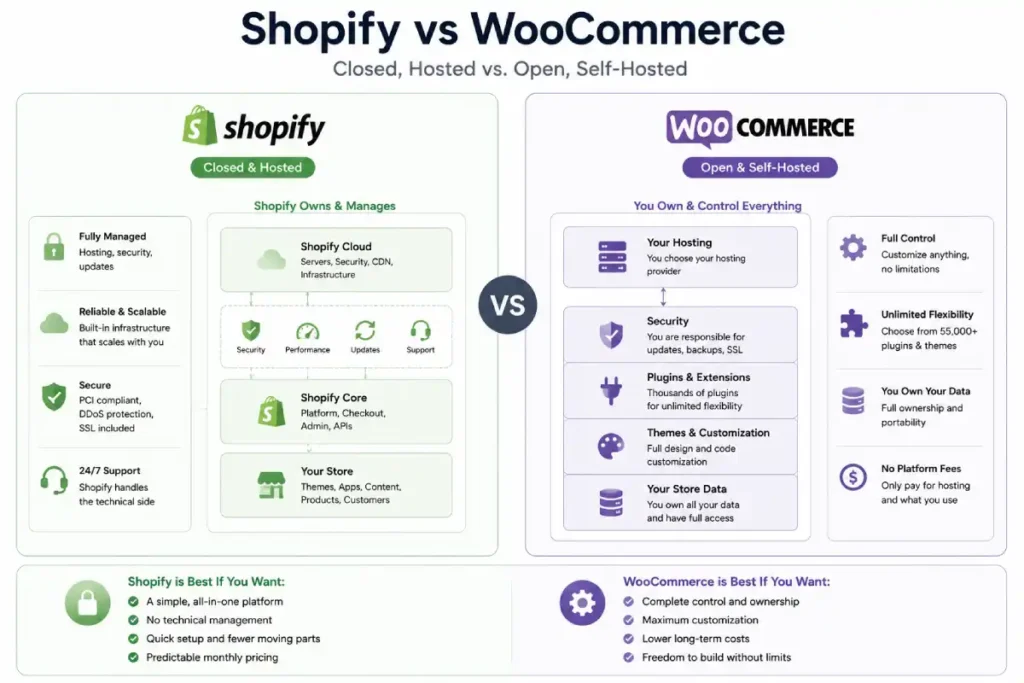
Your Shopify store does not live on a server you control. It lives inside Shopify’s own infrastructure, running on Shopify’s code, subject to Shopify’s rules about what can and cannot be changed.
Your WooCommerce store lives on hosting you choose, running on software you can edit line by line. That single difference, not pricing, is the real fork in this decision.
This looks at what ownership actually means on each platform: what you can change, what you cannot, what happens if a platform makes a decision you disagree with, and what leaving each one actually involves.
Key Takeaways
- On Shopify, your store’s code, hosting, and infrastructure belong to Shopify. You are renting space inside their system, not running your own.
- On WooCommerce, your store’s code and data live on hosting you choose and control. You are running your own system on infrastructure you selected.
- Shopify can change its rules, fees, or app policies, and you have no vote, only the choice to accept or leave. WooCommerce’s core software is open-source, no single company can unilaterally change what you already have installed.
- Exporting your full store, every product, every order, every customer record, is simple on both platforms. What differs is whether the destination has to be another closed platform or can be infrastructure you fully control.
- Full customization on Shopify means working within a theme language and an API Shopify defines. Full customization on WooCommerce means editing the actual code your store runs on, with no platform gatekeeping what is possible.
What Ownership Actually Means Here
Two stores can look identical to a customer and be built on completely different foundations underneath.

- Shopify: your store’s application code, database, and server infrastructure are Shopify’s property, not yours. You have an account with permissions, not a server with root access.
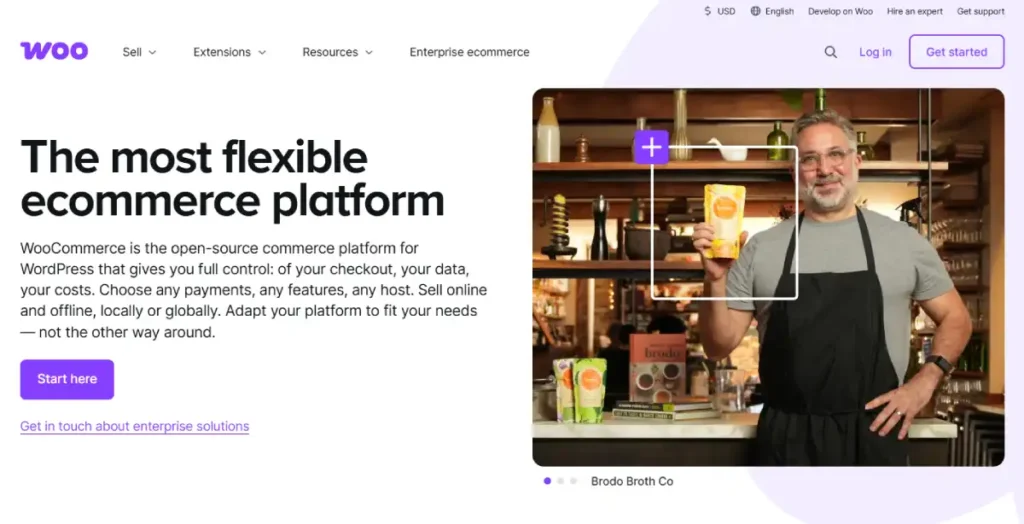
- WooCommerce: your store’s application code, database, and server infrastructure sit on hosting you selected and pay for directly. You have genuine administrative control over every layer.
Neither approach is wrong. The question is which kind of control your business actually needs, and whether the convenience of not managing infrastructure is worth giving up direct control over it.
What You Can and Cannot Change
| Layer | Shopify | WooCommerce |
|---|---|---|
| Storefront design | Theme customization within Shopify’s theme system | Full code-level control, any design is possible |
| Checkout flow | Locked to Shopify’s checkout on most plans, deep customization requires Shopify Plus | Fully customizable, no platform restriction |
| Core platform code | Not accessible, Shopify’s backend is closed | Fully open, WordPress and WooCommerce core code is visible and editable |
| Hosting environment | Fixed, Shopify controls server configuration completely | Your choice, any host meeting WordPress requirements |
| App and plugin approval | Apps go through Shopify’s App Store review process | Any plugin can be installed directly, no approval gate |
The pattern is consistent: Shopify trades control for consistency and support.
WooCommerce trades that consistency for direct, unrestricted access to everything underneath, a trade-off worth weighing against the numbers in any real store startup cost estimate.
When the Platform Makes a Decision You Do Not Control
This is the part cost comparisons skip completely, and it is worth taking seriously.
What Shopify can change unilaterally:
- Transaction fee structures
- App store policies and what apps are allowed to do
- What a theme is permitted to modify
- API access rules for third-party developers
These changes have happened before and will happen again. As a merchant, your options when this happens are to adapt or to leave, you do not have a vote in the decision.
What WooCommerce cannot have changed out from under you:
- The core platform code already running your store, open-source, not owned by one company’s roadmap
- Your hosting relationship, completely separate from the software itself
- Your data, which was never inside a closed system to begin with
The real risk on WooCommerce instead: a plugin developer can abandon a plugin you depend on. That is a genuine exposure, but it is a narrower, more manageable one than a platform-wide policy change affecting every merchant at once.
A business that has built real operational processes around specific platform behavior is more exposed on Shopify to a policy change than the equivalent WooCommerce store is to anything short of choosing to update its own software.
What Leaving Each Platform Actually Involves
Every platform comparison should be honest about the exit, not just the entry.
Leaving Shopify:
- Export your product, order, and customer data, Shopify supports this natively as CSV files
- Rebuild your storefront design from scratch on the new platform, Shopify themes do not transfer
- Reconnect every app and integration you relied on, none of it carries over automatically
- Redirect your old Shopify URLs to the new platform’s URL structure to preserve search rankings
Leaving WooCommerce:
- Export your product, order, and customer data, using WordPress’s native export tools or a migration plugin
- If moving to another WordPress-based setup, much of your existing customization can carry over directly
- If moving to a fully different platform like Shopify, expect the same rebuild work Shopify migrations require
- Your hosting relationship is already independent of the storefront software, one less thing to untangle
Leaving WooCommerce for another self-hosted, open platform is generally less disruptive than leaving a closed platform like Shopify, since your data was never locked inside a single company’s proprietary system to begin with.
Who Should Prioritize Ownership Over Convenience
This is less about company size than about need, a small business with real technical capacity can benefit from ownership just as much as a larger one without it.
- A business planning to build something highly specific, a checkout flow, a customer account experience, or an integration Shopify’s app ecosystem does not support well
- A business wary of platform risk, one that has seen a competitor disrupted by a policy change on a closed platform and wants to avoid that exposure
- A team with real technical capacity that can actually use the control WooCommerce provides, ownership without the ability to act on it is not a real advantage
- A business planning a long time horizon, ownership concerns compound over years, a five-year-old Shopify store has more built up inside a system it does not control than a five-year-old WooCommerce store built on infrastructure it has always owned
Who Should Prioritize Convenience Over Ownership
- A business without technical capacity, in-house or reliably contracted, since WooCommerce’s control is only valuable if someone can use it
- A business that wants to launch fast and is not thinking in five-year platform-risk terms yet
- A business comfortable trusting Shopify’s roadmap decisions, many merchants never experience a policy change that meaningfully affects them, the same trade-off worth it weighs directly
- A business prioritizing support and stability over the ability to customize anything at the code level
FAQ’s
Does Shopify own my store’s data?
No, but Shopify controls the infrastructure it runs on. Your product, order, and customer data is exportable at any time, but the application itself, the code, the hosting, the server environment, belongs to Shopify, not you.
Is WooCommerce actually more secure than Shopify?
Not automatically. Shopify manages security updates and infrastructure for you, a real advantage for a team without technical capacity. WooCommerce requires you or your host to manage security actively, more control but also more responsibility.
Can Shopify shut down my store without warning?
Rarely, but the terms of service give Shopify the right to suspend accounts that violate policy. On WooCommerce, since your store runs on hosting you control, no single company can unilaterally take your store offline the way a closed platform theoretically could.
Is it harder to customize a Shopify store than a WooCommerce store?
Yes, meaningfully, for anything beyond what Shopify’s theme system and app ecosystem support natively. WooCommerce’s open code allows any customization a developer can build, with no platform-level restriction on what is technically possible.
Which platform is easier to migrate away from later?
WooCommerce, generally. Moving between self-hosted, open platforms tends to preserve more of your existing setup than moving off a closed platform like Shopify, where themes, checkout customizations, and app integrations do not transfer and must be rebuilt.
Does platform ownership actually matter for a small store?
Less than for a large one, but it is not irrelevant. A small store rarely runs into Shopify’s policy limits in practice. The consideration matters more as a business grows and builds deeper, harder-to-replace processes around whichever platform it chose.