
Estimates on dropshipping failure rates range from 80 to 90 percent within the first year, depending on which study and which definition of failure you use.
That range includes something worth knowing before it discourages you: a large share of it counts people who set up a store, ran no marketing, and abandoned it within weeks.
That is not really a measure of whether dropshipping works, it is a measure of how many people quit before they ever really started.
For context, the US Bureau of Labor Statistics puts the first-year failure rate for all new businesses at around 20 percent, and roughly half fail within five years.
Dropshipping is a harder business than that baseline number suggests, low barriers to entry mean more people try it half-heartedly, but the model itself is not the primary reason most fail.
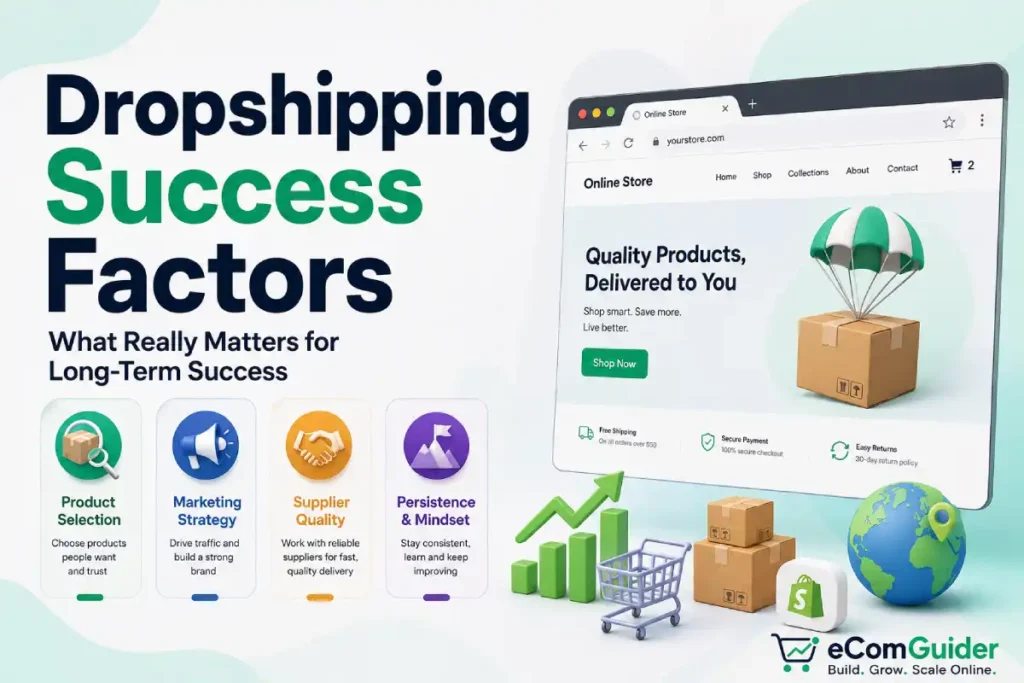
Three specific causes account for the large majority of failures: poor product selection, weak marketing, and unreliable suppliers.
In every failed store I have reviewed, at least one of these three shows up, usually more than one.
All three are preventable with a defined process, not luck.
This guide covers that process in full, product research, supplier vetting, and customer acquisition, then walks through the actual setup on both Shopify and WooCommerce, since the two platforms actually differ in how dropshipping works on each one.
Table of Contents
Key Takeaways
- 10 to 20 percent of dropshipping businesses reach profitability in year one, and that number climbs considerably once you exclude people who never seriously tried.
- Poor product selection causes roughly 35 percent of failures, ineffective marketing causes 30 percent, supplier quality issues cause 20 percent, and giving up too early accounts for 15 percent.
- A real winning product needs a 30 percent minimum profit margin, moderate competition from 5 to 15 active advertisers, and 3 to 6 months of upward demand trend, not a short viral spike.
- Supplier vetting has five real checkpoints: communication speed, sample quality, shipping accuracy, return policy, and order consistency. Test 4 to 6 suppliers before settling on 2 to 3 you actually trust.
- Shopify and WooCommerce differ meaningfully for dropshipping. Shopify has over 500 supplier app integrations and simpler hosted setup, WooCommerce requires more technical work but avoids some ongoing subscription costs.
The Real Odds, Explained Properly
Why the Failure Rate Numbers Are All Over the Place
Different sources report failure rates anywhere from 80 to 95 percent, and the gap comes down to what counts as a real attempt. Some data includes anyone who created a store and never ran a single ad, other data tracks only sellers who actually tried to build a business for at least a few months.
Narrow the definition to people who actually committed real time and money, and the picture looks meaningfully better than the headline number suggests.
What Actually Separates Success From Failure
- Poor product selection, roughly 35 percent of failures. Chasing a trending product with no actual demand data, or picking something with too much competition and too thin a margin to survive paid ad costs
- Ineffective marketing, roughly 30 percent. Running ads without understanding customer acquisition cost against actual margin, or relying completely on one channel with no backup
- Supplier quality issues, roughly 20 percent. Long shipping times, inconsistent product quality, or a supplier that goes unresponsive during a dispute, all things a vetting process catches before launch
- Giving up too early, roughly 15 percent. Average time to profitability runs 3 to 6 months, a store judged as a failure at week 6 was often never given the runway the model needs
The Real Numbers Behind a Working Store
| Metric | Real Figure |
|---|---|
| Average time to first sale | 2 to 6 weeks |
| Average time to actual profitability | 3 to 6 months |
| Net profit margin, experienced seller | 15 to 20 percent |
| Net profit margin, beginner | Often below 10 percent |
| Stores surviving past year one, still profitable | Roughly 50 to 60 percent |
| Stores earning over $50,000 a month | About 1.5 percent |
Real Product Research, Not Guessing
Poor product selection alone accounts for more failures than any other single cause. This is the highest-leverage part of the entire process, worth doing properly before anything else.
The Criteria a Real Winning Product Meets
- A minimum 30 percent profit margin after all costs, product, shipping, transaction fees, and ad spend all factored in, not just the markup on the supplier’s price
- Moderate competition, roughly 5 to 15 active advertisers for the product. Zero competition usually signals no actual demand exists, not an untapped opportunity. Oversaturated markets with dozens of advertisers make differentiation actually difficult
- A demand trend spanning 3 to 6 months, not a short viral spike that peaks and disappears within weeks, this distinguishes a real, sustainable product from a fad you would be entering too late to profit from
- A specific problem it solves or desire it fulfills, not just something that looks interesting, does this solve a real pain point is an actually useful filter question to apply honestly
How to Actually Validate a Product
- Check Google Trends for the product category, looking for a genuine upward trajectory over months, not a single spike
- Search Meta Ad Library and TikTok Creative Center for active ads on the product, this tells you competitors are already spending money on it, a sign of validated demand
- Cross-check demand on Amazon for the same or a similar product, consistent sales there confirms people actually buy this category, not just click on ads for it
- Calculate your actual unit economics before committing, product cost, shipping cost, transaction fees, and a realistic estimated ad cost per sale, if the math does not leave a workable margin, move on regardless of how appealing the product looks
A Realistic Expectation to Set Now
Expect to test 5 to 10 products before finding one that actually scales profitably. Most will fail initial testing, that is normal, not a sign you are doing something wrong.
I have watched new sellers abandon the model completely after their first two or three products flopped, when that failure rate is exactly what the validation process predicts, not a signal to quit.
The validation process above exists specifically to filter out the obvious losers before you spend ad budget finding out the hard way.
If you are using AI-powered research tools to speed this up, treat their output as a draft to verify, not a final answer, the sellers who do well combine AI-assisted speed with actual human judgment on margin, supplier quality, and a small-budget test, not a tool’s suggestion alone.
Real Supplier Vetting, Not the First Result You Find
Supplier issues account for roughly 20 percent of failures, and unlike product selection, this risk is actually invisible until an order actually ships wrong.
The single most common mistake I see at this stage is treating supplier selection as a formality after the product decision is already made, when it deserves its own real evaluation.
The Five Real Vetting Checkpoints
- Communication speed. Message a supplier directly with a specific question before ordering anything, a slow or vague response now predicts how they will handle a problem later
- Sample quality. Order a sample yourself before listing the product, judge it against the actual photos and description, not just whether it arrived
- Shipping accuracy. Confirm the shipping times a supplier advertises match reality, ask directly, and cross-check against reviews from other sellers where possible
- Return policy. Understand exactly what happens when a customer wants to return a defective item, before you need this process, not during your first actual dispute
- Order consistency. A supplier’s catalog and stock levels changing constantly is an operational risk, confirm they can reliably fulfill the specific products you plan to list long term
Real Red Flags Worth Walking Away From
- No verifiable physical business address
- Demands full prepayment with no recourse if something goes wrong
- Product listings using stock photos only, with no supplier-provided photography available on request
The Real China Versus US/EU Tradeoff
- Chinese suppliers, commonly accessed through AliExpress-connected apps, offer the widest product variety and lowest unit costs, but shipping commonly runs 15 to 30 days, a genuine constraint on customer experience
- US or EU suppliers, accessed through apps like Spocket, ship in 3 to 7 days at meaningfully higher unit cost
- A common, actually effective strategy: test new products through lower-cost Chinese suppliers first, then move confirmed winners to a faster US or EU supplier once you know the product actually sells
How Many Suppliers to Actually Use
Every store I have seen get burned by a supplier issue was running exactly one supplier for its core product. Test 4 to 6 suppliers before settling on ones you trust.
Keep 2 to 3 vetted suppliers ready at any given time, not just one, a single point of failure in your supply chain becomes a serious problem the moment that one supplier has an issue, a factory delay, a stock shortage, a shipping disruption.
Real Customer Acquisition, Not Just Running Ads
Ineffective marketing accounts for roughly 30 percent of failures, nearly as much as product selection itself.
Running ads without understanding the math behind them is how a store with real sales still loses money, and it is the single most common financial mistake I walk new sellers through after the fact, when it would have been a five-minute calculation before the fact.
Real Channel Performance by Usage
| Channel | Used By | Typical ROAS |
|---|---|---|
| Facebook and Instagram ads | 72 percent of dropshippers | 2 to 4x |
| TikTok ads | 45 percent, the fastest-growing channel | 2.5 to 5x |
| Google Shopping | 38 percent, strongest for established stores | 3 to 6x |
The Real Math Before You Scale Any Ad Spend
- Calculate your actual customer acquisition cost, total ad spend divided by number of resulting customers, not just cost per click
- Compare that number directly against your actual profit margin per order from the product research step above
- Only scale spend once a channel is producing a sustainable profit after acquisition cost, not just top-line revenue that looks impressive without the math behind it
Choosing Your Platform for Dropshipping
Both Shopify and WooCommerce support dropshipping well, the right choice depends on your actual technical comfort and how hands-off you want fulfillment to be.
This guide covers both in full detail below, since they cover the large majority of real dropshipping stores.
Other platforms in our full lineup, Wix among them, do support dropshipping through native app integrations too, worth a look if you are already committed to one of them for other reasons.
| Factor | Shopify | WooCommerce |
|---|---|---|
| Supplier app integrations | 500+, the largest ecosystem by far | Fewer, some popular suppliers have no WooCommerce integration at all |
| Setup complexity | Hosted, no server management | Self-hosted, you manage hosting, WordPress, and security yourself |
| AI store-building tools | Multiple native and third-party options | Limited AI automation support |
| Ongoing app costs | Recurring, budget $19 to $99+ a month for a full app stack | Some tools are one-time purchases, like AliDropship at $89 |
| Best fit | Most beginners, and anyone wanting the widest supplier selection | Sellers already comfortable with WordPress wanting more platform control |
Setting Up Dropshipping on Shopify
Step 1: Create Your Shopify Store
- Go to shopify.com and start a free trial, creating an account with an email and password or an existing Google, Apple, or Facebook login
- Choose your store name carefully, this becomes your myshopify.com domain and can only be changed once afterward
- Select a plan, Basic covers most new dropshipping stores at $39 a month
- Choose and install a theme, keep it simple and fast-loading rather than heavily customized at launch, speed matters more than polish for a new store
Step 2: Choose Your Sourcing App
- DSers, Shopify’s official AliExpress connector, free tier supports 3,000 products with bulk ordering, the standard choice for low-cost AliExpress sourcing with longer shipping windows
- Zendrop, warehouses inventory in the US for 2 to 5 day shipping, free plan exists but fulfillment fees add up, paid plans run $49 to $79 a month
- Spocket, curated US and EU suppliers with 3 to 7 day shipping, the free plan is browse-only, paid plans start at $39.99 a month
- CJdropshipping, no subscription fee at all, pay per order instead, an actually functional free option for testing
- AutoDS, the broadest multi-channel automation coverage, worth it once you are managing multiple suppliers and need deeper automation
Most successful stores end up running 2 to 3 of these together, commonly a primary low-cost sourcing app plus a faster-shipping option for confirmed bestsellers, following the China-to-US/EU strategy covered above.
Step 3: Import and Configure Products Using Your Research
- Import only products that passed the validation process covered earlier, margin, competition level, and demand trend all confirmed first
- Rewrite product titles and descriptions in your own voice, imported listings are commonly thin or awkwardly translated
- Set your actual pricing with your calculated margin built in, not a flat markup applied without checking the math
Step 4: Connect Payments and Test
- Activate Shopify Payments or a supported alternative
- Place a real test order through your own store before launching any paid traffic
- Confirm the order actually routes to your supplier correctly and that tracking syncs back to your store
Setting Up Dropshipping on WooCommerce
Step 1: Set Up Your WordPress and WooCommerce Foundation
- Select hosting that explicitly supports WordPress
- Install WordPress, then install and activate WooCommerce
- Budget extra setup time here, this step alone commonly takes longer than Shopify’s equivalent hosted signup
Step 2: Choose Your Dropshipping Plugin
WooCommerce’s dropshipping ecosystem is smaller than Shopify’s, confirm your chosen supplier actually has a working WooCommerce integration before building around it.
- AliDropship, a one-time $89 plugin cost rather than a recurring subscription, imports products from AliExpress and automates fulfillment
- WooDropship, another AliExpress import option some sellers use, verify its current features and support directly before committing, since it has a smaller track record than AliDropship
- Spocket, also offers WooCommerce integration for US and EU suppliers if faster shipping matters more than lowest unit cost for your niche
Step 3: Import and Configure Products Using Your Research
- Import your validated product catalog through your chosen plugin, same validation standard as the Shopify path above, margin, competition, and demand all confirmed first
- Rewrite descriptions and titles rather than keeping supplier-provided copy as-is
- Confirm inventory sync is actually working, a WooCommerce dropshipping setup with a smaller integration ecosystem is more prone to sync gaps than Shopify’s more mature app connections
Step 4: Connect Payments and Test
- Activate WooCommerce Payments or a supported gateway
- Place a real test order and confirm it reaches your supplier correctly
- Confirm tracking information actually syncs back to the customer, this is a more common failure point on WooCommerce specifically given the smaller integration ecosystem
What the Successful Minority Actually Does Differently
- They vet suppliers before listing a single product, using the five-checkpoint process above rather than picking whichever listing has the lowest price
- They calculate actual margin before setting a price, factoring in ad costs and transaction fees, not just marking up the supplier’s cost by a flat percentage
- They give the business the full 3 to 6 month runway profitability actually takes, rather than judging success or failure after a few slow weeks
- They test 5 to 10 products expecting most to fail, treating this as a normal part of the process rather than evidence the model does not work
- They calculate customer acquisition cost against actual margin before scaling ad spend, rather than chasing top-line revenue that looks impressive without profit behind it
FAQ for Starting Dropshipping
What percentage of dropshipping stores actually fail?
Estimates range from 80 to 90 percent within the first year, though this figure includes many stores that were abandoned with little genuine effort behind them. Narrowing the definition to sellers who actually committed time and marketing budget produces a meaningfully better picture.
What makes a good dropshipping product?
A minimum 30 percent profit margin after all costs, moderate competition from roughly 5 to 15 active advertisers, and a demand trend spanning 3 to 6 months rather than a short viral spike. Products that solve a specific problem outperform ones chosen just because they look interesting.
How do I know if a dropshipping supplier is reliable?
Check five things before committing: communication speed, sample quality, shipping accuracy, return policy, and order consistency. Test 4 to 6 suppliers before settling on 2 to 3 you actually trust, and never rely on a single supplier for a product you plan to sell long term.
Is Shopify or WooCommerce better for dropshipping?
Shopify has a far larger supplier app ecosystem, over 500 integrations, and simpler hosted setup, making it the better default for most beginners. WooCommerce works well for sellers already comfortable with WordPress who want more platform control and fewer recurring app subscription costs.
How much does it cost to actually start dropshipping?
A basic Shopify setup runs roughly $39 a month for the plan plus $0 to $79 a month for sourcing apps, before ad spend. Product testing itself commonly requires an ad budget of several hundred dollars to validate 5 to 10 candidate products properly.
What is the single biggest cause of dropshipping failure?
Poor product selection, responsible for roughly 35 percent of failures, followed closely by ineffective marketing at 30 percent. Both are preventable with structured product research and a clear understanding of customer acquisition cost before scaling ad spend.