
A Shopify SEO strategy is the order you do things in, and the reasoning behind that order, not the technical checklist itself.
Fix the highest-leverage technical issues first, build content around what actually drives purchase decisions, and measure results on an honest timeline before deciding whether something worked. This guide covers that strategic layer directly.
This piece assumes you already run a Shopify store, or will use, this cluster’s Shopify SEO guide for the exact admin paths and theme edits, robots.txt, sitemaps, canonicals, structured data, and answer engine optimization are all covered there in full.
What that guide does not cover is the order to do things in, what to prioritize when you cannot do everything at once, and how to actually know if it worked. That is what this guide is for.
Key Takeaways
- Traffic is not the goal, revenue is. Define what a real win looks like in actual numbers before choosing any tactic, otherwise every tactic looks equally justified.
- Your strategic posture depends on your actual starting authority. Broad category dominance works for established stores, long-tail defensibility is the real starting point for most new or small ones.
- SEO competes with paid, email, and social for your real time and budget. A genuine strategy decides how much weight it deserves right now, not by default.
- Order matters more than most stores assume. Fixing collection content before your duplicate URL problem, or chasing backlinks before your on-site foundation is solid, wastes effort on the wrong priority.
- Results take genuine time to show up. Judge a strategic change on a real 3 to 6 month window, not a few days, industry research consistently puts meaningful SEO results in this range, not weeks.
Why a Checklist Is Not a Strategy
This guide’s companion, our broader SEO guide, covers the full technical checklist across every platform. A checklist alone tells you what to fix.
It does not tell you what you are actually trying to achieve, where you are starting from, which strategic path fits your specific store, or how SEO fits against everything else competing for your time and budget.
Those are the actual questions a strategy answers, and most Shopify SEO advice skips straight past them into another list of tasks.
Start With What Success Actually Means for Your Store
Traffic is not the goal, revenue is. Before choosing any tactic, define this in real numbers.
- What is organic revenue actually worth chasing right now? A store doing $500,000 a year and a store doing $20,000 a year should not be running the same SEO strategy, the second one likely needs faster, cheaper wins, not a 12-month content investment
- What does a realistic win look like in 6 months? A specific number, 20 percent more organic revenue, ranking for 5 named category terms, whatever is actually true for your situation, not a vague hope for more traffic
- What are you willing to NOT do? A real strategy says no to some tactics on purpose, chasing every possible SEO lever at once is not a strategy, it is a task list with no priorities
Audit Your Actual Starting Position
You cannot choose a strategic path without knowing where you actually stand.
- Pull your current organic traffic and revenue from Shopify analytics and Google Search Console, this is your actual baseline, not a guess
- Identify whether you currently have a technical problem, a content problem, or both, a store ranking for almost nothing likely has a technical block, a store ranking but not converting likely has a content or targeting problem
- Check your domain’s actual age and existing authority against your actual competitors, a brand-new store and a 5-year-old store need different strategic timelines, not the same 90-day plan
Choose Your Strategic Posture
This is the central strategic decision most guides skip. Two clearly different postures exist, and picking the wrong one for your situation wastes real time.
| Broad Category Dominance | Long-Tail Defensibility | |
|---|---|---|
| Targets | Homepage, top-level collections, biggest product lines | Specific product variants, buyer questions, narrow use cases |
| Works best for | Stores with real existing domain authority | New or small stores with little authority yet |
| Real risk | Getting outranked for months with nothing to show | Slower initial traffic, but real, winnable results sooner |
| Right posture for most new Shopify stores | No | Yes |
Broad category dominance:
- Target your main category terms directly
- Works when you already have real domain authority, or a truly differentiated product a customer cannot easily find elsewhere
- Fails for a new or small store, you are competing directly against sites with years of accumulated authority you do not have yet
Long-tail defensibility:
- Target specific, lower-competition searches first, a particular product variant, a specific buyer question, a narrow use case
- The sensible starting posture for most new or small Shopify stores
- You win searches a larger competitor is not bothering to target specifically, then expand outward from proven wins rather than starting broad and hoping
Common mistake. Choosing broad category dominance because it sounds more ambitious, then getting badly outranked for months with nothing to show for the effort. Start where you can actually win, expand from there.
How SEO Fits Your Broader Growth Mix
SEO is one channel, not the whole strategy. A genuine strategic decision includes how much of your total growth effort should go here versus paid ads, email, or social.
- SEO is the right heavier investment when you have actual runway, months not weeks, before you need results, and a product category with actual sustained search demand worth capturing
- Paid channels deserve more weight when you need revenue faster than SEO can realistically deliver it, SEO’s actual payoff timeline does not fit every stage of a business
- The two are not actually in competition. Paid traffic data tells you which keywords and product angles convert, feed that data into your SEO content priorities instead of guessing
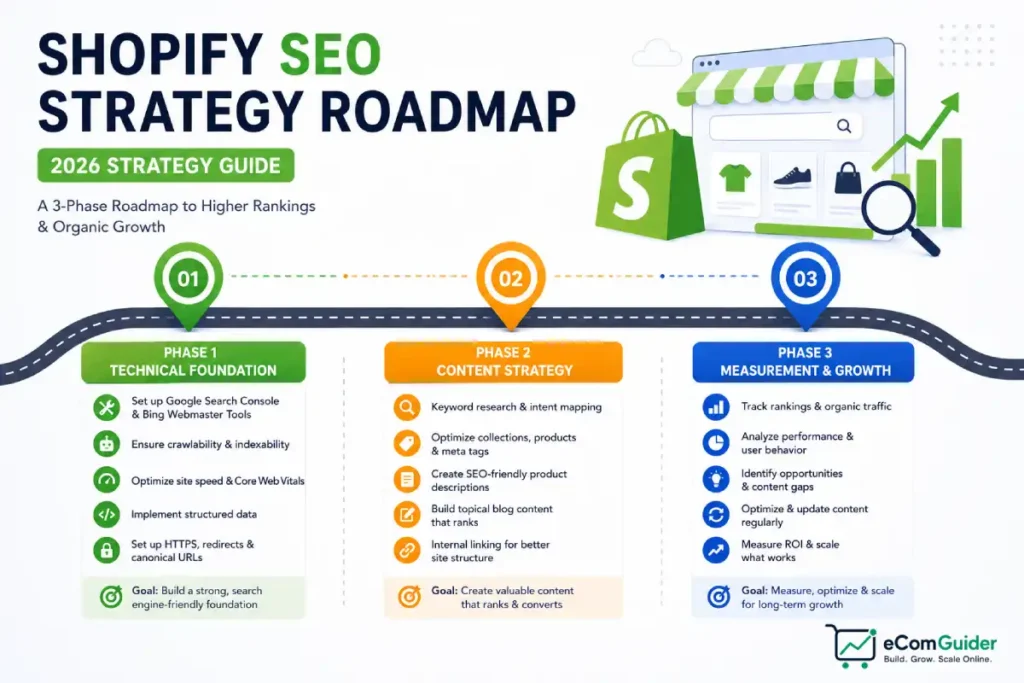
Your 90-Day Priority Roadmap
Technical fixes, content work, and growth activity happen in a specific order, doing them out of sequence wastes effort.
Days 1 to 30, technical foundation
- Fix the duplicate URL problem first, nothing else fully works until Google is crawling and indexing your actual pages correctly, the technical guide covers the exact fix
- Confirm structured data is present and valid on your highest-traffic product pages specifically, not your full catalog yet
- Audit and fix Core Web Vitals, oversized images and excess apps are the most common real culprits
Days 31 to 60, page-level content
- Write real, unique content for every collection page, prioritize your highest-traffic categories first, not alphabetically
- Rewrite product descriptions that are still manufacturer boilerplate, starting with your best-selling products, not your newest ones
- Set up your redirect strategy for any URLs you change during this process, never let a changed handle 404
Days 61 to 90, growth and content strategy
- Build out a keyword strategy for your product categories, not just individual products
- Launch or expand your blog around real buyer questions in your category
- Begin actual link building outreach once your on-site foundation is solid enough to be worth linking to
Common mistake. Starting with content or link building because they feel more like growth work than technical fixes do. A collection page full of great copy still will not rank if Google is indexing the wrong version of it.
Keyword and Content Strategy for Shopify
Technical fixes make your pages crawlable. Strategy determines what you actually rank for once they are.
Product-level keyword research
- Target how customers actually search, not your internal product naming, a customer searches ceramic travel mug, not your SKU name
- Check actual search volume and intent for both the product name and its close variations before finalizing product titles and collection names
- Prioritize research on your best-selling and highest-margin products first, not your full catalog at once
Category-level content strategy
- Build content around actual buyer questions at each stage, comparison content for shoppers still deciding, and specific product content for shoppers ready to buy
- Use Shopify’s native blog specifically for content that ranks around informational, non-transactional searches your product pages cannot naturally target, content marketing timelines commonly run 6 to 12 months before this compounds meaningfully
- Link blog content back to relevant collections and products directly, this is genuine internal linking value your blog would otherwise waste
A simple content calendar structure worth using
- One comparison or buyer’s guide post per month, targeting the research phase
- One product-focused post per month, tied to a specific, genuine launch or seasonal push
- Ongoing collection page refreshes, treated as content maintenance, not a one-time task
Common mistake. Writing blog content disconnected from your actual product catalog. A blog that never links back to what you sell captures traffic without converting any of it.
Competitive Positioning Strategy
Know what you are actually competing against before setting keyword targets.
- Identify your 3 to 5 actual competitors ranking for your actual target categories, not just the biggest brand names in your space
- Check what they are missing, a real content gap, a weaker collection page, thinner product detail, this is where you can realistically win, not head-on against a much larger site’s homepage authority
- Target long-tail, specific searches first if you are a smaller store, broad category terms are commonly dominated by sites with far more existing authority
- Revisit this quarterly, competitive positions shift as competitors publish new content or fix their own technical issues
Resourcing Your Strategy, DIY, In-House, or Agency
- Under 50 SKUs, DIY is commonly realistic, the technical fixes are a handful of one-time changes, and content work is manageable for one person
- 50 to 500 SKUs, a mix works well, DIY the technical foundation once, then bring in dedicated help for ongoing content and collection page work at this volume
- 500+ SKUs, dedicated in-house help or an agency becomes worth the real cost, the ongoing content and technical monitoring workload at this scale is actually difficult for one person to sustain alongside running the actual business
Common mistake. Hiring an agency before the technical foundation is fixed. Paying for content and link building on top of an unresolved duplicate URL problem wastes a meaningful portion of that spend.
Measuring Whether Your Strategy Is Actually Working
Track this monthly, not just once after a big technical push.
- Organic traffic by page type, product, collection, and blog traffic separately, a rise in one and a drop in another tells you something specific happened
- Rankings for your actual target keywords, not just overall traffic, traffic can rise from irrelevant queries while your real targets stay flat
- Indexation status in Google Search Console, confirm your fixed pages are actually showing the canonical result you intended, not just that traffic moved
- Conversion rate from organic traffic specifically, rising traffic that does not convert points to a content or targeting problem, not a technical one
Common mistake. Only checking results immediately after a technical fix. SEO changes commonly take months to fully reflect in rankings, judge a change on a real 3 to 6 month window, not the first few days.
Common Mistakes
- Treating this as a technical checklist instead of a sequenced strategy. Fixing collection content before the duplicate URL problem, or chasing link building before your on-site foundation is solid, wastes effort on the wrong order
- Setting keyword targets without checking real competitive positioning first. Chasing a broad term dominated by far larger sites wastes effort better spent on a specific, winnable target
- Writing blog content disconnected from your product catalog. Traffic that never links back to what you sell rarely converts
- Hiring outside help before your technical foundation is fixed. Paying for growth work on top of an unresolved indexing problem wastes meaningful budget
FAQ for Shopify SEO Strategy
What is the actual difference between Shopify SEO technical fixes and a strategy?
Technical fixes are individual changes, robots.txt, canonicals, schema. A strategy is the order to do them in, what to prioritize when you cannot do everything at once, and how to measure whether it worked. See this cluster’s technical Shopify SEO guide for the exact fixes themselves.
What should I fix first in a Shopify SEO strategy?
The duplicate URL problem, before anything else. Content and link building on top of an unresolved indexing issue wastes effort, since Google may not be crawling and indexing your actual intended pages correctly yet.
How do I build a keyword strategy specifically for Shopify?
Research at two levels, product-level for exact buyer searches and category-level for the research phase before a purchase decision. Prioritize your best-selling products first, then expand, rather than researching your full catalog at once.
Should I hire an agency for Shopify SEO?
It depends on catalog size and whether your technical foundation is already fixed. Under 50 SKUs, DIY is commonly realistic. Past 500 SKUs, dedicated help becomes worth the cost, but only once the technical basics are already resolved.
How long does it take to see results from a Shopify SEO strategy?
Commonly 3 to 6 months before a change fully reflects in rankings, longer in competitive categories. Checking results after a few days will mislead you in either direction, judge a strategic change on that longer, real window.
Does my blog actually help Shopify SEO?
Only if it links back to your products and collections directly. A blog that ranks for informational searches but never connects to what you sell captures traffic without converting any of it into revenue.