
Selling exclusively to other businesses is a fundamentally different problem than running a consumer storefront, and the dominant filter here reflects that: quote-to-order workflows, NET payment terms, multiple buyer roles per account, and ERP integration depth matter more than checkout speed or visual merchandising.
A B2B buyer isn’t browsing casually; they’re a procurement contact who needs to see contracted pricing and submit a purchase order, not a credit card.
This guide ranks 5 platforms specifically for pure B2B sellers, distinct from a wholesale guide covering brands adding a bulk channel alongside an existing consumer store.
In this guide, you’ll learn which platforms handle quote management, NET terms, and account hierarchies natively versus which require expensive third-party apps to fill the gap, and how to match platform choice to your ERP stack and order complexity.
Key Takeaways
- Shopify Plus added native B2B features (company profiles, wholesale price lists, payment terms) in 2024-2025, but lacks native quote management (RFQ), which Oracle-tier competitors handle out of the box.
- BigCommerce B2B Edition ships quote management, shared shopping lists, corporate accounts, and NET payment terms as part of the base product, not an expensive add-on layer.
- For complex B2B workflows, approval chains, deep ERP integration, multi-organization account structures, Shopify Plus commonly requires $500 to $2,000/month in third-party apps to match what OroCommerce or Adobe Commerce handle natively.
- Eight capabilities separate genuine B2B-ready platforms from consumer tools with B2B add-ons: customer-specific pricing, multi-user accounts with roles, quote management, quick reorder, NET terms, ERP/CRM integration, self-service portal, and product recommendations.
- WooCommerce can support B2B workflows through plugins, but every one of those eight capabilities becomes a separate plugin decision and cost, unlike a platform built B2B-first.
Quick Comparison
| Platform | Starting Price | Native Quote Management | Best For |
|---|---|---|---|
| Shopify Plus | $2,300/month (negotiated) | No (requires apps) | Brands wanting speed to launch over deep B2B customization |
| BigCommerce B2B Edition | $105+/month (B2B Edition priced separately) | Yes | Mid-market wholesalers wanting quotes and NET terms without a long build |
| Adobe Commerce | Custom (~$22,000+/year) | Yes | Enterprises with development resources for maximum customization |
| OroCommerce | Custom quote | Yes, plus native CRM | Manufacturers and distributors where B2B is the core motion, not an add-on |
| WooCommerce (B2B plugins) | Free plugin + hosting + B2B plugins | Via plugin | Technical teams wanting full control over a custom B2B build |
The Real Decision Factors for B2B Sellers
A B2C platform ranking cares about checkout speed and design. A B2B seller’s real filter is whether eight specific capabilities exist natively: customer-specific pricing, multi-user accounts with roles, quote management (RFQ), quick reorder, NET payment terms, ERP/CRM integration, a self-service buyer portal, and product recommendations based on purchase history.
The first real test is quote management. Large B2B orders often start with a request for pricing on a specific quantity or configuration, and a platform without built-in RFQ-to-order conversion means that workflow lives in email and spreadsheets, where deals fall through the cracks.
The second test is ERP integration depth, since a B2B seller’s inventory, pricing, and order data usually already live in an ERP system like NetSuite, SAP, or Microsoft Dynamics, and a platform requiring custom middleware to sync that data adds real, ongoing engineering cost.
We evaluated each platform against the eight core B2B capabilities, native versus app-dependent implementation, and total cost of ownership including the third-party app spend required to fill any native gaps, cross-referenced against the BigCommerce vs Shopify comparison for the platforms where that specific choice is the main fork in the road.
Shopify Plus: Best for Speed to Launch Over Deep B2B Customization

Shopify Plus brings native B2B functionality, company profiles, customer-specific catalogs and pricing, NET payment terms, and wholesale ordering, directly into the same admin as a consumer storefront, which suits brands wanting one unified system rather than two separate platforms.
The real gap is quote management: Shopify Plus has no native RFQ workflow, meaning complex negotiated-quote sales still require a third-party app.
See our Shopify vs Shopify Plus comparison for the full breakdown of what the Plus tier adds over standard Shopify.
Key Features
Unified B2B and DTC admin: Manage wholesale and consumer sales from the same system with shared inventory and customer data.
Company profiles and customer-specific pricing: Buyers log into dedicated accounts seeing only their approved products and contracted rates.
Native NET payment terms: Approved accounts can check out on NET 30 or similar terms instead of immediate card payment.
ERP integration ecosystem: Connects to NetSuite, SAP Business One, Microsoft Dynamics, and Acumatica through established integrations.
Fast time-to-launch: The shortest implementation timeline among enterprise-tier platforms on this list.
Pros
- The fastest path to market for a brand running both B2B and DTC channels from one system.
- Native NET terms and customer-specific pricing cover a large share of straightforward B2B needs without custom development.
Cons
- No native quote management (RFQ), a real gap for sellers whose orders commonly start with a negotiated quote rather than fixed pricing.
- Complex B2B workflows, approval chains, multi-organization hierarchies, commonly require $500 to $2,000/month in third-party apps to match what B2B-native competitors handle out of the box.
Who It’s Best For
Brands running both B2B and consumer sales who prioritize speed to launch and unified systems over deep, negotiated-quote B2B workflows.
Pricing
Shopify Plus starts at $2,300/month (negotiated), with additional cost for third-party apps filling native B2B gaps like quote management.
BigCommerce B2B Edition: Best for Quotes and NET Terms Without a Long Build
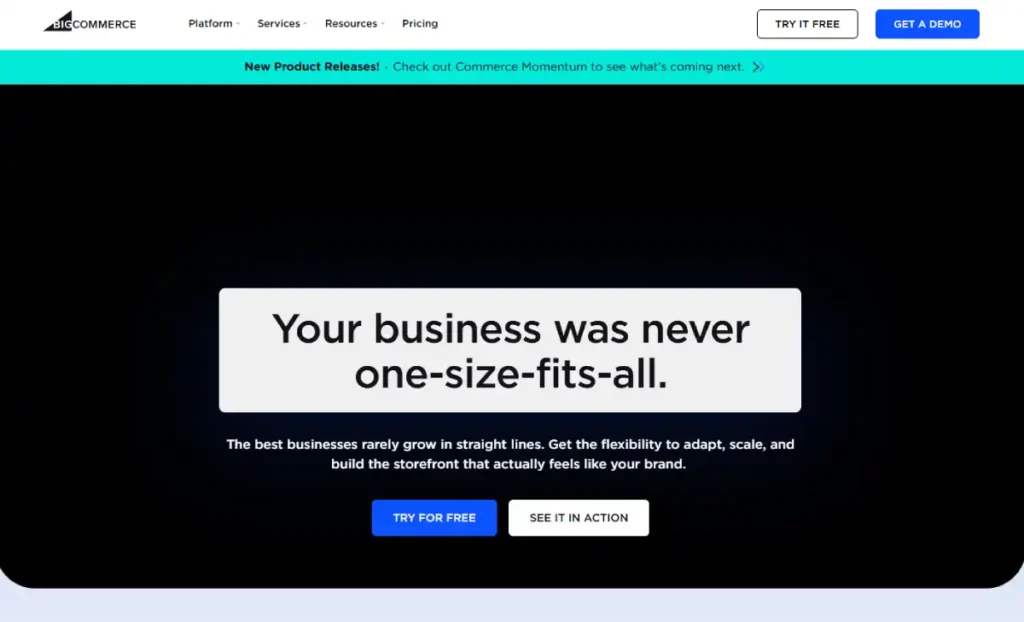
BigCommerce B2B Edition, co-built with BundleB2B, ships quote management, shared shopping lists, corporate accounts, and NET payment terms as part of the base product, filling exactly the gap Shopify Plus leaves open. For mid-market wholesalers who want proven, quick deployment with quote-to-order built in natively, it’s the strongest balance of depth and speed on this list. See our full BigCommerce review for more on its native capabilities.
Key Features
Native quote management: RFQ-to-order conversion built in, not requiring a separate app to fill the gap.
Purchase order support: Approved accounts can submit orders against a PO number and pay on NET terms natively.
Customer group pricing: Unlimited customer groups (Wholesale, VIP, Distributor) with different pricing and catalog visibility per group.
Shared shopping lists: Buyers can build and submit lists for quoting or repeat ordering.
Zero transaction fees on core plans: A direct cost advantage as B2B order volume scales.
Pros
- Native quote management closes the exact gap that makes Shopify Plus require third-party apps for negotiated-pricing workflows.
- Zero transaction fees compound meaningfully at real B2B order volume and average order size.
Cons
- The B2B Edition is priced and licensed separately from core BigCommerce plans, adding a real line item to budget for beyond the base subscription.
- Theme and design flexibility is more basic than a full CMS platform, a real tradeoff for teams wanting deep storefront customization.
Who It’s Best For
Mid-market wholesalers and distributors wanting native quote management and NET terms with a quick, proven deployment rather than a long custom build.
Pricing
BigCommerce plans start at $39/month (Standard); B2B Edition is priced separately based on order volume and features required.
Adobe Commerce: Best for Enterprises with Development Resources
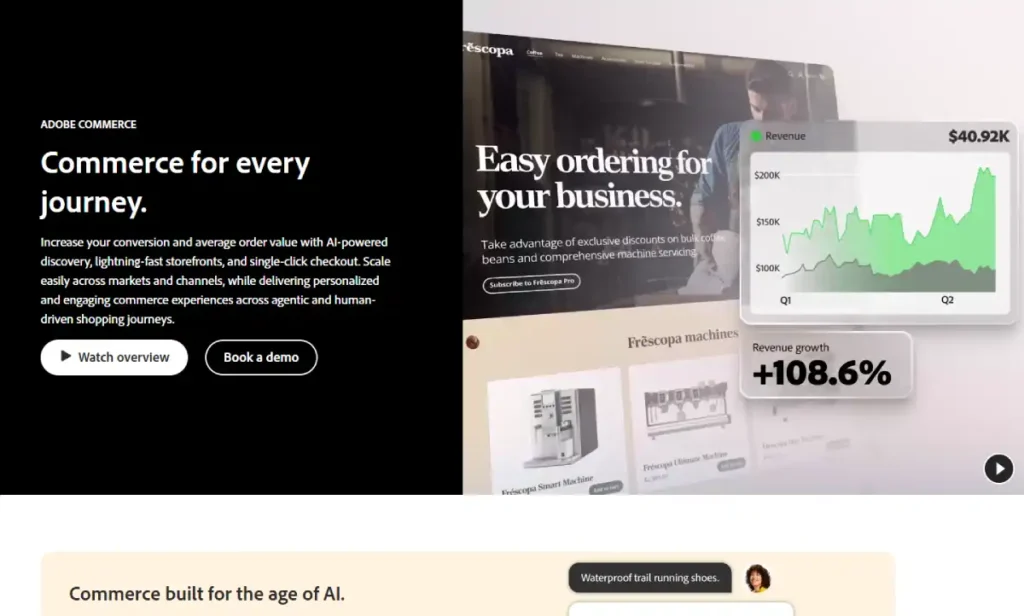
Adobe Commerce (built on the Magento platform) offers configurable products with unlimited attribute-based variants and native quote management, ideal for enterprises with complex catalogs and the development resources to build and maintain a fully custom implementation.
The tradeoff is real: total cost of ownership runs meaningfully higher than SaaS competitors once implementation and ongoing maintenance are included.
Key Features
Unlimited configurable variants: No platform-imposed cap, suited to complex fashion, industrial, or configurable product catalogs.
Native quote management and CPQ: Configure-Price-Quote workflows built into the core platform, not an add-on.
Deep ERP integration: Strong native connectivity to SAP, NetSuite, and other major ERP systems.
Massive extension ecosystem: Thousands of extensions covering nearly any B2B workflow gap.
Full open-source customization: Complete control over code and structure for a genuinely custom implementation.
Cons
- Total cost of ownership is meaningfully higher than SaaS competitors, commonly starting around $22,000/year for the cloud-hosted edition plus implementation and ongoing maintenance costs.
- Requires a dedicated development team; this is not a platform a non-technical team can self-manage.
Who It’s Best For
Enterprise B2B sellers with complex catalogs, dedicated development resources, and a budget that supports high total cost of ownership in exchange for maximum customization.
Pricing
Magento Open Source is free (self-hosted, requires developer). Adobe Commerce cloud-hosted starts around $22,000/year, plus implementation and maintenance costs.
OroCommerce: Best for Manufacturers and Distributors Where B2B Is the Core Motion
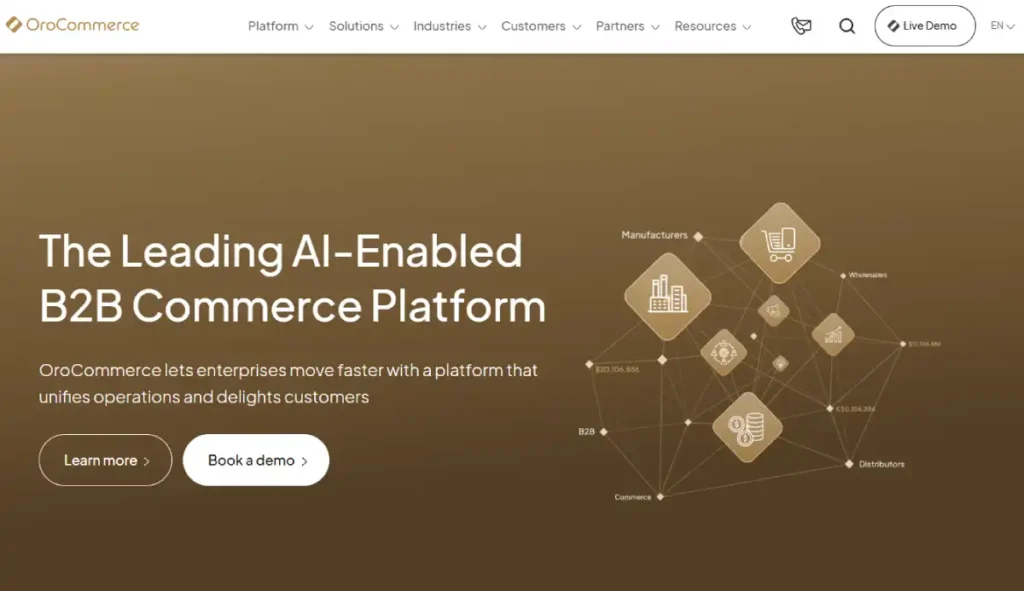
Unlike platforms extending B2C functionality into B2B, OroCommerce is built exclusively for B2B from the ground up, which shows in its native support for corporate account hierarchies, multiple catalogs and price lists, and RFQ workflows without requiring custom development to fill gaps that shouldn’t exist on a true B2B platform.
Key Features
Native corporate account hierarchy: Multi-organization and multi-site support for distributors selling across regions or business units.
Built-in CRM: A unified view of every B2B account, interaction, and order across the full sales cycle, without a separate CRM subscription.
Native RFQ and combined price lists: Quote-to-order workflows and customer-specific contract pricing built in, not bolted on.
ERP connectors: Native integrations for SAP, Microsoft Dynamics, NetSuite, and Oracle without custom middleware.
Built-in PIM: Manages complex product catalogs and customer-specific catalogs from a single system.
Pros
- Every core B2B workflow, RFQ, account hierarchy, contract pricing, is native rather than requiring third-party apps to fill gaps.
- The built-in CRM eliminates a separate subscription and data-sync problem most competitors require solving separately.
Cons
- Pricing is quote-based and not publicly listed, making upfront budget comparison harder than a platform with transparent tiers.
- Admin configuration for complex price lists and role structures has a real learning curve.
Who It’s Best For
Manufacturers, distributors, and wholesalers where B2B is the entire business model, not a channel added to an existing consumer brand.
Pricing
Custom quote-based pricing; contact sales for a tailored estimate based on order volume and features required.
WooCommerce: Best for Technical Teams Wanting Full Control Over a Custom B2B Build
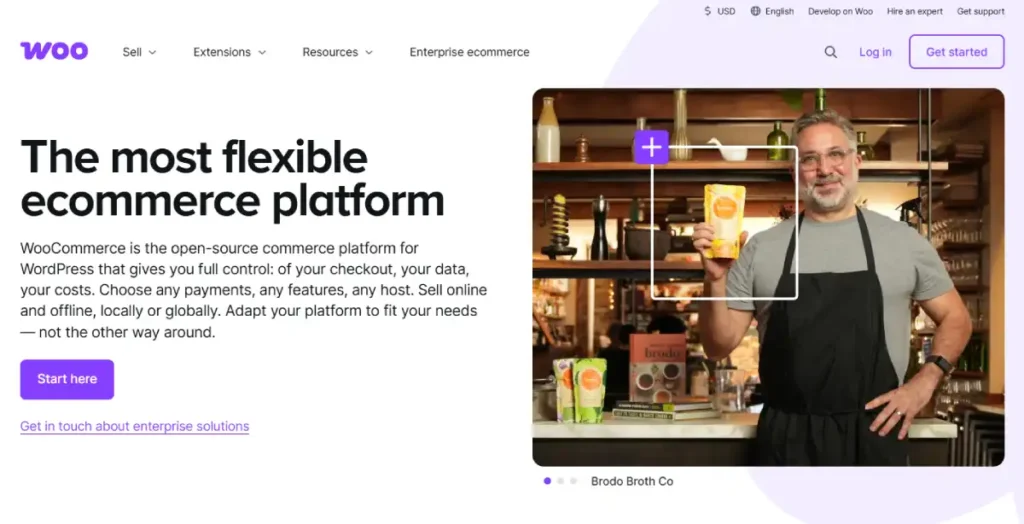
WooCommerce has no native B2B functionality out of the box, but its open plugin architecture lets a technical team assemble a genuinely custom B2B storefront, wholesale pricing, quote requests, customer-specific catalogs, through dedicated B2B plugins.
The tradeoff is that every one of the eight core B2B capabilities becomes a separate plugin decision, cost, and maintenance responsibility.
Key Features
Flexible B2B plugin ecosystem: Dedicated plugins add wholesale pricing, quote requests, and customer-specific catalogs individually.
No platform transaction fees: Only standard payment gateway fees apply, regardless of order size.
Full customization control: Complete flexibility to build a B2B workflow specific to your exact process, unlike a fixed-template SaaS platform.
WordPress content integration: Strong for B2B sellers who also maintain extensive product documentation or technical content.
Lower entry cost than enterprise platforms: A realistic starting point without Adobe Commerce or OroCommerce’s implementation budget.
Pricing
Core plugin is free. Realistic total cost including hosting, B2B-specific plugins, and development time runs $150 to $500+/month depending on workflow complexity.
B2B Platform Pitfalls to Avoid
Choosing a Platform Before Listing Your Actual B2B Workflows
Map your specific requirements, approval chains, customer pricing rules, payment terms, before comparing platforms. If your list has more than three genuinely complex B2B-specific workflows, a consumer platform with B2B add-ons likely costs more in apps than a B2B-native platform’s higher sticker price.
Assuming Shopify Plus’s B2B Features Cover Everything You Need
Shopify Plus’s native B2B functionality genuinely covers company profiles, pricing, and NET terms well, but quote management (RFQ) requires a separate app. Confirm this specific gap doesn’t apply to your sales process before assuming Shopify Plus is fully B2B-ready out of the box.
Evaluating Total Cost of Ownership Only in Year One
Enterprise platform costs are often front-loaded with implementation, making year-one costs misleading. By year three, licensing, maintenance, and extension costs reveal the real total cost picture, which sometimes favors a different platform than the one that looked cheapest at signing.
Underestimating ERP Integration Complexity
A platform’s marketing page listing ERP integration doesn’t guarantee it matches how your specific ERP handles inventory, pricing, and order sync. Validate the actual integration depth against your specific ERP system before committing.
How to Choose eCommerce Platform for B2B
If you run both B2B and consumer sales and want a unified, fast-to-launch system, Shopify Plus is the strongest starting point, provided your sales process doesn’t depend heavily on negotiated quotes.
If quote management and NET terms are core to your sales process and you want them native without a long implementation, BigCommerce B2B Edition is built specifically for that gap.
If you’re an enterprise with development resources and need maximum customization for a complex catalog, Adobe Commerce offers that depth at a real cost.
If B2B is your entire business model, not a channel added to a consumer brand, OroCommerce’s B2B-first architecture avoids paying for consumer features you’ll never use.
If you have technical resources and want full control over a custom, lower-cost B2B build, WooCommerce’s plugin ecosystem offers that flexibility.
FAQ’s
What’s the difference between Shopify Plus and BigCommerce B2B Edition?
Shopify Plus offers faster time-to-launch and a unified B2B/DTC system but lacks native quote management. BigCommerce B2B Edition ships quote management, shared shopping lists, and NET terms natively, making it the stronger fit for sellers whose process depends on negotiated quotes.
Do I need a dedicated B2B platform, or can I add B2B features to a consumer platform?
It depends on how many of the eight core B2B capabilities (customer pricing, multi-user roles, quotes, reorder, NET terms, ERP integration, self-service portal, recommendations) you need natively. Fewer than three, a consumer platform with apps likely works.
More than three, a B2B-native platform often costs less overall despite a higher sticker price.
How much does a real B2B ecommerce implementation cost?
Shopify Plus starts around $2,300/month plus potential app costs for gaps like quote management. Adobe Commerce commonly starts around $22,000/year plus implementation.
BigCommerce and OroCommerce pricing varies by order volume and features, typically requiring a custom quote.
What’s the difference between this guide and the wholesale guide?
This guide covers pure B2B sellers, manufacturers and distributors selling exclusively to other businesses. A wholesale guide covers a DTC brand adding a bulk or wholesale channel alongside an existing consumer store, a meaningfully different starting point and platform calculation.
Can WooCommerce really handle serious B2B sales?
Yes, with the caveat that every B2B capability requires a separate plugin decision and ongoing maintenance responsibility, unlike a platform built B2B-first. It’s a legitimate option for technically comfortable teams wanting full control at a lower starting cost than enterprise platforms.
Does my platform need native ERP integration, or can I build custom middleware?
Native integration reduces both upfront and ongoing engineering cost significantly. Custom middleware is viable but adds real, ongoing maintenance burden as your ERP and platform both update independently over time.
Final Thoughts
For pure B2B sellers, the platform decision comes down to how many of the eight core B2B capabilities you need natively versus how much you’re willing to fill with third-party apps or custom development. Shopify Plus offers the fastest unified path for straightforward B2B needs, BigCommerce B2B Edition closes the quote-management gap natively, and OroCommerce or Adobe Commerce serve businesses where B2B complexity is the entire operation, not an add-on.
If you’re weighing Shopify Plus against BigCommerce specifically, or considering whether your B2B needs actually require enterprise-tier complexity, the BigCommerce vs Shopify comparison and the best platform for wholesale guide are good next stops.