
A large catalog is a technical scale problem, not an audience or business-model question. The dominant filter here is raw performance: can the platform’s search, filtering, and product management stay fast and usable at 10,000, 50,000, or 100,000-plus SKUs, independent of whether you’re B2B, B2C, or both.
This guide ranks 5 platforms specifically on that scale question, distinct from a B2B guide covering buyer workflows or a wholesale guide covering channel strategy. In this guide, you’ll learn where each platform’s real performance ceiling sits, what breaks first as catalog size grows, and how to avoid choosing a platform that looks fine in a demo with 50 products but buckles at your actual scale.
Key Takeaways
- WooCommerce’s performance degrades significantly above 5,000 to 10,000 products without significant hosting and caching optimization, a real ceiling most WordPress-based stores hit sooner than expected.
- Shopify works well up to tens of thousands of products, but its 100-variant, 3-option cap per product becomes the binding constraint before raw catalog size does for many merchants.
- BigCommerce supports large catalogs more gracefully than Shopify natively, including higher per-product variant counts, without requiring a workaround app.
- Adobe Commerce (Magento) handles millions of SKUs efficiently, but total cost of ownership, commonly $50,000 to $200,000-plus for initial build, only makes sense at genuinely large scale.
- A complex catalog isn’t just large, it’s layered: variants, customer-specific pricing, technical specifications, and compliance documents all compound the real technical requirement beyond raw SKU count.
Quick Comparison
| Platform | Starting Price | Realistic SKU Ceiling | Best For |
|---|---|---|---|
| BigCommerce | $39/month | Tens of thousands, higher variant depth than Shopify | Growing catalogs needing native scale without a rebuild |
| Shopify Plus | $2,300/month (negotiated) | Tens of thousands of products | Fast-scaling catalogs wanting managed infrastructure |
| Adobe Commerce | Custom (~$22,000+/year) | Millions of SKUs | Enterprise catalogs with development resources |
| Salesforce Commerce Cloud | Custom (revenue-based) | Enterprise scale, deep CRM integration | Large retailers needing unified customer data across channels |
| WooCommerce | Free plugin + hosting | 5,000-10,000 products before real degradation | Smaller large-catalog stores with heavy optimization investment |
The Real Decision Factors at Catalog Scale
A general platform ranking treats catalog size as a footnote. For a genuinely large catalog, it’s the entire evaluation: does search stay fast at 50,000 products, do bulk edits take minutes or hours, and does the platform’s variant architecture handle real attribute complexity, not just raw count.
The first real test is search and filter performance under real product volume, not a lightly populated demo store. A platform that feels fast with 50 sample products can slow dramatically at 50,000, especially with faceted filtering across many product attributes.
The second test is bulk catalog management: batch-editing pricing, inventory, or metadata across thousands of SKUs at once, since manual per-product edits become operationally impossible past a few thousand items.
We evaluated each platform on documented real-world SKU ceilings, native variant and attribute depth, and total cost of ownership at genuinely large scale, cross-referenced against the platforms hub for the broader platform landscape this guide narrows down specifically for catalog scale.
BigCommerce: Best for Growing Catalogs Needing Native Scale
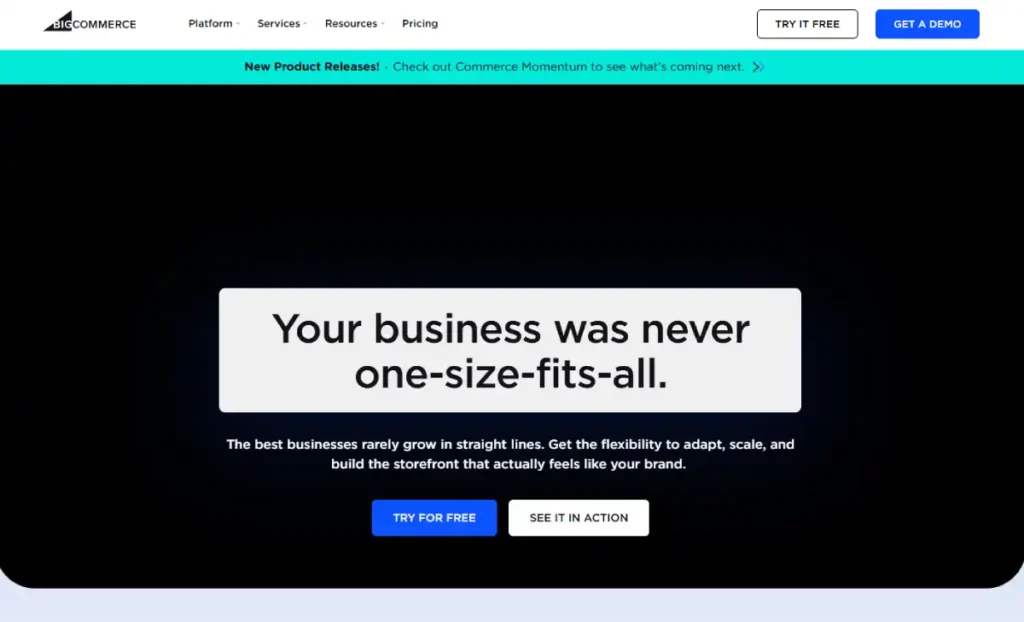
BigCommerce supports large catalogs more gracefully than Shopify without requiring a workaround app, including meaningfully higher per-product variant counts, which matters directly for catalogs with deep attribute combinations.
For a catalog that’s outgrowing a smaller platform but doesn’t yet need Adobe Commerce’s enterprise complexity, BigCommerce is the natural middle step. Our BigCommerce review covers its broader feature set in more depth.
Key Features
Higher native variant capacity: Supports significantly more SKUs per product than Shopify’s 100-variant cap, without a third-party app.
Zero transaction fees on every plan: A direct margin advantage that compounds at the order volume large catalogs typically generate.
Advanced product filtering: Native faceted search and filtering built for large, complex catalogs, not requiring a separate search app.
Unlimited staff accounts: Relevant for large-catalog operations needing multiple team members managing different product categories.
Native multi-channel selling: Reduces the number of separate apps needed to sync a large catalog across marketplaces.
Pros
- Genuinely handles more catalog complexity natively than Shopify before requiring workaround apps or a platform migration.
- Zero transaction fees preserve margin at the volume large catalogs typically process.
Cons
- Still requires deliberate optimization and configuration at genuinely enterprise scale (100,000-plus SKUs), where Adobe Commerce or Salesforce Commerce Cloud become the stronger fit.
- The steeper learning curve than Shopify is a real ramp-up cost for a team managing a large, complex catalog.
Who It’s Best For
Growing catalogs that have outgrown a smaller platform’s variant and filtering limits but don’t yet need full enterprise-tier complexity.
Pricing
Standard plan is $39/month, scaling to Plus ($105/month) and Pro ($399/month) as catalog size and feature needs grow, with custom Enterprise pricing at genuine scale.
Shopify Plus: Best for Fast-Scaling Catalogs Wanting Managed Infrastructure

Shopify Plus provides enterprise-grade performance through fully managed infrastructure that scales automatically for traffic spikes and extensive catalogs, working well up to tens of thousands of products. Its real binding constraint is usually the 100-variant, 3-option cap per product rather than raw catalog size, which becomes the practical limit before infrastructure does for many merchants. Our Shopify vs Shopify Plus comparison breaks down exactly what the upgrade buys you at this scale.
Key Features
Fully managed, auto-scaling infrastructure: No server or hosting management required, even at extensive catalog size and peak traffic.
Global CDN and built-in caching: Ensures fast storefront response regardless of catalog size or geographic customer distribution.
Up to 9 expansion stores: Supports multi-brand or multi-region catalog structures from one system.
200+ inventory locations: Native support for complex, distributed inventory at scale.
Extensive app ecosystem: Covers catalog management gaps without custom development for most large-catalog needs.
Pros
- Managed infrastructure means the merchant never handles server scaling or hosting decisions, even as the catalog and traffic grow substantially.
- Genuinely fast performance up to tens of thousands of products without the implementation timeline of an Adobe Commerce build.
Cons
- The 100-variant, 3-option cap per product is often the real limiting factor before raw catalog size becomes a problem, requiring a workaround app for deep attribute combinations.
- The $2,300/month starting price is a real budget commitment compared to BigCommerce’s lower entry point for a similarly scaled catalog.
Who It’s Best For
Fast-scaling catalogs in the tens of thousands of products wanting fully managed infrastructure without an enterprise-tier implementation project.
Pricing
Shopify Plus starts at $2,300/month (negotiated), with a 0.25% revenue share over $800K in monthly revenue for high-volume merchants.
Adobe Commerce: Best for Enterprise Catalogs with Development Resources
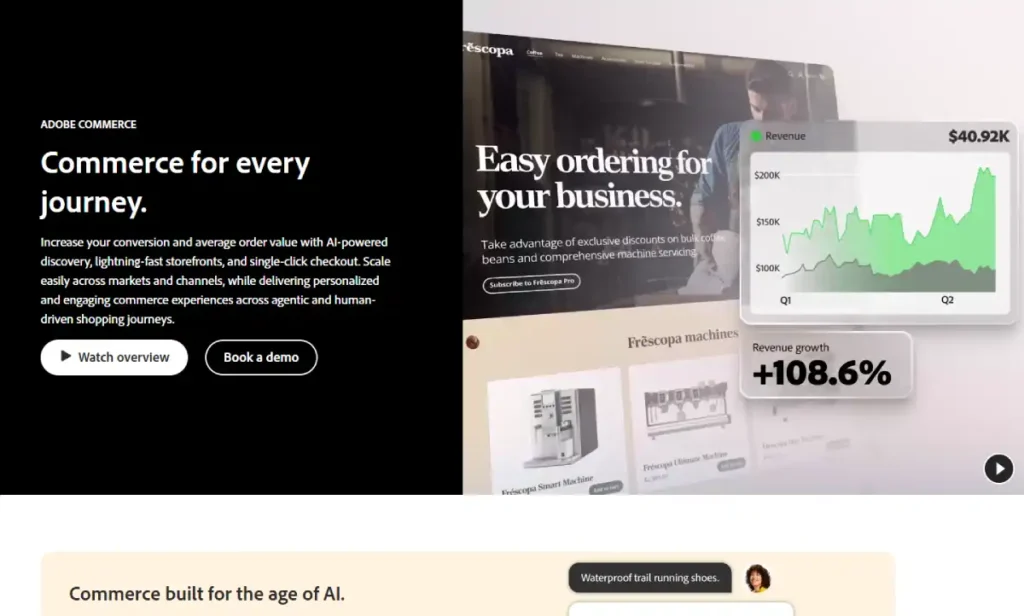
Adobe Commerce (Magento) handles millions of SKUs efficiently, the deepest raw scale of any platform on this list, with unlimited attribute-based variant configuration that suits genuinely complex catalogs, technical specifications, compliance documents, fitment data. The tradeoff is real: total cost of ownership commonly runs $50,000 to $200,000-plus for initial build, only justified at genuine enterprise scale.
Key Features
Millions of SKUs supported efficiently: The deepest raw catalog scale of any platform here, used by large established retailers.
Unlimited configurable attributes: No platform-imposed cap on variant complexity, suited to technical or compliance-heavy product data.
Full open-source customization: Complete control over catalog architecture, search behavior, and data structure.
Deep PIM and ERP integration: Native connectivity for managing complex product information at scale alongside enterprise business systems.
Massive extension ecosystem: Thousands of extensions covering nearly any large-catalog workflow gap.
Cons
- Total cost of ownership, commonly $50,000 to $200,000-plus for initial build plus $20,000 to $100,000-plus in annual maintenance, only makes financial sense at genuinely large catalog scale.
- Requires a dedicated development team; this is not a platform a non-technical team can self-manage at any catalog size.
Who It’s Best For
Enterprise retailers with catalogs in the hundreds of thousands to millions of SKUs and the development budget to support genuine platform ownership.
Pricing
Magento Open Source is free (self-hosted, requires developer). Adobe Commerce cloud-hosted starts around $22,000/year, plus significant implementation and maintenance costs.
Salesforce Commerce Cloud: Best for Large Retailers Needing Unified Customer Data
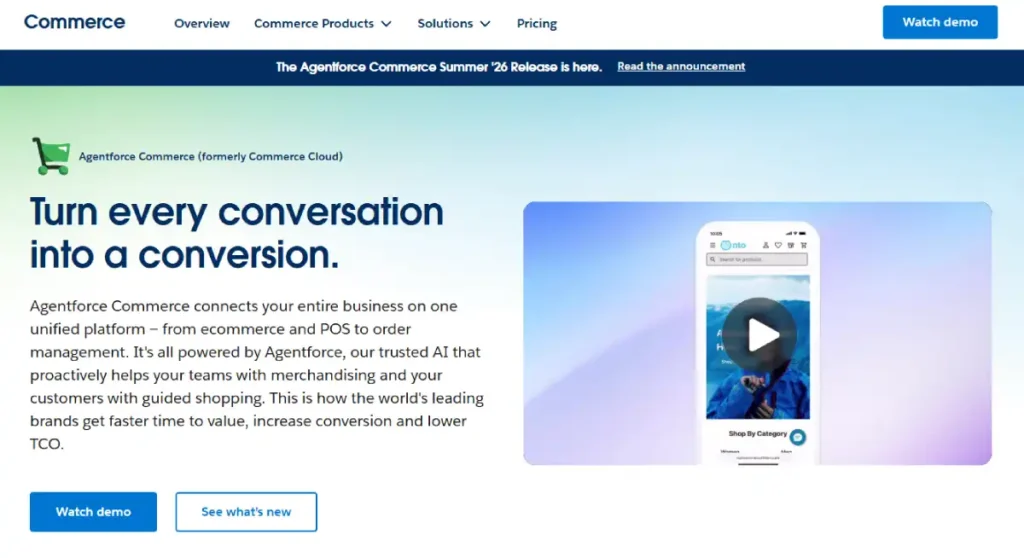
Salesforce Commerce Cloud combines large-catalog commerce infrastructure with Salesforce’s CRM, giving large retailers a unified view of customer data across sales, marketing, and service alongside catalog and order management. For an enterprise already invested in the Salesforce ecosystem, that native data unification is a real advantage over a standalone commerce platform.
Key Features
Native Salesforce CRM integration: Unifies customer data across sales, marketing, service, and commerce without custom middleware.
AI-driven personalization: Leverages cross-system customer data for product recommendations and merchandising at scale.
Real-time inventory across channels: Supports unified commerce across web, mobile, and in-store for large, multi-channel catalogs.
Progressive Web App support: Native tooling for fast, app-like storefront performance at large catalog scale.
Cons
- Pricing is revenue-based and not publicly listed, making upfront budget comparison harder than a platform with transparent tiers.
- The strongest value case depends on existing Salesforce ecosystem investment; the advantage is smaller for a retailer not already using Salesforce CRM.
Who It’s Best For
Large retailers with an existing or planned Salesforce CRM investment who need unified customer data across a large, multi-channel catalog.
Pricing
Custom, revenue-based pricing; contact sales for a tailored estimate based on catalog size and channel requirements.
WooCommerce: Best for Smaller Large Catalogs with Heavy Optimization Investment
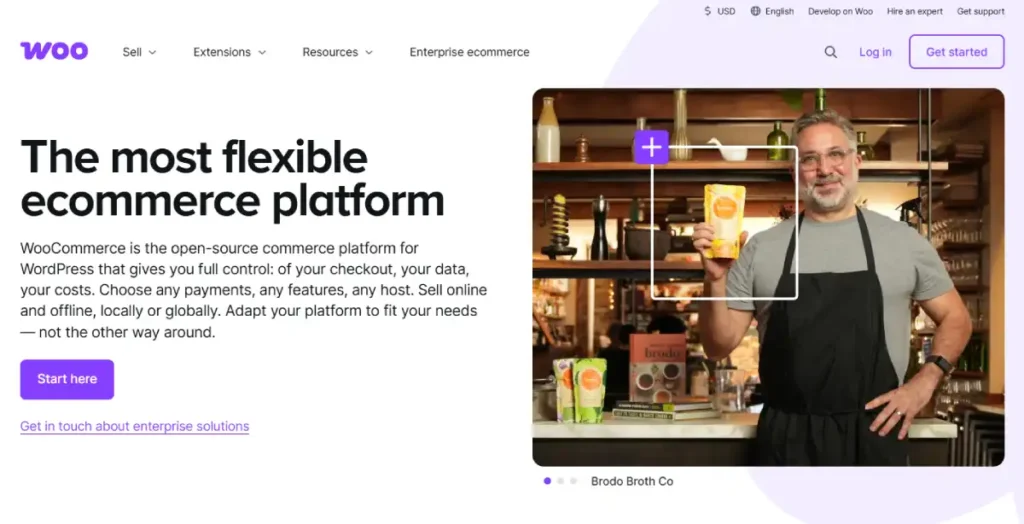
WooCommerce can support a large catalog, but its documented real-world performance degrades significantly above 5,000 to 10,000 products without meaningful hosting and caching optimization. For a catalog in that range with a technical team willing to invest in ongoing performance work, WooCommerce’s flexibility and lack of platform fees remain a real option below true enterprise scale.
Key Features
No hard product cap: Product count is limited by hosting capacity and optimization, not a platform-imposed ceiling.
No platform transaction fees: Only standard payment gateway fees apply, regardless of catalog size.
Flexible catalog architecture: Full customization of product data structure through custom development and plugins.
Caching and CDN plugin ecosystem: A range of performance tools exist, though they require active configuration rather than working automatically.
Lower entry cost than enterprise platforms: A realistic option below the true enterprise scale where Adobe Commerce or Salesforce Commerce Cloud become necessary.
Cons
- Documented performance degradation above 5,000 to 10,000 products without significant optimization investment, a real and well-documented ceiling.
- Achieving that optimization requires ongoing technical investment in hosting, caching, and database tuning, an operational cost beyond the plugin’s zero price.
Who It’s Best For
Catalogs in the 5,000 to 10,000 product range with a technical team willing to invest in ongoing performance optimization, below the scale that justifies Adobe Commerce or Salesforce Commerce Cloud.
Pricing
Core plugin is free. Realistic total cost including hosting, caching infrastructure, and performance optimization runs $800 to $3,000+/year depending on catalog size.
Scaling Mistakes That Cost Real Money
Testing Platform Performance on a Lightly Populated Demo Store
A platform’s demo or trial store with 50 sample products tells you nothing about real performance at 50,000. Test search, filtering, and bulk edit speed on a realistic product count, ideally your actual catalog, before committing.
Confusing Raw SKU Count with Real Catalog Complexity
A complex catalog isn’t just large, it’s layered: variants, customer-specific pricing, technical specifications, and compliance documents all compound the real technical requirement. Map your actual complexity, not just product count, before assuming a platform’s SKU ceiling is the only relevant number.
Underestimating the Real Cost of Enterprise-Tier Platforms
Adobe Commerce and Salesforce Commerce Cloud’s sticker prices are only the starting point. Implementation, ongoing maintenance, and the development team required to run them add real cost that a smaller retailer’s catalog size may not justify.
Choosing WooCommerce for a Genuinely Large Catalog Without Budgeting for Optimization
WooCommerce’s flexibility is real, but its documented performance ceiling around 5,000 to 10,000 products requires real, ongoing optimization investment to avoid, not a one-time setup cost.
How to Choose eCommerce Platform for a Large Catalog
If your catalog is growing past a smaller platform’s limits but isn’t yet at genuine enterprise scale, BigCommerce’s native variant and filtering depth is the natural next step.
If you want fully managed infrastructure that scales automatically without an enterprise implementation project, Shopify Plus handles tens of thousands of products well, provided the variant cap doesn’t bind first.
If your catalog is in the hundreds of thousands to millions of SKUs with genuine technical complexity, Adobe Commerce’s raw scale justifies its real implementation cost.
If you’re a large retailer with existing Salesforce CRM investment, Salesforce Commerce Cloud’s unified customer data is worth its custom pricing.
If your catalog is in the 5,000 to 10,000 product range and you have technical resources for ongoing optimization, WooCommerce remains a viable, lower-cost option below true enterprise scale.
FAQ’s
At what catalog size do I need to move past Shopify or WooCommerce?
WooCommerce’s documented performance ceiling sits around 5,000 to 10,000 products without heavy optimization. Shopify works well up to tens of thousands, though its 100-variant cap per product often binds before raw catalog size does.
Past that, BigCommerce, Adobe Commerce, or Salesforce Commerce Cloud become the realistic options depending on your exact scale.
Does BigCommerce really handle large catalogs better than Shopify?
Yes, specifically in per-product variant depth. BigCommerce supports meaningfully more variants per product natively, which matters directly for catalogs with deep size, color, or material combinations, without requiring a workaround app the way Shopify’s 100-variant cap sometimes does.
How much does an enterprise-scale catalog platform really cost?
Adobe Commerce commonly starts around $22,000/year for cloud hosting, with total implementation running $50,000 to $200,000-plus and $20,000 to $100,000-plus in annual maintenance. Salesforce Commerce Cloud uses custom, revenue-based pricing requiring a direct quote.
Can WooCommerce handle a genuinely large catalog with the right optimization?
To a point. With significant investment in managed hosting, caching, and database optimization, WooCommerce can push past its default performance ceiling, but it’s not a substitute for a platform architecturally built for tens of thousands or more products at genuine enterprise scale.
What’s the difference between this guide and a best platform for B2B guide?
This guide evaluates raw technical performance at scale, independent of business model. A B2B guide evaluates buyer-specific workflows like quote management and NET terms, which matter regardless of whether the catalog itself is large or small.
Is a headless or composable architecture worth it for a large catalog?
It depends on how much custom control you need over the buying experience across channels. Composable architecture avoids re-engineering everything when requirements change, but it adds real complexity and typically requires more development resources than a standard SaaS platform.
Final Thoughts
For a large catalog, the platform decision comes down to matching your real technical scale, not just current product count, to a platform’s documented performance ceiling.
BigCommerce offers the natural next step past Shopify’s variant limits, Shopify Plus provides managed infrastructure for tens of thousands of products, and Adobe Commerce or Salesforce Commerce Cloud become necessary once catalog complexity reaches genuine enterprise scale.
If you’re deciding between Shopify and BigCommerce specifically for a growing catalog, or want the full platform landscape before committing, the BigCommerce vs Shopify comparison and the platforms hub are good next stops.