
Free in ecommerce almost never means zero cost. It usually means the monthly subscription fee is zero while a transaction fee, product cap, or missing feature quietly transfers the real cost somewhere else.
This guide’s entire job is to interrogate that claim platform by platform, not to rank by ease of use or brand fit, which are covered in separate guides.
In this guide, you’ll learn which platforms are honestly free versus which only look free until you calculate the real percentage fee, what specific limitations each free tier hides, and when paying for a platform from day one actually costs less than staying on a free plan.
Key Takeaways
- Square Online is the only platform on this list that lets you actually process real online sales for $0/month, but its 3.3% plus 30 cent online transaction fee is genuinely higher than what the same platform charges paid subscribers.
- Wix’s free plan doesn’t support online payments at all. It’s a website preview tier, not a functional free ecommerce plan, despite frequently appearing on free platform lists.
- WooCommerce’s plugin is genuinely free, but real total cost including hosting, a domain, and basic plugins commonly runs $60 to $80/month once you account for everything needed to actually run a store.
- Big Cartel’s free plan is honestly free with zero transaction fees, but caps at 5 products, a real ceiling for anyone beyond the smallest test catalog.
- Ecwid’s free plan covers up to 5 products with no transaction fees, similar to Big Cartel, making the choice between them mostly about which existing website or platform each embeds into best.
Quick Comparison
| Platform | Advertised Free Tier | Real Hidden Cost | Best For |
|---|---|---|---|
| WooCommerce | Free plugin | Hosting + domain + plugins: $60-$80/month realistic total | Full control, technical comfort |
| Ecwid | Free (5 products) | No transaction fees, but 5-product cap | Adding a small store to an existing site |
| Square Online | Free (unlimited products) | 3.3% + $0.30 per online transaction | Genuinely free to start selling today |
| Big Cartel | Free (5 products) | No transaction fees, but 5-product cap | Small, curated creative catalogs |
| Wix | Free plan exists but can’t sell | Real ecommerce requires $29/month Business plan | Not a true free option for selling |
What Free Actually Means, Platform by Platform
The honest first question for any free platform is whether you can actually process a real sale on it, not just build a preview site. Wix’s free plan, despite appearing on many best free platform lists, doesn’t support online payments at all.
It’s a website preview tier that requires upgrading to at least the $29/month Business plan before you can sell anything, which disqualifies it as a genuine free ecommerce option regardless of how often it’s included in free-platform roundups.
The second question is what the free tier’s real percentage or product cap costs you at actual sales volume. Square Online’s free plan is genuinely free in the sense that you can process real sales at $0/month, but its 3.3% plus 30 cent online transaction rate is measurably higher than the 2.9% plus 30 cents its own $49/month Plus plan charges, meaning the free plan has a real, calculable cost embedded in every transaction.
We evaluated each platform based on what its free tier can actually support in practice, including selling capability, real total cost, and the limits that push you onto a paid plan.
For additional context on platform fees beyond the free tier, see our Shopify transaction fees breakdown.
WooCommerce: Free Plugin, Real Cost Is Hosting and Setup
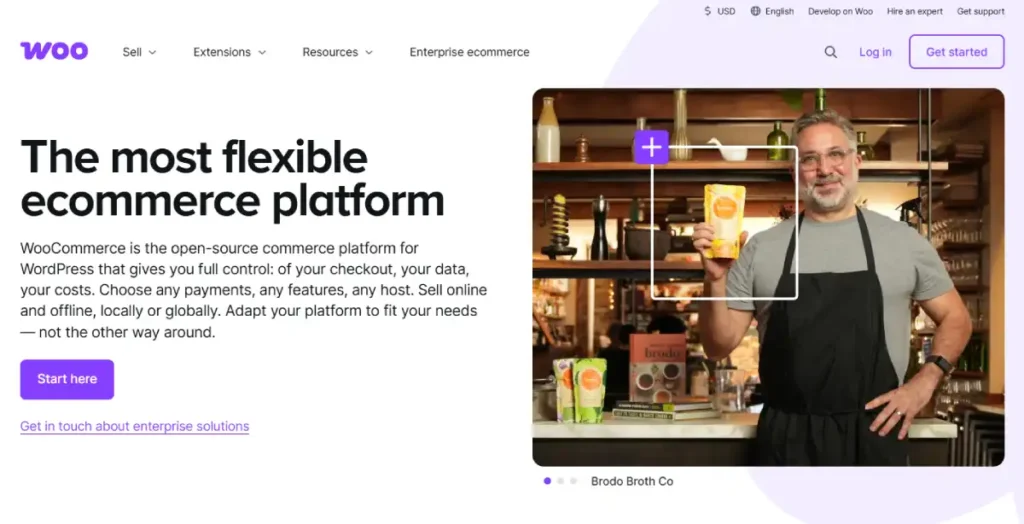
WooCommerce’s core plugin genuinely costs nothing to install, which is the source of its free reputation. The real cost lives elsewhere: separate hosting, a domain, an SSL certificate (usually free via Let’s Encrypt), and the premium plugins most real stores eventually need.
Add those up and a realistic small WooCommerce store runs $60 to $80 a month, not $0, before any premium theme or extension purchase.
Key Features
Genuinely free core plugin: No licensing cost for the core ecommerce functionality itself.
No platform transaction fees: Only standard payment gateway fees apply (Stripe: 2.9% + 30 cents), with no additional platform cut.
Unlimited products: No artificial product cap, limited only by hosting capacity.
Complete customization control: Full access to code and structure, unlike a hosted platform’s template constraints.
Massive plugin ecosystem: Thousands of free and paid extensions covering nearly any feature gap.
Pros
- The core software cost is genuinely zero, and there’s no percentage-of-sales platform fee ever.
- Full ownership and control means no forced migration risk from a platform shutting down or changing terms.
Cons
- The realistic all-in monthly cost, hosting, domain, basic plugins, commonly runs $60 to $80/month, a real and often underestimated figure compared to the free framing.
- Security, backups, and updates are the merchant’s responsibility, an ongoing operational cost beyond the dollar figure.
Who It’s Best For
Technically comfortable sellers or those with development budget who want zero platform fees and full control, and who understand the real cost lives in hosting and setup, not the plugin itself.
Pricing
Core plugin is free. Realistic total cost including hosting, domain, and essential plugins runs $60 to $80/month for a basic functioning store.
Ecwid: Genuinely Free for a Small Catalog
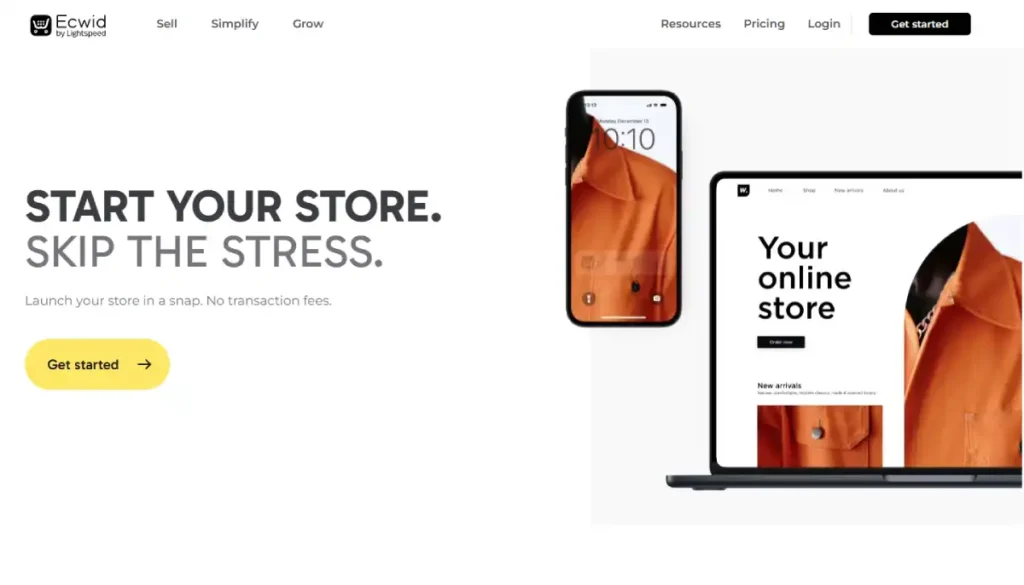
Ecwid’s free plan is honestly what it claims to be for a small catalog: no transaction fees, real online payment processing, and a genuine ability to sell up to 5 products at zero monthly cost. The honest limitation is the 5-product cap, which is a real ceiling, not a soft nudge, once a catalog grows past a small test collection.
Key Features
No transaction fees on any plan: Only standard payment gateway fees apply, even on the free tier.
Real online payment processing: Unlike Wix’s free tier, Ecwid’s free plan genuinely supports processing actual sales.
Embeddable into any existing site: Adds ecommerce to a website you already have without a rebuild.
Multi-channel selling: Sell across a website, Instagram, and Facebook from the same free-tier dashboard.
Clear upgrade path: Moves from free to Venture ($25/month, 100 products) to Business ($45/month, 2,500 products) as the catalog genuinely grows.
Pros
- A genuinely functional free plan that processes real sales with no transaction fee, not just a preview tier.
- The 5-product cap is an honest limitation clearly communicated upfront, not a hidden fee discovered later.
Cons
- The 5-product cap is restrictive quickly for anyone beyond the smallest test catalog, forcing an upgrade sooner than some competitors.
- Design and merchandising tools remain comparatively basic even on paid tiers.
Who It’s Best For
Sellers with an existing website who want to genuinely test a small ecommerce catalog at zero cost before committing to a paid tier.
Pricing
Free for up to 5 products with no transaction fees. Venture is $25/month (100 products), Business is $45/month (2,500 products).
Square Online: The Only Platform Here That’s Free with Unlimited Products
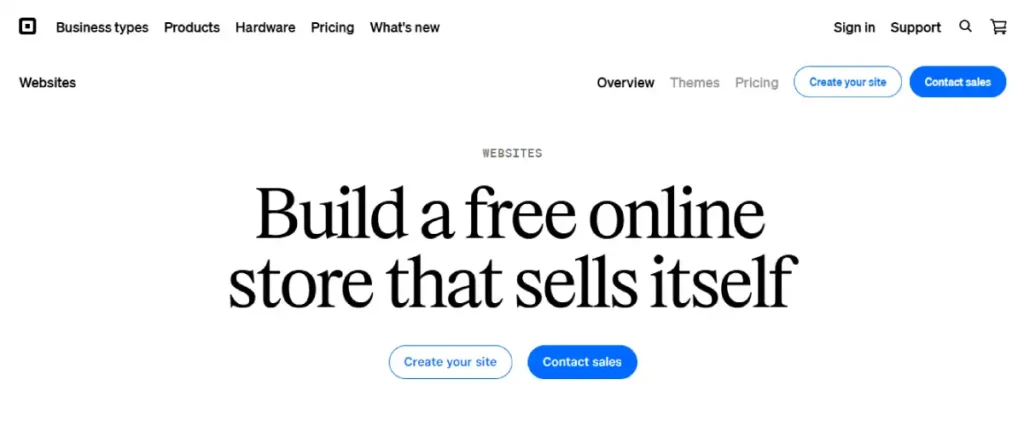
Square Online is the one platform on this list that lets you sell an unlimited product catalog at $0/month with no product cap, which is a genuinely rare combination. The honest tradeoff is the transaction fee: 3.3% plus 30 cents per online sale on the free tier, a rate that’s meaningfully higher than the 2.9% plus 30 cents the same platform charges once you’re paying $49/month for Plus.
Key Features
Unlimited products on the free plan: No catalog size cap, unlike Ecwid or Big Cartel’s 5-product free tier limit.
Real online payment processing: Genuinely functional checkout, unlike Wix’s free tier.
No chargeback fees: A real ongoing savings compared to processors that charge per dispute.
Native POS integration: Useful if you also sell in person and want unified inventory tracking.
Basic inventory tracking included: Real stock management functionality even at the free tier.
Pros
- The only platform here offering both a genuinely free plan and unlimited products, a combination no competitor matches.
- Real payment processing works out of the box, unlike Wix’s free tier which can’t process payments at all.
Cons
- The 3.3% plus 30 cent online transaction rate is a real, calculable cost that’s higher than the platform’s own paid-tier rate, worth running the numbers on before assuming free is cheapest.
- The free plan lacks ecommerce themes and detailed sales/store statistics, limiting design and reporting depth.
Who It’s Best For
Sellers who want to start selling online today at zero monthly cost and are comfortable with a higher per-transaction rate in exchange for no product cap.
Pricing
Free plan available with no monthly fee (3.3% + $0.30 per online transaction). Plus plan is $49/month per location (2.9% + $0.30 online).
Big Cartel: Free and Zero Transaction Fees, with a Real 5-Product Cap

Big Cartel’s free plan is honestly free in the fullest sense: no monthly fee and no transaction fees at all, a rare combination. The tradeoff, like Ecwid, is a hard 5-product cap, making it a genuine option only for a very small, curated catalog rather than a growing one.
Key Features
Zero transaction fees, even on the free plan: A genuinely rare combination among platforms claiming to be free.
Custom domain support: Even the free tier supports connecting your own domain, unlike some competitors that reserve this for paid plans.
Real-time stats included: Basic sales tracking available even at the free tier.
Artist-focused templates: Built specifically for creative and handmade sellers rather than adapted from a general template.
Clear, simple upgrade tiers: Platinum ($9.99/month, 50 products) and Diamond ($19.99/month, 500 products) as the catalog genuinely grows.
Pros
- Zero transaction fees on the free plan is a genuinely rare and valuable combination, unlike most free platforms that hide a percentage fee.
- Custom domain support even on the free tier, unlike competitors that gate this behind a paid plan.
Cons
- The 5-product cap is a hard ceiling, forcing an upgrade decision quickly for anyone beyond a small test catalog.
- The broader app and integration ecosystem is thinner than platforms built for larger-scale operations.
Who It’s Best For
Artists and small-batch creators with a genuinely small, curated product line who want zero transaction fees without a monthly cost.
Pricing
Free for up to 5 products with no transaction fees. Platinum is $9.99/month (50 products), Diamond is $19.99/month (500 products).
Wix: Not a Real Free Ecommerce Option
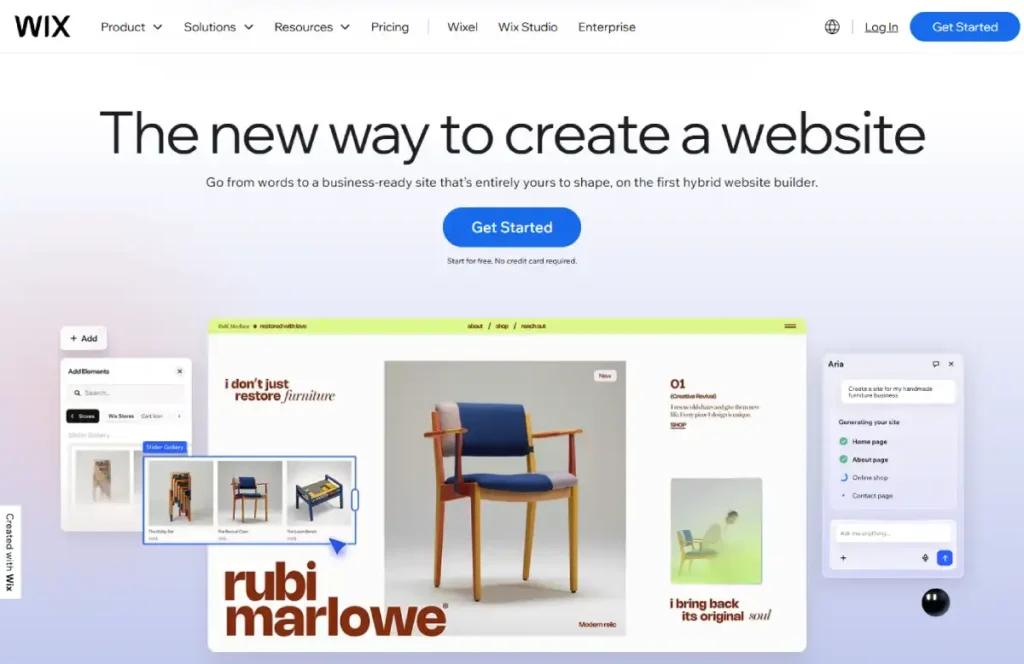
Wix’s free plan appears on many best free platform lists, which is misleading. The free tier is a website preview mode: it doesn’t support online payments at all, meaning you cannot actually process a sale without upgrading to at least the $29/month Business plan.
Included here specifically to correct that common misconception, not as a genuine free recommendation.
Key Features
Website preview only on free tier: No online payment processing available, meaning no real ecommerce functionality.
Mandatory Wix branding on free tier: Further signals this is a preview mode, not a production-ready free store.
Business plan required to sell: Real ecommerce functionality begins at $29/month, not at the free tier.
Who It’s Best For
No one, for actual ecommerce purposes. If Wix’s design approach appeals to you, budget for the $29/month Business plan from the start rather than expecting the free tier to support real sales.
Pricing
Free plan exists but cannot process online payments. Business plans (required for ecommerce) start at $29/month.
Free Platform Traps to Skip
Assuming Free Means the Cheapest Option at Real Volume
A free plan’s transaction fee or product cap has a real, calculable dollar cost. Run the math at your actual expected sales volume before assuming a free plan beats a paid one; Square Online’s free-tier fee difference alone can outweigh Square Plus’s $49/month at meaningful volume.
Confusing a Website Preview Tier with a Functional Free Store
Not every free plan that appears on a comparison list can actually process a sale. Confirm the free tier supports real payment processing, not just a preview or trial mode, before counting on it as a genuine option.
Underestimating WooCommerce’s Real All-In Cost
WooCommerce’s plugin cost of $0 is only one line item. Hosting, a domain, SSL, and basic plugins commonly bring the realistic monthly total to $60 to $80, a figure worth planning for rather than being surprised by.
Staying on a Free Plan Past the Point It Makes Sense
A product cap or high transaction fee that made sense during initial testing can quietly cost more than a paid plan once sales become consistent. Recalculate the real cost comparison periodically, not just at initial signup.
How to Choose eCommerce Platform for Free
If you want to sell an unlimited catalog at zero monthly cost and can accept a higher per-transaction fee, Square Online is the most genuinely free option with no product cap.
If you have a very small, curated catalog (5 products or fewer) and want zero transaction fees, Big Cartel or Ecwid are honestly free for that specific scenario.
If you’re technically comfortable and want zero platform fees long-term, WooCommerce’s plugin cost is genuinely free, but budget $60 to $80/month realistically for hosting and setup.
If you’re considering Wix because it appeared on a free platform list, budget for the $29/month Business plan from the start, since the actual free tier cannot process sales.
FAQ’s
Is there a truly free ecommerce platform with no hidden costs?
No platform is entirely free once you account for either a transaction fee (Square Online), a product cap (Ecwid, Big Cartel), or hosting costs (WooCommerce). The honest framing is that each platform’s free tier has a specific, identifiable cost; the question is which cost fits your situation best.
Can I actually sell products for free on Wix?
No. Wix’s free plan does not support online payment processing at all.
Real ecommerce functionality requires upgrading to at least the $29/month Business plan, despite Wix frequently appearing on free-platform comparison lists.
What’s the real cost of a free WooCommerce store?
Realistically $60 to $80/month once you include hosting ($15-$60/month depending on provider), a domain (~$10-$15/year), and basic plugins, even though the core WooCommerce plugin itself costs nothing.
Is Square Online’s free plan actually good for selling online?
Yes, with a real tradeoff. It’s the only platform here offering unlimited products at $0/month, but its 3.3% plus 30 cent online transaction fee is higher than what the same platform charges on paid plans, a cost worth calculating against your expected sales volume.
When should I upgrade from a free plan to a paid one?
When the free tier’s real cost, whether a transaction fee percentage or a product cap forcing an artificial catalog limit, exceeds what a paid plan would cost at your actual sales volume. Recalculate this periodically as sales grow, not just once at signup.
What’s the difference between this guide and a best platform for beginners guide?
This guide specifically interrogates free-tier claims and their real hidden costs. A beginner’s guide evaluates setup speed and ease of use more broadly, including paid platforms that a beginner might reasonably choose from day one.
Final Thoughts
No ecommerce platform is free in the sense of having zero real cost. Square Online and Big Cartel come closest to honest free tiers for their specific use cases, unlimited catalog with a transaction fee, or a small catalog with zero fees, while Wix’s free plan doesn’t support real ecommerce at all despite its reputation, and WooCommerce’s true cost lives in hosting rather than the plugin price.
If you’re ready to compare paid platforms honestly once you’ve outgrown a free tier, the Shopify’s transaction fees breakdown and the best ecommerce platform for beginners guide are good next stops.