
Most Shopify Capital content stops at explaining the factor rate and calling it a day. That leaves out the one detail that actually determines whether an offer is reasonable or expensive: paying it back faster does not save you money, it raises your effective annual cost.
This guide calculates that real cost at different revenue stages, not just the number Shopify shows you in the offer screen.
Shopify Capital is fast, has no credit check, and repays itself automatically from daily sales, which is exactly why the actual cost gets glossed over so often.
In this guide, you will learn how the factor rate converts to a real APR, what that cost looks like at a small, growing, and established store’s typical advance size, and which alternatives are worth comparing before accepting an offer.
Key Takeaways
- Shopify Capital charges a fixed factor rate, typically 1.10 to 1.13 for most merchants, up to 1.17 or higher for higher-risk profiles, and that total cost does not change no matter how fast or slow you repay it.
- Repaying an advance faster raises your effective annualized cost, not lowers it, since the same fixed dollar fee gets compressed into fewer days.
- The same $50,000 advance at a 1.13 factor rate carries a real APR anywhere from roughly 53% if repaid in 3 months down to 13% if stretched over a full year.
- Shopify Capital is invite-only. You cannot apply directly; offers appear in your admin based on sales history, order volume, and account health.
- Capital Flex, a revolving line of credit introduced in 2026, is available only to US merchants with $50,000 or more in trailing 12-month GMV.
How Shopify Capital Actually Works
Shopify Capital offers two products in 2026. The original product is a merchant cash advance, structured as a lump sum repaid through a fixed percentage of daily sales until the total is paid off.
Capital Flex, newer for 2026, is a revolving line of credit that lets a merchant draw funds repeatedly without waiting for a new offer cycle, though it replaces Shopify’s older, now-discontinued Line of Credit product.
Both are invite-only. Shopify analyzes your store’s actual sales data, order volume, and account health to prequalify you, and an offer appears directly in your admin if you meet the bar.
There is no separate application, no personal credit pull, and no paperwork to submit, and accepted funds typically land in your account within 2 to 5 business days.
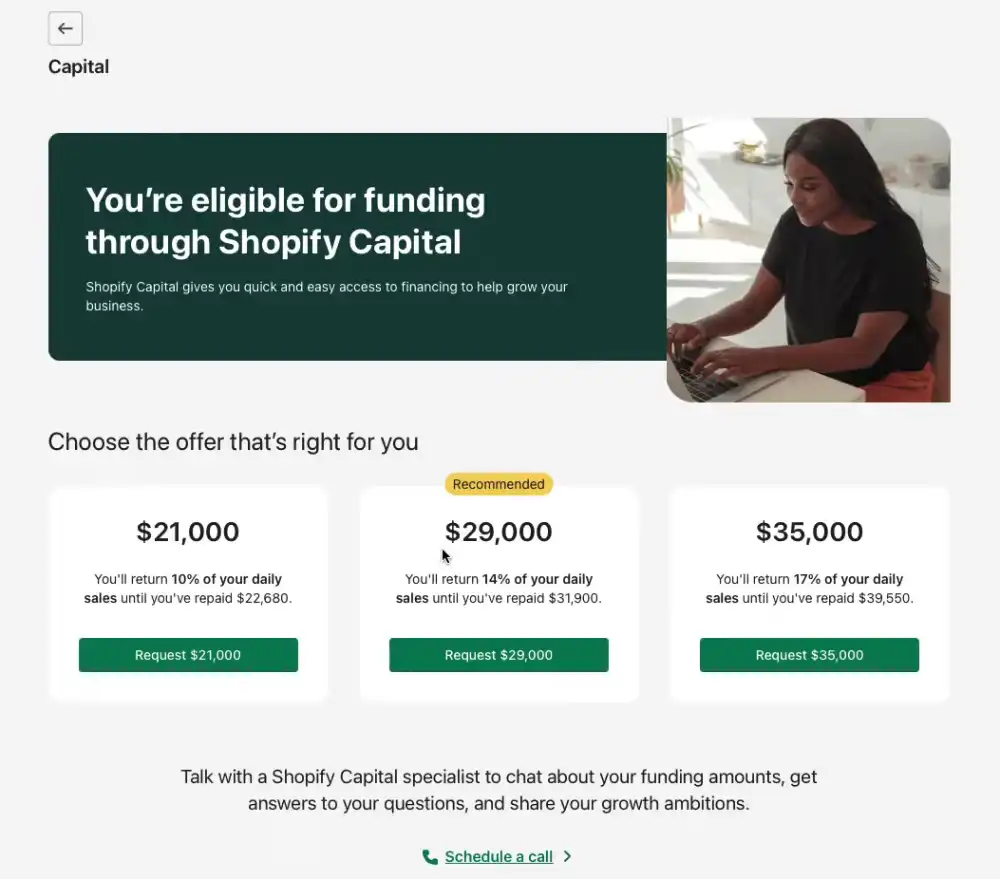
Repayment happens automatically as a fixed percentage of daily sales, commonly cited around 10%, though it can run as high as 17% depending on the specific offer.
On a zero-sales day, you owe nothing that day. For the loan product specifically, Shopify also requires a 60-day milestone: you must have repaid one-sixth of the total by each 60-day mark to stay on pace for the standard 12-month term.
We cross-referenced Shopify’s own official Shopify Capital documentation against the Federal Reserve’s Small Business Credit Survey data on factor-rate financing to build the cost examples below, since Shopify’s published mechanics and the real borrower cost data frequently diverge from the clean average numbers most reviews quote.
The Real Cost: Factor Rate Versus Effective APR
Shopify Capital does not charge interest. It charges a factor rate, a single fixed multiplier applied to the amount you borrow, and the total repayment never changes regardless of how quickly you pay it off.
Borrow $10,000 at a 1.15 factor rate and you owe $11,500 total, whether you repay it in three months or eighteen.
That fixed-cost structure is exactly what makes the real cost counterintuitive. Since the total fee is set in dollars, not as a percentage that accrues over time, repaying faster compresses the same fee into fewer days, which mathematically produces a higher annualized cost.
Repaying slower spreads that same fee over more days, producing a lower one. This is the opposite of how most business owners are used to thinking about repayment speed.
The table below shows this using the same advance and the same factor rate, varying only how fast it gets repaid.
| Repayment Speed | Advance | Factor Rate | Total Fee | Effective APR |
|---|---|---|---|---|
| 3 months | $50,000 | 1.13 | $6,500 | ~53% |
| 6 months | $50,000 | 1.13 | $6,500 | ~26% |
| 9 months | $50,000 | 1.13 | $6,500 | ~18% |
| 12 months | $50,000 | 1.13 | $6,500 | ~13% |
The dollar cost never moves. Only the annualized rate does, and it moves entirely based on how fast your daily sales happen to repay it, a variable you do not fully control once you accept the offer.
Real Cost by Store Stage
The factor rate a merchant is offered, and how fast that advance realistically gets repaid, both shift meaningfully with store size.
The table below uses typical, publicly reported ranges for each stage rather than a single average.
| Store Stage | Typical Advance | Typical Factor Rate | Typical Repayment Window | Realistic Effective APR |
|---|---|---|---|---|
| Small (under $15K/mo revenue) | $5,000 to $15,000 | 1.12 to 1.17 | 4 to 6 months | 30% to 45% |
| Growing ($15K to $75K/mo revenue) | $15,000 to $75,000 | 1.10 to 1.13 | 5 to 8 months | 20% to 30% |
| Established ($75K+/mo revenue) | $75,000 to $500,000+ | 1.09 to 1.12 | 6 to 12 months | 12% to 22% |
Smaller, newer stores tend to see both a higher factor rate and a faster forced repayment window, since lower daily sales volume means the fixed remittance percentage takes longer to reach the milestone thresholds relative to the total owed, which compounds into a meaningfully higher realistic APR at the small end of this table.
Established stores with a longer sales history and larger daily volume tend to see the lowest factor rates and the most room to stretch repayment across the fuller 12-month term.
Shopify Capital Alternatives, Compared Honestly
Shopify Capital’s real advantage is not cost. It is speed and access: no credit check, no application, and funds in days.
Several alternatives trade some of that speed for a meaningfully lower real cost, and which one makes sense depends on how urgently the capital is needed.
SBA loans carry the lowest real APR of any option here, typically 6% to 13%, but approval takes 6 to 8 weeks and requires a personal guarantee, which rules them out for anything but planned, non-urgent capital needs.
Bank lines of credit run a similar 8% to 15% APR range with revolving access, but require an existing banking relationship and solid credit history to qualify.
PayPal Working Capital and similar fixed-fee products fund in 1 to 3 days with mechanics close to Shopify Capital’s own factor-rate structure, making them a reasonable direct comparison specifically for merchants already processing meaningful volume through PayPal.
Revenue-based financing providers aimed at larger ecommerce brands, generally requiring $1M or more in annual revenue, commonly quote flat fees in the 2% to 8% range with 48 to 72 hour funding, which can undercut Shopify Capital’s effective APR meaningfully at that scale.
Eligibility and What Actually Disqualifies You
Shopify does not publish a minimum revenue threshold for the standard merchant cash advance.
Eligibility is determined algorithmically from your store’s sales consistency, order volume, dispute history, and account standing rather than a credit score, factors Shopify outlines in its own Shopify Capital eligibility documentation.
Capital Flex specifically requires US-based merchants with $50,000 or more in trailing 12-month GMV, a hard eligibility line rather than a soft guideline.
A store’s payment processor matters more than most merchants expect. Shopify Capital is built around Shopify Payments transaction data, so a store running primarily on a third-party gateway may see thinner offers or none at all, since Shopify has less direct visibility into that revenue.
Our Shopify transaction fees breakdown covers the tradeoffs of using Shopify Payments specifically, which is worth reading if this is a factor in your decision.
Common Complaints Worth Knowing Before You Accept
Merchant sentiment toward factor-rate financing products like Shopify Capital follows a documented pattern, not just anecdotal reviews.
The Federal Reserve’s Small Business Credit Survey found that net satisfaction among online lending borrowers, the category that includes merchant cash advances, fell from 15% to just 2% between 2023 and 2024, with 60% of these borrowers reporting that actual costs came in higher than expected.
That gap traces directly back to the factor rate structure covered above: a merchant who expects the advertised factor rate to behave like a simple percentage fee is genuinely likely to be surprised once repayment speed pushes the effective APR higher than anticipated.
Set expectations using the real APR at your likely repayment speed, not the factor rate alone, before accepting an offer.
Who Shopify Capital Actually Makes Sense For
Shopify Capital is a reasonable choice specifically for short-term, high-return needs where speed matters more than shaving a few points off the cost, restocking inventory ahead of a proven sales spike, or covering a cash flow gap you can see the other side of within a few months.
It is a poor fit for financing that will take a year or more to pay off, or for any purchase whose return does not clearly exceed the real APR shown in the tables above.
Before accepting an offer, calculate the actual effective APR at your expected repayment speed, not the advertised factor rate, and compare that number directly against at least one alternative from the table above.
If you are still deciding whether Shopify is the right platform for a growing business overall, our Shopify for small business guide and full Shopify review cover the broader platform decision this financing question sits inside.
FAQ’s
What is Shopify Capital?
Shopify Capital is Shopify’s built-in merchant financing program, offering a one-time merchant cash advance or a revolving Capital Flex line of credit, both invite-only and based on a store’s own sales data rather than a credit application.
How much does Shopify Capital really cost?
The real cost depends entirely on repayment speed, not just the factor rate. The same advance at the same factor rate can carry an effective APR anywhere from roughly 13% if repaid slowly over a year to over 50% if repaid quickly in a few months, since the total dollar fee is fixed regardless of timing.
Does paying back Shopify Capital early save money?
No. The total repayment amount is fixed by the factor rate at the time you accept the offer, so paying it back faster does not reduce the dollar cost. It only compresses that same fixed cost into fewer days, which raises the effective annualized rate.
Can I apply for Shopify Capital directly?
No. Shopify Capital is invite-only, and offers appear automatically in your Shopify admin based on your store’s sales history, order volume, and account standing. There is no application form to submit proactively.
What is Capital Flex?
Capital Flex is a revolving line of credit introduced in 2026, letting eligible merchants draw funds repeatedly without waiting for a new offer, unlike the one-time lump-sum merchant cash advance.
It is currently limited to US merchants with at least $50,000 in trailing 12-month GMV.
Is Shopify Capital better than a bank loan?
It depends entirely on urgency versus cost. A bank loan or SBA loan typically carries a lower real APR, often 6% to 15%, but takes weeks to approve and usually requires strong credit and a personal guarantee.
Shopify Capital funds in days with no credit check, at a real cost that is usually meaningfully higher.
Final Thoughts
Shopify Capital’s convenience is real, and so is its cost once the factor rate gets converted into an honest effective APR.
The number that matters is not what the offer screen shows, it is what that fixed fee works out to at your actual expected repayment speed, and that number is frequently higher than merchants assume going in.
Calculate the real APR before accepting any offer, and weigh it directly against at least one lower-cost alternative if the timeline allows.
For the broader picture of what running a store on Shopify actually costs beyond financing, our cost to start an online store guide and Shopify hidden downsides guide are good next stops.