
Wix’s marketing says it supports up to 50,000 products. What it does not say clearly is that the backend visibly slows down well before that number, that wholesale selling does not exist natively at all, and that the app ecosystem covering the gaps is a fraction of the size competitors offer.
This article names those limits directly, then covers what to actually do about each one.
Every limit below comes from Wix’s own documentation or from how the platform behaves in practice, not a competitor’s marketing framing.
Table of Contents
Key Takeaways
- Wix has no native B2B or wholesale pricing. Every wholesale feature comes from a third-party app costing an additional $49 a month or more on top of the Wix subscription itself.
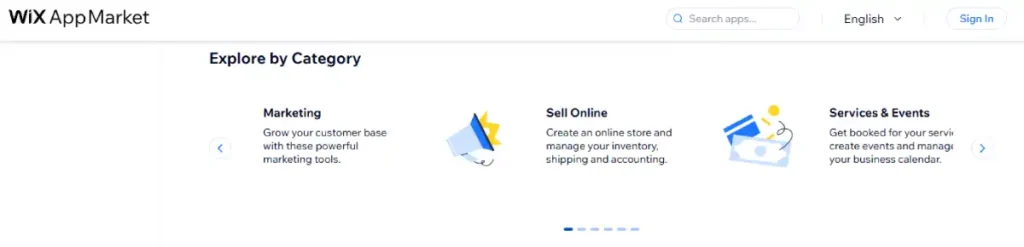
- The Wix App Market carries roughly 300 ecommerce-relevant apps against a competitor ecosystem of more than 17,000. A missing integration is often a dead end, not a workaround away.
- Wix advertises support for up to 50,000 products, but stores report visible backend slowdown starting around 5,000 SKUs, a tenth of the advertised ceiling.
- Products are capped at 1,000 variants and 6 options each. A product needing a seventh attribute cannot be built as one listing.
- Real-time carrier shipping is locked behind the Business plan. Core, the entry-level plan for selling, cannot pull live rates.
- There is no native multi-location inventory management for a business running more than one warehouse or a combined online and retail setup.
- Wix does not export site design or code. Leaving the platform means rebuilding the entire storefront by hand, your data comes with you, your design does not.
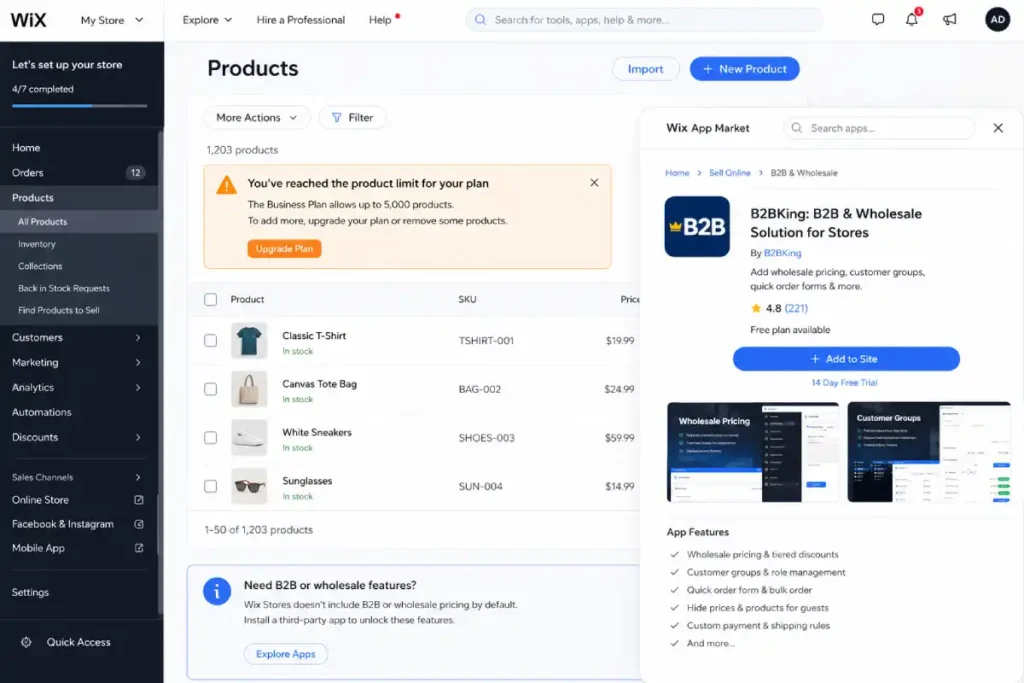
The Full List of Wix eCommerce Limitations
- No native B2B or wholesale pricing, requires a paid third-party app
- A thin app ecosystem, roughly 300 ecommerce apps versus competitors’ tens of thousands
- Backend performance degrades around 5,000 SKUs, well before the advertised 50,000-product ceiling
- A hard cap of 1,000 variants and 6 options per product
- Real-time carrier shipping rates locked behind the Business plan
- Several acknowledged shipping gaps even on the top plan: no minimum-order shipping rules, no scheduled pickup, no native label purchase via the app
- No native multi-location inventory tracking
- No export of site design or code, only product and customer data transfers to another platform
Summary Table: Limitation, Impact, and the Fix
| Limitation | Why It Is a Real Limitation | How to Overcome It |
|---|---|---|
| No native B2B or wholesale | Every wholesale feature, tiered pricing, customer groups, MOQs, is absent from the core platform | Install SparkLayer or B2B Wholesale Pricing from the App Market, budget $49+/month on top of your Wix plan |
| Thin app ecosystem (~300 vs 17,000+) | A missing integration for ERP, POS, or a specific marketplace channel has no build-your-own path on a closed platform | Audit every required integration before committing to Wix, not after. Check for a Zapier or Make.com bridge if no direct app exists |
| Backend slowdown near 5,000 SKUs | The 50,000-product ceiling is real but operationally irrelevant, slowdown hits at a tenth of that number | Archive discontinued products regularly, use collections to reduce concurrent catalog load, and plan a migration threshold before you approach 5,000 active SKUs |
| 1,000 variants, 6 options per product | A product needing a 7th attribute (common in apparel and fitment-based catalogs) cannot exist as one listing | Split into multiple products by the least-used attribute, or move non-inventory attributes (engraving text, gift notes) to modifiers instead of options |
| Real-time shipping gated to Business | Core, the plan marketed as the selling starting point, cannot calculate live carrier rates | Upgrade to Business if shipping cost accuracy matters, or use flat-rate bands calculated from your actual average package weight until you can upgrade |
| Shipping feature gaps on every plan | No minimum-order shipping rules, no scheduled pickup, no native label purchase via app | Fill specific gaps with a dedicated shipping app (ShipStation-style integrations connect to Wix) rather than waiting on a native fix |
| No multi-location inventory | A business with more than one warehouse or a blended online and retail setup cannot split stock counts natively | Add a dedicated inventory management app, or for two simple locations, reconcile manually with a shared spreadsheet and scheduled stock counts |
| No design or code export | Leaving Wix means a full manual storefront rebuild, not a data migration | Document your design (screenshots, a written style guide, exported brand assets) early, so a future rebuild starts faster regardless of when you eventually leave |
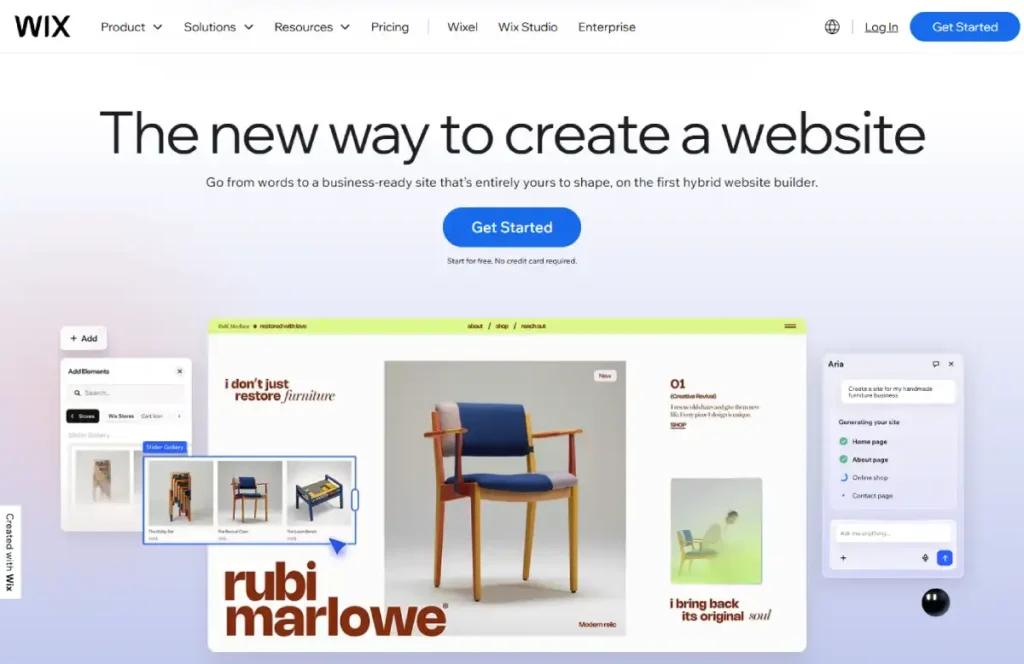
No Native B2B or Wholesale Selling
What it is. Wix Stores has no built-in wholesale pricing, no customer account groups, no tiered discounts, no minimum order quantity rules. None of it exists in the core platform.
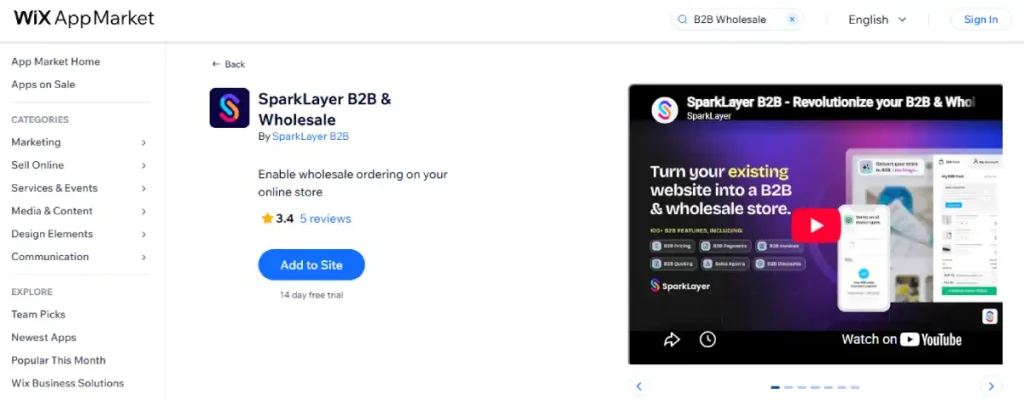
Why it is a real limitation. Every one of these features is a third-party app installation, most commonly the B2B Wholesale Pricing app or SparkLayer, both documented on Wix’s own support site as the way to add wholesale functionality.
SparkLayer’s paid plans start at $49 a month, a cost that sits completely on top of whatever Wix plan you are already paying for. A store running Business at $39 a month that also needs wholesale selling pays at least $88 a month before any other app.
How to overcome it. If wholesale is a core part of your business, budget the app cost from the start rather than discovering it after building the storefront.
Install SparkLayer or B2B Wholesale Pricing from the App Market, set up customer account groups through the app’s own onboarding, and treat the combined Wix-plus-app cost as your real monthly platform price, not the Wix subscription alone.
The App Market Is Thin
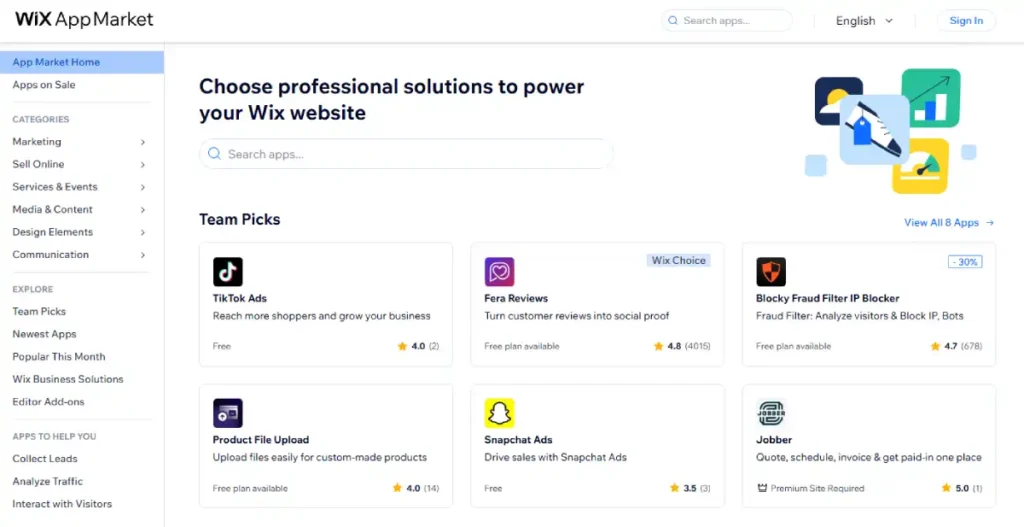
What it is. Wix’s App Market lists roughly 300 apps in ecommerce-relevant categories. Competing platforms list more than 17,000.
Why it is a real limitation. Specific categories feel this gap directly: ERP and inventory system connectors, advanced subscription billing beyond the basics, POS systems with real hardware and staff PIN support, and marketplace channel integrations for selling on Amazon, TikTok Shop, or Google.
Wix’s platform is closed in a way that does not allow a developer to build a custom integration the way an open platform does. A missing app is often the end of the conversation.
How to overcome it. Before committing to Wix, list every integration your operation actually needs and check the App Market for each one specifically, not just a general browse.
For gaps without a direct app, check whether Zapier or Make.com offers a workaround bridge between Wix and the missing tool. If a critical integration has no app and no automation bridge, that is a real signal to evaluate a different platform before building further.
The Product Ceiling Is Real, Just Earlier Than Advertised
What it is. Wix markets support for up to 50,000 products on its higher plans.
Why it is a real limitation. Store owners and agencies working with larger Wix catalogs report visible slowdown in the products backend, search, filtering, bulk editing, starting around 5,000 SKUs, roughly a tenth of the advertised ceiling.
The platform does not fail outright at that point, it becomes noticeably slower to manage, a real operational cost for any team updating a catalog daily.
How to overcome it. Archive discontinued or seasonal products rather than leaving them live indefinitely, keep active SKUs as lean as the business allows, and use collections and categories to reduce how much of the catalog loads at once during normal browsing and admin tasks.
If your catalog is already approaching 5,000 active SKUs and growing, plan your migration timeline now rather than after the slowdown becomes a daily frustration.
Variant and Option Limits, Stated Plainly
What it is. Wix caps products at 1,000 variants, 6 product options per product, and 100 choices per option, figures confirmed directly in Wix’s own support documentation.
Why it is a real limitation. A product needing a seventh distinct attribute, common in apparel with size, color, fit, fabric, length, and pattern, cannot be built as a single product.
Auto parts and fitment-based catalogs hit the 1,000-variant cap even faster, since a single product fitting hundreds of vehicle year and model combinations can exhaust the limit through fitment data alone.
How to overcome it. Split a product exceeding 6 options into multiple listings by the least customer-critical attribute, a shirt in 8 colors and 3 fits becomes two products by fit rather than one impossible product.
For attributes that do not affect inventory or price, engraving text, a gift message, a monogram, use Wix’s product modifiers instead of options, since modifiers do not count against the option or variant cap.
Shipping: Gated by Plan, and Gapped Even on the Best Plan
What it is. Real-time carrier rates from USPS, UPS, and FedEx require the Business plan. Even on Business, several shipping features remain unbuilt.
Why it is a real limitation. Core, the plan Wix positions as the starting point for selling, is limited to flat rate, weight-based, and price-based rules set manually.
A Core store shipping products of varying size and weight is either overcharging some customers or undercharging others.
On every plan, Wix’s own public feature request pages confirm gaps the platform has acknowledged but not built: no way to limit a shipping method by minimum order amount, no scheduled pickup time selection, no native shipping label purchase through the mobile app.
How to overcome it. If shipping accuracy is costing sales or margin on Core, the Business plan upgrade pays for itself quickly once volume is real.
Calculate your actual average shipping variance before assuming the upgrade is optional.
For the specific gaps that persist even on Business, a dedicated shipping app fills most of them, minimum order rules, scheduled pickup, and label batching, rather than waiting for a native Wix fix.
No Native Multi-Location Inventory
What it is. Wix Stores tracks one inventory count per product with no built-in way to split stock across locations.
Why it is a real limitation. A business selling from more than one warehouse, or running both an online store and a physical retail location with separate stock, cannot see or manage that split within Wix itself.
Overselling and stock discrepancies become a real operational risk without external tracking.
How to overcome it. For two simple locations, a shared spreadsheet with a fixed reconciliation schedule, checked daily or after each shift, closes the gap manually without added cost.
For anything more complex than two locations or meaningful order volume, a dedicated inventory app from the App Market is worth the subscription cost, since manual reconciliation error compounds quickly past a certain scale.
The Exit Cost: What Leaving Wix Actually Requires
What it is. Wix does not export site design or code. Product and customer data comes out as CSV files. The storefront itself does not transfer anywhere.
Why it is a real limitation. This is a fundamentally different kind of lock-in than an open platform where the underlying files can be downloaded and moved.
A store owner who spends a year building out a Wix storefront is committing that design work to a system with no exit path for it.
How to overcome it. Document your design as you build it, screenshots of every key page, a written style guide covering fonts and colors, and exported copies of any custom graphics or brand assets.
This does not eliminate the rebuild work on migration day, but it turns a from-scratch design project into a faster reconstruction with a clear reference to follow.
Treat the choice to build deeply on Wix as a long-term commitment from day one, not a temporary starting point.
FAQ’s
Does Wix support wholesale or B2B selling?
Not natively. Wix Stores has no built-in wholesale pricing, customer groups, or minimum order rules. B2B functionality requires a third-party app such as SparkLayer, which starts at $49 a month on top of the Wix subscription itself.
How many product variants does Wix allow?
Wix allows up to 1,000 variants per product, a maximum of 6 product options, and up to 100 choices per option. A product needing more than 6 distinct attributes has to be split into multiple listings.
Does Wix slow down with a large product catalog?
Yes, well before its advertised 50,000-product ceiling. Store owners commonly report the products backend, search, filtering, bulk editing, becoming noticeably slower starting around 5,000 SKUs.
How many apps does Wix have compared to competitors?
Wix’s App Market carries roughly 300 apps in ecommerce-relevant categories, against competitor ecosystems exceeding 17,000. Specific integrations, ERP connectors, advanced subscriptions, full POS systems, are far less likely to exist for Wix.
Does Wix support real-time shipping rates?
Only on the Business plan or higher. Core, Wix’s entry-level selling plan, is limited to flat rate, weight-based, and price-based shipping rules rather than live carrier rates from USPS, UPS, or FedEx.
Can I manage inventory across multiple locations on Wix?
Not natively. Wix Stores tracks one inventory count per product with no built-in support for splitting stock across multiple warehouses or a combined online and retail location setup. This requires a third-party inventory app.
Can I export my Wix store if I want to switch platforms?
Partially. Product and customer data exports as CSV. The site’s design, layout, and any custom sections built in Wix’s editor do not export at all and have to be rebuilt manually on the new platform.