
Our platform specialist has built and audited WooCommerce cost structures across 30+ stores, from $500/year solo operations to $60,000/year enterprise builds.
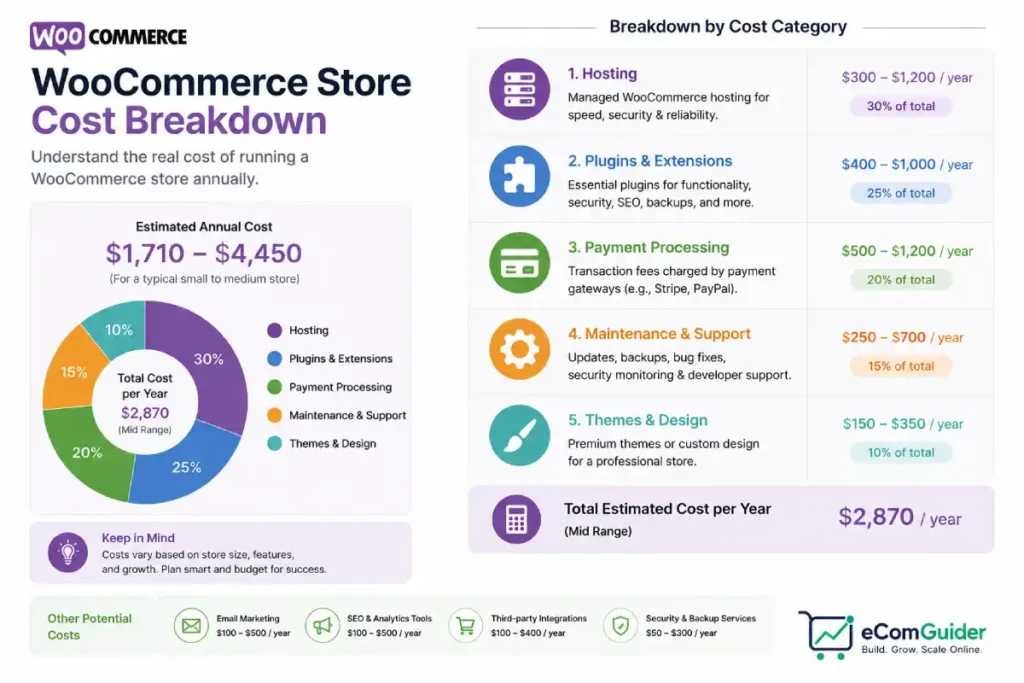
WooCommerce does not have a pricing page. That is not an oversight. WooCommerce is not selling you a product, you are assembling one from a free plugin, a hosting provider you choose, extensions from a marketplace, and developer time you either spend or pay for. Every one of those components has a different cost depending on how you configure it.
This is the pricing page that should exist. Real numbers, by store type, including what changes between year one and year two, and the specific points where WooCommerce becomes cheaper or more expensive than Shopify.
WooCommerce Cost Summary by Store Type
Before the breakdown, the short answer for each store profile:
| Store Type | Year 1 Annual Cost | Year 2 Annual Cost | Notes |
|---|---|---|---|
| Basic solo store, DIY management | $500-$1,200 | $800-$1,800 | Hosting renews at full rate; plugin renewals kick in |
| Growing brand, 200-1,000 orders/month | $2,500-$5,000 | $3,500-$7,000 | Support costs increase with order volume |
| Subscriptions or memberships included | $4,000-$9,000 | $5,500-$12,000 | Extension renewals and support complexity compound |
| Established store, managed care | $6,000-$15,000 | $7,000-$18,000 | Retainer, premium hosting, full plugin stack |
| Enterprise custom build | $20,000-$60,000+ | Similar or higher | Infrastructure and development dominate |
Year two consistently costs more than year one for most WooCommerce stores. The reasons are specific and predictable, and almost no WooCommerce cost guide documents them.
Layer 1: The WooCommerce Plugin
Cost: $0. This will always be $0.
WooCommerce is open-source and will remain so. Automattic, which owns WooCommerce, generates revenue through paid extensions, managed hosting, and WooPayments.
The full extension catalogue is available at the WooCommerce extensions marketplace. The plugin itself is the distribution mechanism for that ecosystem, not the product they are monetising.
What $0 actually means in practice: you get product listings, a cart, a checkout, basic order management, basic customer accounts, and a payment gateway connection point. You do not get subscriptions, advanced shipping rules, PDF invoices, bookings, memberships, or most of the features a real eCommerce operation requires. Those are in the next layer.
Layer 2: Hosting, The Cost That Determines Your Store’s Performance
Hosting is the single most consequential purchasing decision in a WooCommerce setup. Not your theme. Not your plugins. Your hosting.
We have migrated stores from shared hosting to managed WooCommerce hosting and recorded page load times dropping from 4.2 seconds to 1.1 seconds on the same codebase with no other changes.
On one specific store, that hosting upgrade at $120/month more produced a 17% improvement in completed checkouts and approximately $6,000 in additional monthly revenue.
Hosting Cost by Tier
| Hosting Type | Providers | Intro Rate | Renewal Rate | Best For |
|---|---|---|---|---|
| Shared WordPress | Bluehost, Hostinger, SiteGround | $1.99-$2.95/month | $8.99-$13.99/month | Testing only |
| Managed WordPress | SiteGround Go, WP Engine Starter | $15-$30/month | $25-$40/month | Under 200 orders/month |
| Managed WooCommerce | Nexcess, Pressable, Kinsta | $25-$80/month | Same (no intro trap) | 200-5,000 orders/month |
| Dedicated / Cloud VPS | Cloudways, DigitalOcean, WP Engine Scale | $80-$300+/month | Same | 5,000+ orders/month |
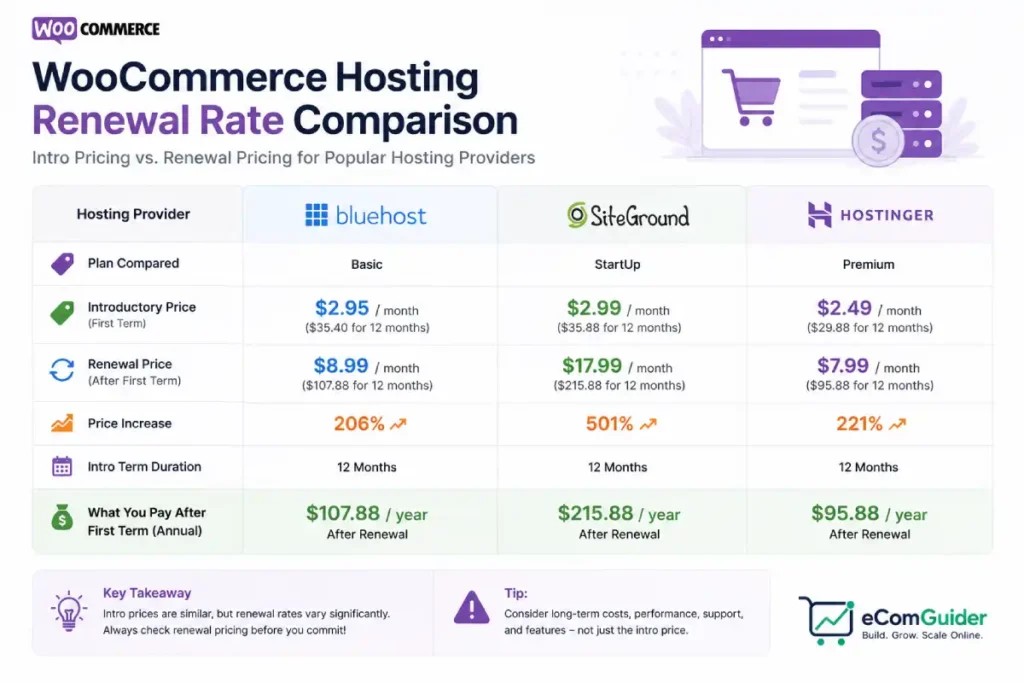
The renewal rate trap nobody warns you about. Shared and managed WordPress hosts advertise introductory rates that are 40-70% below renewal rates. Bluehost’s most promoted plan runs $2.95/month for the first term and renews at $9.99/month. SiteGround’s entry plan goes from $2.99/month to $13.99/month at renewal. Hostinger from $1.99 to $8.99.
A store owner who budgets $36/year for hosting based on the advertised rate pays $120-$168/year from year two onward. That is a 3x to 4.7x increase that appears on a renewal invoice with two weeks’ notice.
Managed WooCommerce providers like Nexcess and Pressable do not use introductory rate models. What you pay in month one is what you pay in month thirteen. For a store planning to be in operation for more than a year, the total cost comparison between shared-with-renewal-rate and managed-WooCommerce is often closer than it appears from the headline prices.
Layer 3: Essential Plugins, The Unavoidable Stack
WooCommerce core covers the basics. Most real stores need a minimum plugin stack that covers the gaps.
The Core Stack Most Stores End Up Running
| Plugin Category | Free Option | Paid Option | Annual Cost (Paid) |
|---|---|---|---|
| SEO | Yoast Free | Yoast Premium / Rank Math Pro | $89-$229 |
| Security + firewall | Wordfence Free | Wordfence Premium | $119 |
| Backups | UpdraftPlus Free | UpdraftPlus Premium | $70-$145 |
| Caching + performance | WP Super Cache (free) | WP Rocket | $59-$99 |
| PDF invoices | Basic free options | YITH or WooCommerce PDF Invoices | $79-$129 |
| Core stack total | $416-$721/year |
Specialist Plugins by Store Type
| Store Type | Required Plugins | Additional Annual Cost |
|---|---|---|
| Subscriptions store | WooCommerce Subscriptions | $199 |
| Bookings business | WooCommerce Bookings | $249 |
| Memberships | WooCommerce Memberships | $199 |
| B2B wholesale | WholesaleX or B2BKing | $149-$199 |
| Multi-currency / international | WPML + currency switcher | $99-$299 + $79-$149 |
| Tax automation | TaxJar or Avalara | $228-$1,188 |
A subscriptions store running the core stack plus WooCommerce Subscriptions pays $615-$920/year in plugins before hosting, developer time, or payment processing.
The plugin renewal discount trap. Several WooCommerce extensions offer a first-year discount at purchase. WooCommerce’s own extensions sometimes run 30-50% off at launch. Year one: $99. Year two renewal: $199. Stores that buy during sales and budget based on the sale price get a surprise at renewal. Read the renewal pricing on every extension before you buy it.
Layer 4: Payment Processing, The Fee Everyone Forgets
WooCommerce does not charge transaction fees. The payment processors you connect to it do.
Processing Rate Comparison at $10,000 Monthly Volume
| Processor | Rate | Monthly Fee at $10K volume | Annual Processing Cost |
|---|---|---|---|
| Stripe | 2.9% + $0.30 | $290 + per-transaction | $3,480+ |
| PayPal Checkout | 3.49% + $0.49 | $349+ | $4,188+ |
| WooPayments (Stripe-based) | 2.9% + $0.30 (US) | $290+ | $3,480+ |
| Shopify Payments (for comparison) | 2.6% + $0.10 (Basic) | $260+ | $3,120+ |
Payment processing is the largest ongoing cost for most WooCommerce stores at meaningful revenue, and it scales linearly with volume. At $10,000/month, Stripe costs approximately $3,480/year. At $50,000/month, that is $17,400/year. These numbers dwarf hosting and plugin costs.
The Shopify transaction fee comparison. Shopify charges an additional fee, 0.5% to 2% depending on plan, when you use a payment processor other than Shopify Payments. WooCommerce charges no such fee regardless of processor choice. At $10,000/month in sales on Shopify Basic with a third-party processor, that 2% surcharge costs $200/month, $2,400/year, on top of the processor’s own fees.
WooCommerce users pay only the processor rate, no surcharge for using Stripe, PayPal, or any other gateway. For a full breakdown of Shopify’s fee structure by plan, see our Shopify transaction fees guide.
Layer 5: Developer and Maintenance Time
This is the layer every competitor omits because it is uncomfortable to quantify. We are going to quantify it.
A WooCommerce store requires recurring developer involvement at a frequency and cost that depends on store complexity:
| Task | Frequency | Developer Time | Cost at $85/hour |
|---|---|---|---|
| Major WooCommerce core update with testing | Quarterly | 1-3 hours | $85-$255 |
| Plugin conflict diagnosis and resolution | 1-3x per year | 2-6 hours | $170-$510 |
| Performance optimisation review | 2x per year | 2-4 hours | $170-$340 |
| Security incident response | Varies | 4-16 hours | $340-$1,360 |
| Custom code compatibility after updates | Varies | 2-8 hours | $170-$680 |
A store with no custom code, running a managed update service, and experiencing one plugin conflict per year spends $500-$1,200/year in developer time. A store with custom code, doing its own updates, and experiencing one security incident spends $2,000-$5,000/year.
The $39-$100/month managed update service covers routine updates, backups, and basic monitoring. It does not cover plugin conflicts, custom code maintenance, or incident response. Those remain reactive costs.
For a detailed breakdown of what WooCommerce maintenance costs and what each service tier covers, see our WooCommerce maintenance cost guide.
WooCommerce vs Shopify: The Break-Even Analysis
At what revenue level does WooCommerce’s total cost of ownership become lower than Shopify’s?
The comparison depends on which Shopify plan and which payment setup you are using. Here is the calculation using the most common scenario: Shopify Basic with Shopify Payments versus WooCommerce with Stripe.
Shopify Basic annual cost at different revenue levels:
| Monthly Revenue | Shopify Basic Sub | Processing (2.9%+$0.10) | Annual Total |
|---|---|---|---|
| $2,000/month | $468 | $720+ | $1,188+ |
| $5,000/month | $468 | $1,740+ | $2,208+ |
| $10,000/month | $468 | $3,480+ | $3,948+ |
| $25,000/month | $468 | $8,700+ | $9,168+ |
WooCommerce annual cost at the same revenue levels (managed hosting, core plugin stack, Stripe):
| Monthly Revenue | Hosting | Plugins | Processing (2.9%+$0.30) | Maintenance | Annual Total |
|---|---|---|---|---|---|
| $2,000/month | $600 | $500 | $720+ | $500 | $2,320+ |
| $5,000/month | $900 | $700 | $1,740+ | $800 | $4,140+ |
| $10,000/month | $1,200 | $900 | $3,480+ | $1,200 | $6,780+ |
| $25,000/month | $2,400 | $1,000 | $8,700+ | $2,400 | $14,500+ |
Reading the table honestly: Shopify Basic with Shopify Payments is cheaper than WooCommerce at every revenue level shown when WooCommerce includes managed hosting and professional maintenance.
The break-even calculation shifts significantly when you factor in the third-party processor surcharge (Shopify adds 2% on Basic), the Shopify subscription increasing to $105/month on the Grow plan, or the store outgrowing Basic plan features.
The revenue level at which WooCommerce makes financial sense is not primarily about processing fees.
It is about the customisation requirements and data ownership needs that Shopify cannot meet at any price, or cannot meet without Shopify Plus at $2,300/month minimum.
For the full Shopify cost picture including plan fees, transaction rates, and app costs, see our Shopify for small business guide.
What Year Two Actually Costs
Year one WooCommerce budgets are usually built around promotional rates. Year two is the honest cost.
What changes in year two:
Hosting renewal rates apply. A store on Bluehost’s introductory rate goes from $36/year to $120-168/year. A store on SiteGround’s entry plan goes from $36 to $168/year.
Plugin renewals apply at full rate. Any plugin purchased during a promotional sale renews at standard pricing.
WooCommerce Subscriptions at $99 during a sale renews at $199. The $100 difference compounds across every extension in the stack.
Support needs increase with order volume. A store that launched with 50 orders a month is often running 300-500 orders a month by year two.
That volume increase brings support complexity, performance demands, and plugin maintenance overhead that did not exist at launch.
Realistic year-two cost increase by store type:
| Store Type | Year 1 Cost | Year 2 Cost | Increase |
|---|---|---|---|
| Basic DIY store | $700 | $1,200 | +71% |
| Growing brand, managed hosting | $3,500 | $5,000 | +43% |
| Subscriptions store | $5,500 | $8,000 | +45% |
| Established with retainer | $9,000 | $11,500 | +28% |
The percentage increase narrows as store sophistication grows because mature stores are already paying realistic rates in year one rather than benefiting from introductory pricing.
How to Build an Honest WooCommerce Budget
Step 1: Choose hosting at renewal rate, not intro rate. Budget for what you will pay in month 13, not month one. If shared hosting is actually appropriate for your stage, use the renewal rate. If managed WooCommerce hosting is the realistic target, budget for it from the start.
Step 2: List every plugin you need before you start. Map your required functionality to specific extensions. Sum the annual renewal rates, not the first-year sale prices. Add 20% for plugins you will discover you need after launch.
Step 3: Put developer time in the budget. At minimum, budget $500-$800/year for a small store on a self-managed update approach. Budget $2,400-$5,000/year if you plan to use a managed maintenance service.
Step 4: Calculate your payment processing cost at projected revenue. Use your realistic monthly revenue target and multiply by your processor rate. This number will likely be the largest line item once you are trading at any meaningful scale.
Step 5: Build the year-two budget before you launch. This takes 20 minutes. Look at your hosting renewal rate, your plugin renewal rates at standard pricing, and your estimated order volume growth. The year-two number is the one that determines whether WooCommerce is financially sustainable for your operation.
For context on total eCommerce startup costs across all platform options, see our cost to start an online store guide. For the full WooCommerce platform picture beyond cost, including which store types benefit most from it, see our complete WooCommerce review.
FAQ’s
How much does WooCommerce cost per year?
WooCommerce costs between $500 and $60,000+ per year depending on store complexity. A basic self-managed store on shared hosting with a minimal plugin stack costs $500-$1,200 in year one, rising to $800-$1,800 in year two. A growing brand with managed hosting, a full plugin stack, and professional maintenance typically costs $3,500-$7,000/year. Stores with subscriptions, memberships, or custom development cost $5,000-$15,000/year at an established scale.
Is WooCommerce really free?
The WooCommerce plugin is free. Running a WooCommerce store is not. Hosting starts at $100-$600/year at realistic renewal rates, essential plugins cost $400-$900/year, payment processing costs 2.9-3.5% of revenue, and developer or maintenance time adds $500-$5,000/year depending on who manages the store. A store owner who budgets $0 for WooCommerce based on the plugin price will spend $500-$3,000 before their first sale.
What is the cheapest way to run WooCommerce?
The cheapest sustainable WooCommerce setup for a real store: managed WordPress hosting at $15-$25/month ($180-$300/year at renewal), a minimal plugin stack using free tiers where available ($0-$200/year), Stripe for payment processing (2.9% + $0.30), and self-managed updates with a staging environment. Total: $380-$700/year before processing fees. This requires technical competence. Non-technical store owners who skip professional maintenance typically pay more in emergency developer fees than a managed service would have cost.
Why does WooCommerce cost more in year two?
Three factors drive year-two cost increases: shared hosting introductory rates expire and renewal rates are 3-5x higher, plugin sales prices from year one renew at standard pricing, and order volume growth increases hosting and support requirements. Most WooCommerce cost guides show year-one promotional budgets. Year two is the realistic operating cost.
Is WooCommerce cheaper than Shopify?
It depends on your Shopify plan, payment setup, and WooCommerce configuration. At most revenue levels, Shopify Basic with Shopify Payments is cheaper than a professionally managed WooCommerce store.
The comparison shifts when Shopify’s third-party processor surcharge applies (2% extra on Basic), when growth moves you to the $105/month Grow plan, or when customisation needs reach Shopify Plus at $2,300/month. WooCommerce is not inherently cheaper; it is more configurable, and that configurability can produce a lower total cost for the right store at the right scale.
What WooCommerce plugins do I actually need?
Every serious WooCommerce store needs at minimum: a security plugin (Wordfence free tier), a backup plugin (UpdraftPlus free or paid), an SEO plugin (Yoast or Rank Math), and a caching plugin (WP Rocket or WP Super Cache). Stores selling subscriptions need WooCommerce Subscriptions ($199/year). Stores with appointment-based products need WooCommerce Bookings ($249/year). Beyond the core stack, plugin requirements vary entirely by what your store actually does.
Does WooCommerce charge transaction fees?
WooCommerce itself charges no transaction fees. Your payment processor charges its standard rate. Stripe costs 2.9% + $0.30 per transaction in the US. PayPal costs 3.49% + $0.49. WooPayments, WooCommerce’s native payment solution, uses Stripe’s infrastructure at similar rates.
This is a genuine advantage over Shopify, which charges an additional 0.5-2% surcharge on top of processor fees when you do not use Shopify Payments.
WooCommerce cost planning is not a one-time exercise. Run your budget annually using the five-layer framework above. Your year-two costs will differ from year one in predictable ways.
Budget for them now and they stay predictable. Ignore them and they arrive as surprises. For the full platform picture beyond cost, see our complete WooCommerce review.