
Most Shopify theme roundups group picks by price tag: free themes in one bucket, premium themes in another. That misses the two things that actually decide whether a theme works for your store: whether it’s built for your product type, and whether it stays fast once you add real product photos, apps, and traffic.
This guide reviews 23 themes across three lenses at once: store type (free starter vs. premium flagship vs. large-catalog), niche fit (fashion, beauty, electronics, food, single-product, wholesale), and speed, since a beautiful theme that loads slowly costs conversions no design can make up for.
One thing worth knowing before you start comparing: most of Shopify’s free themes share the same underlying code as Dawn, so the “which free theme is fastest” question has a simpler answer than most guides let on, covered in the free section below.
In this guide, you’ll learn which theme fits your store type and niche, what actually differs between similar-looking options, and which common theme-shopping habits waste money without improving conversion.
Table of Contents
Key Takeaways
- Nine of Shopify’s official free themes (Dawn, Craft, Sense, Refresh, Origin, Colorblock, Taste, Publisher, and a few others) share Dawn’s core codebase. They differ in default presets and section styling, not underlying speed or capability.
- Premium Shopify Theme Store themes typically run $340 to $450 as a one-time purchase, not a subscription, and often replace 3 or more paid conversion apps.
- A theme choice matters less than most merchants assume for raw speed. Page weight added later by apps, large uncompressed images, and third-party scripts usually costs more speed than the theme itself.
- Store type matters more than aesthetics. A jewelry brand and a wholesale electronics store need fundamentally different navigation, filtering, and image-display logic, not just a different color palette.
- Switching themes later is possible without losing products, orders, or customer data, but restyling takes real time. Pick a theme that can grow with the store for at least 12 to 18 months.
Quick Comparison: 23 Shopify Themes
| Theme | Store Type / Niche | Price | Standout Trait |
|---|---|---|---|
| Dawn | Free, universal starting point | Free | Fastest baseline, Dawn’s core codebase |
| Craft | Free, artisan and maker brands | Free | Storytelling sections, generous spacing |
| Sense | Free, beauty and wellness | Free | Soft visuals, dropshipping-friendly |
| Refresh | Free, active and wellness | Free | Energetic, supplement and fitness fit |
| Origin | Free, heritage and traditional goods | Free | Classic typography, trust signaling |
| Colorblock | Free, bold fashion, large catalogs | Free | Grid layout, mega menu, youth-leaning |
| Taste | Free, food and beverage | Free | Editorial food imagery |
| Publisher | Free, content-led and art brands | Free | Long-form storytelling sections |
| Impulse | Premium, high-volume fashion | ~$380-450 | Promotion tiles, mega menu, filters |
| Prestige | Premium, luxury brand storytelling | ~$380-400 | 30+ sections, editorial layouts |
| Motion | Premium, video-forward visual brands | ~$400-420 | Built-in animation and video |
| Symmetry | Premium, versatile + in-person retail | ~$380-420 | Pairs with Shopify POS |
| Broadcast | Premium, content-led trust building | ~$420 | Advanced announcement bar, unique collections |
| Empire | Premium, marketplace-style large catalog | ~$340 | Amazon-style discovery and filtering |
| Warehouse | Premium, electronics and technical goods | ~$300-400 | Clear categorization for large SKU counts |
| Pipeline | Premium, luxury clothing and lookbooks | ~$360 | Image-first, mobile-optimized |
| Ella | Premium, beauty and jewelry | ~$300-380 | Soft, feminine aesthetic presets |
| Xtra | Premium, single product or small catalog | ~$100 | Budget-friendly, testimonial-focused |
| Debutify | Premium, dropshipping subscription hybrid | Subscription | Theme + built-in conversion app suite |
| Booster | Premium, conversion-optimized dropshipping | ~$150-300 | 30+ built-in conversion tools, sub-2s loads |
| Local | Premium, food and in-person retail | ~$380 | Built for restaurants and local pickup |
| Shoptimized | Premium, paid-traffic CRO specialist | ~$200-300 | Community-built for direct-response funnels |
| Vision | Premium, video-embed heavy niches | ~$300-380 | Native video embeds for beauty and tech |
What Makes a Good Shopify Theme?
Most theme comparisons default to a features checklist: does it have quick view, does it have a mega menu, does it support video. That’s a starting point, not the real evaluation.
The first real test is whether the theme is built on Online Store 2.0 architecture. Every theme in this guide is, which means section-based editing on every page type, not just the homepage. Older Vintage-era themes still circulating on third-party marketplaces lack this, and merchants who buy one often discover they can’t rearrange content without a developer.
The second test is catalog fit. A theme that looks clean with 12 products in a demo can break down at 500, if its filtering, search, and collection navigation weren’t built for scale. Checking a theme’s actual behavior at your realistic catalog size, not the demo size, is the detail most guides skip.
Something worth knowing before comparing individual themes: several of Shopify’s own free themes, including Craft, Sense, Refresh, Origin, Colorblock, and Taste, run on the same core code as Dawn.
The differences are in default presets, section styling, and content focus, not underlying page weight or speed. That means choosing between them is really a design decision, not a performance one, and any of them can be restyled to resemble the others in the theme editor.
How These Themes Were Evaluated
We weighed each theme against four criteria: Online Store 2.0 compatibility and section flexibility, real-world speed behavior (not just demo-store Lighthouse scores), fit for a specific store type or niche rather than generic versatility claims, and total cost of ownership including which paid apps a theme’s built-in features let a merchant skip.
Pricing and feature claims were cross-referenced against the Shopify’s transaction fees breakdown and the best Shopify apps guide, since a theme with strong built-in conversion features can reduce a store’s total app spend meaningfully at the starter and growing stages.
Free Themes: The Fastest Way to Launch
All eight free themes below run Shopify’s Online Store 2.0 architecture and share a fast baseline. The real decision is which default aesthetic and section set is closest to the store being built, since customizing away from a mismatched preset costs more time than starting with the closer match.
Dawn: Best for a Fast, Universal Starting Point
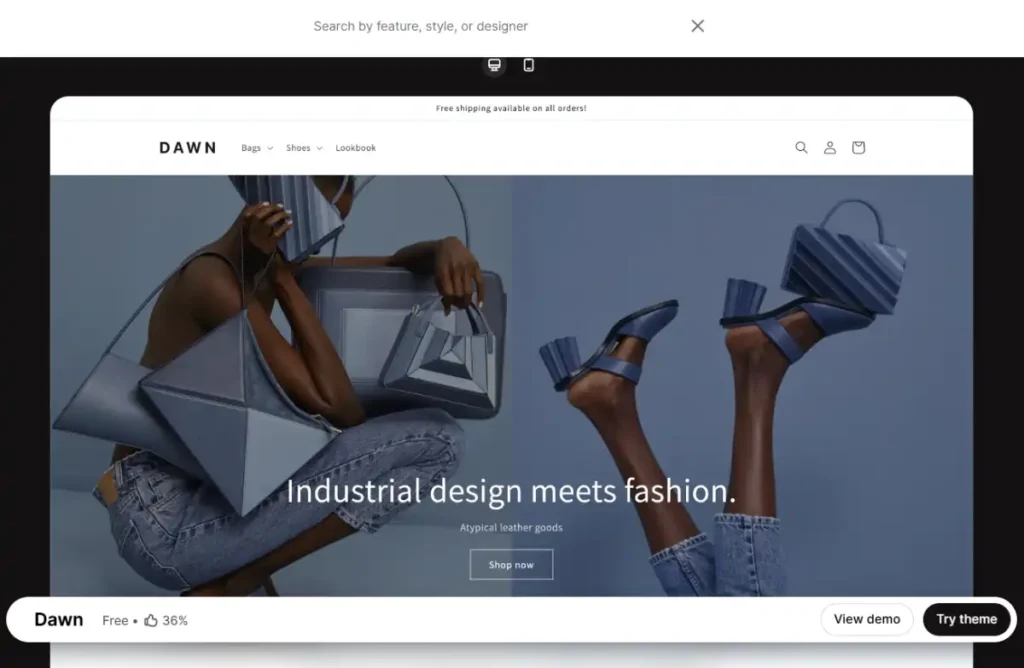
Dawn is Shopify’s flagship free theme and the foundation nearly every other free theme is built on. Its minimal, content-first layout keeps large product images and lifestyle photography front and center without extra code weight slowing things down.
Because Shopify maintains Dawn directly as the reference implementation for Online Store 2.0, it tends to receive new platform features and performance improvements before any other theme, making it the safest long-term foundation for a growing store.
Key Features
Section-based editing everywhere: Rearrange content blocks on any page type, not just the homepage, without touching code.
Media-rich product pages: Native support for video and 3D model embeds directly on product pages.
Related products: Basic but effective cross-selling built in, without a separate upsell app.
Clean, minimal typography: Works across nearly any product category without looking generic.
First access to new Shopify features: As Shopify’s reference theme, Dawn typically gets platform updates and performance improvements before other themes.
Pros
- The fastest baseline among Shopify’s official themes, which benefits both SEO and conversion.
- Free and constantly updated, with the largest base of tutorials and community support of any Shopify theme.
Cons
- The minimal design has limited “luxury” or bold editorial styling out of the box; brands wanting that look may prefer Colorblock or a premium theme instead.
- Genuinely custom visual identity requires more theme-editor work than a theme with a bolder default preset.
Who It’s Best For
New stores, budget-conscious merchants, and any store type willing to invest theme-editor time into customization rather than relying on a bold default look.
Pricing
Free.
Craft: Best for Artisan and Maker Brands
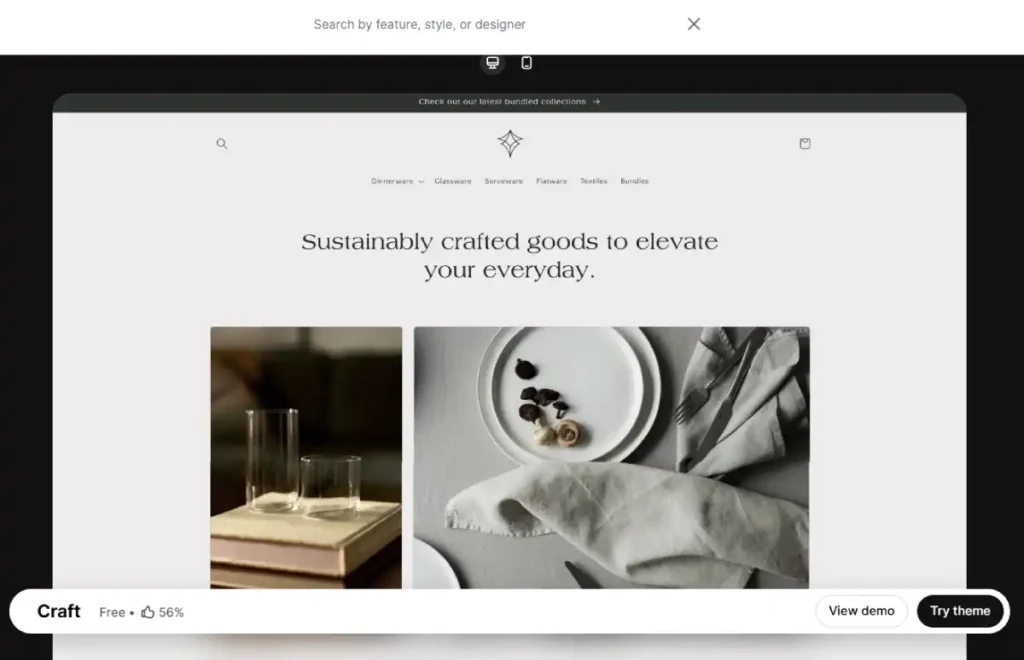
Craft shares Dawn’s core code but leans into generous spacing and elegant serif typography that lets handmade and artisanal products carry the page.
Merchants selling pottery, leather goods, or small-batch food products consistently favor it for the storytelling sections built into product and collection templates.
Its default presets emphasize process photography and maker narratives over dense product grids, suiting brands where the story matters as much as the product, and it inherits Dawn’s performance characteristics at no speed cost.
Key Features
Storytelling-first sections: Built-in blocks for maker stories and process photography, not just product grids.
Generous whitespace: Reduces visual clutter around handmade or textured products that benefit from breathing room.
Serif typography preset: Signals craftsmanship and premium positioning without a paid theme’s price tag.
Same Dawn-level speed: Shares Dawn’s underlying performance since it’s built on the same codebase.
Flexible product page templates: Supports multiple layout variants for showcasing process and materials alongside the product itself.
Pros
- Free artisanal aesthetic that would otherwise require a paid theme or custom design work.
- Storytelling sections are genuinely built for maker narratives, not generic “About Us” blocks.
Cons
- The aesthetic leans specifically toward handmade and premium DTC; it’s a mismatch for high-volume, low-price catalogs.
Pricing
Free.
Sense: Best for Beauty and Wellness, Including Dropshipping
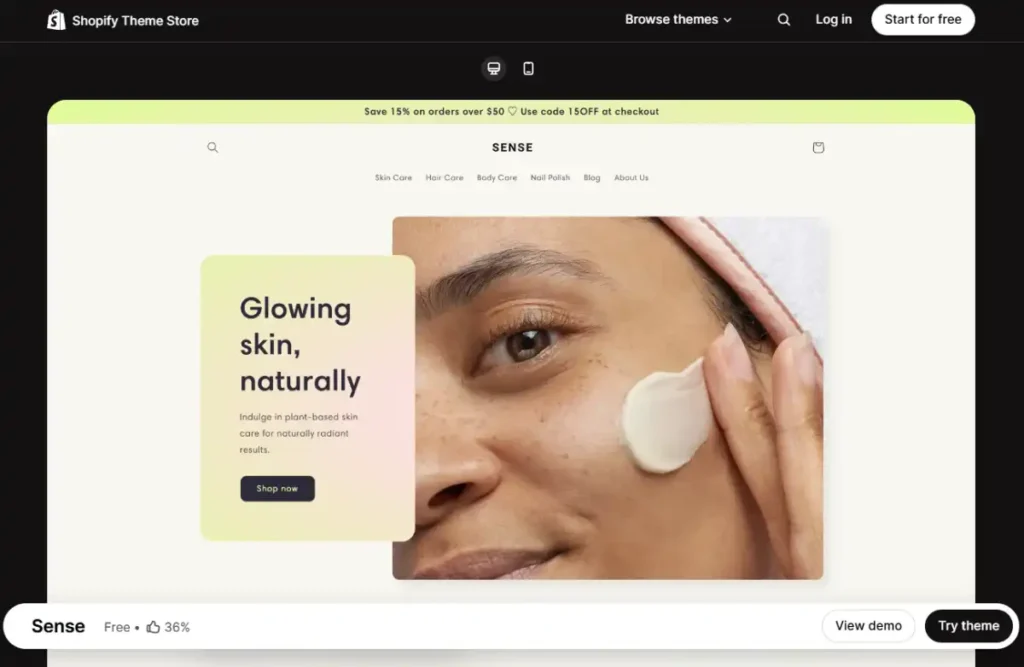
Sense’s bright, soft visual language and curved section elements were built with beauty and wellness brands in mind, though its clean layout and trust-building features have also made it a popular pick for new dropshipping stores wanting a credible-looking launch.
The Sense theme default color palette and imagery-forward homepage sections work particularly well for skincare, supplements, and self-care products, and its built-in trust and recommendation blocks help a brand-new store feel more established to a first-time visitor.
Key Features
Soft, gradient-forward presets: Default color and section styling suited to beauty, skincare, and wellness positioning.
Trust-building layout blocks: Built-in sections designed to build credibility for a brand with no prior reputation.
Product recommendation blocks: Increase browsing depth with related and recommended product sections.
Mobile-first section design: Presets are tuned for the mobile browsing behavior common among beauty and wellness shoppers.
Compatible with common review app widgets: Layout accommodates star ratings and testimonial blocks without custom code.
Pros
- Purpose-built beauty and wellness aesthetic without custom design cost.
- Strong track record among new stores needing to establish credibility quickly.
Cons
- The soft aesthetic is a poor fit for technical, industrial, or bold-statement product categories.
Pricing
Free.
Refresh: Best for Active, Wellness, and Supplement Brands
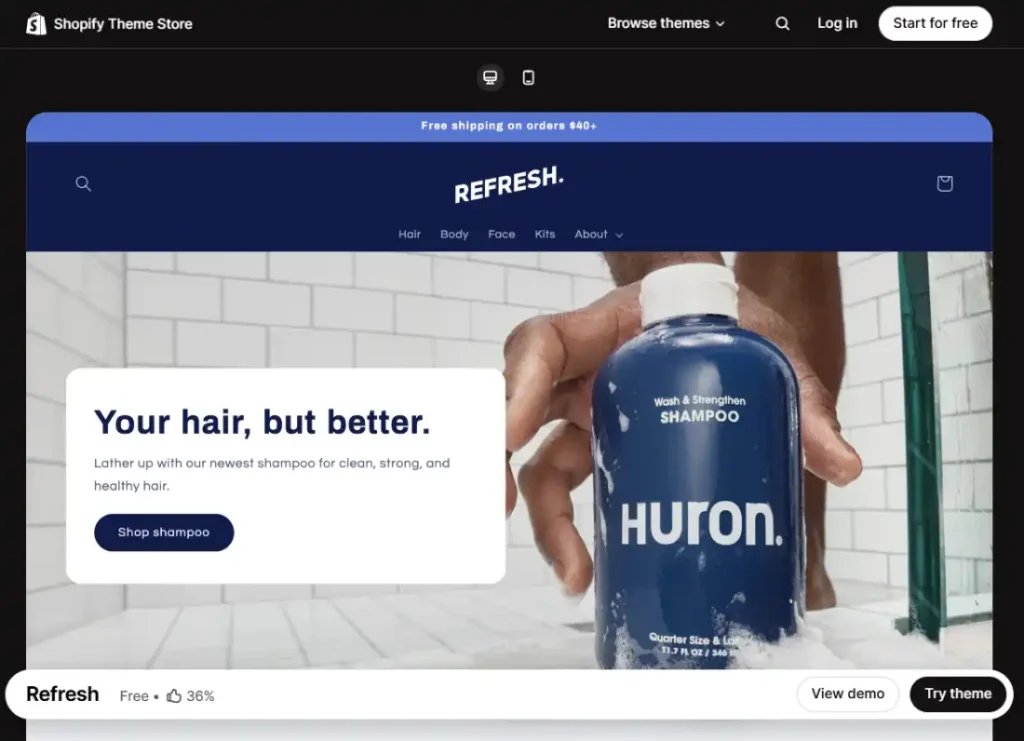
Refresh brings an energetic, vitality-forward aesthetic well suited to fitness, supplement, and active lifestyle brands, using the same fast Dawn-based foundation with a bolder default color palette.
Where Sense leans soft and calming, Refresh leans bright and kinetic, with section presets built around movement, energy, and results-driven messaging that fitness and supplement brands typically want to convey.
It’s a strong pick for stores selling protein powders, activewear, or fitness equipment that want that energy without paying for a premium theme.
Key Features
Energetic default presets: Bold color choices suited to fitness, supplements, and active lifestyle positioning.
Same performance foundation as Dawn: No speed tradeoff for the bolder visual style.
Flexible section library: Full Online Store 2.0 section flexibility across every page.
Ingredient and results-focused product blocks: Section options built for communicating product benefits and results.
Strong mobile optimization: Designed with the mobile-heavy traffic pattern typical of fitness and wellness brands in mind.
Pricing
Free.
Origin: Best for Heritage and Traditional Goods Brands
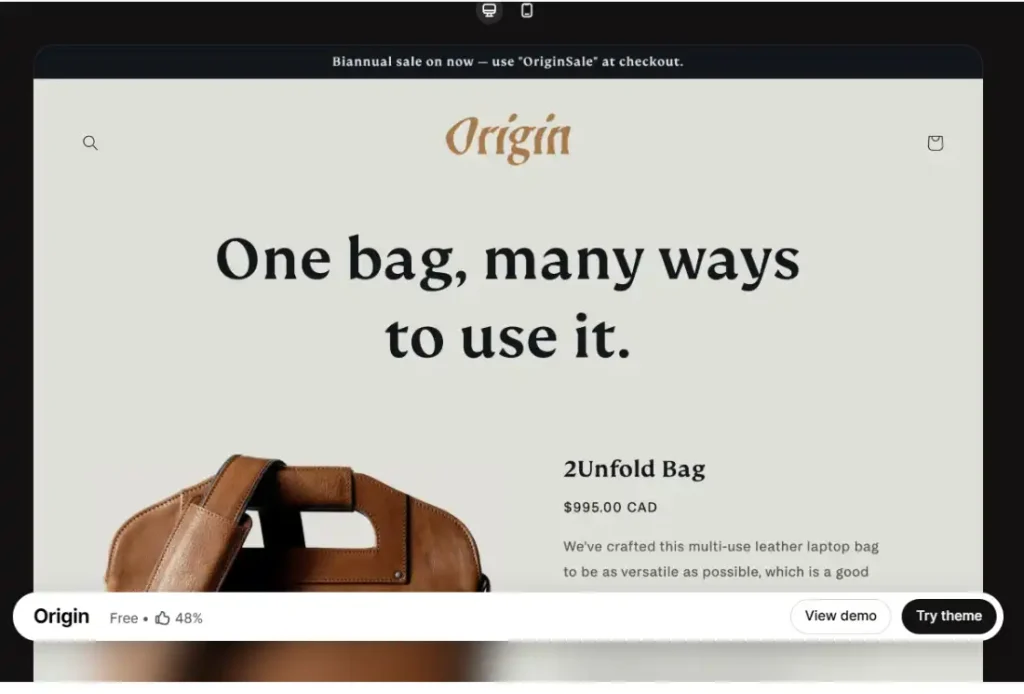
Origin conveys trust and established credibility through classic typography and a neutral color palette, which suits family businesses, heritage brands, and traditional or artisanal product categories that want to signal longevity rather than trend-forward design.
Rather than chasing a visual trend, Origin’s default styling reads as timeless, making it a strong base for brands whose story centers on tradition, craftsmanship, or generational history rather than novelty.
Key Features
Classic typography preset: Signals heritage and trust rather than trend-driven styling.
Neutral color foundation: Works as a base for brands with an existing color identity to layer on top.
Same Dawn-level performance: Full speed parity with Dawn’s codebase.
Story-forward homepage sections: Built-in blocks suited to founder history and heritage narratives.
Timeless design approach: Avoids trend-specific styling that can date quickly, unlike bolder theme presets.
Pricing
Free.
Colorblock: Best for Bold Fashion and Large Catalogs
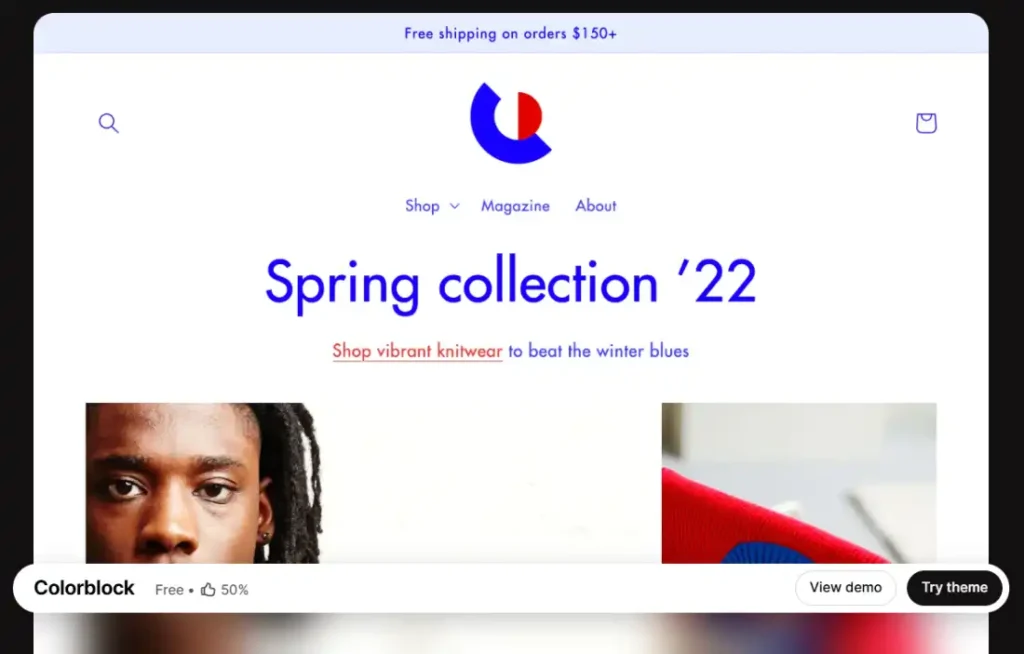
Colorblock’s confident typography and color-blocked sections give it a lookbook feel most free themes can’t match, and it supports mega menu navigation and advanced filtering that genuinely helps once a fashion catalog grows past a few dozen SKUs.
Its grid-based layout handles large, visually varied inventories without becoming cluttered, a real limitation for several other free themes at scale, and its bold, saturated presets stand out from the more minimal Dawn family.
Key Features
Mega menu navigation: Built for catalogs large enough that a standard dropdown menu becomes unusable.
Grid-based collection layout: Makes large, visually varied product catalogs easy to browse.
Bold color-block sections: A distinctive, editorial look most free themes don’t offer.
Advanced filtering: Supports filtering by size, color, and price out of the box for large catalogs.
Editorial-style homepage blocks: Long-form text sections support brand storytelling alongside the bold visual design.
Pros
- Genuinely handles large fashion catalogs better than most free themes, with real filtering depth.
- Distinctive enough visually that a store won’t look like a generic Dawn install.
Cons
- The bold aesthetic skews toward a younger demographic and may not suit a premium or minimalist brand position.
Pricing
Free.
Taste: Best for Food and Beverage Brands
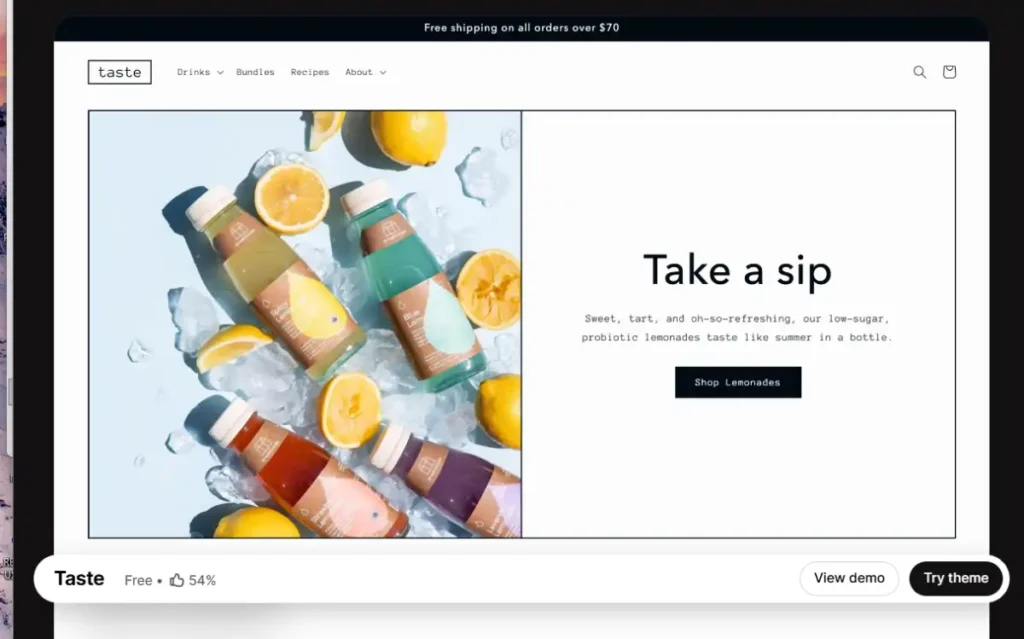
Taste is built with imagery-heavy food and beverage brands in mind, with spacious layouts and navigation designed to present edible products in a way that builds trust and appetite appeal, already powering a large number of live stores in this category.
Its section library is tuned for the large, high-quality food photography that drives purchase decisions here, while keeping navigation simple enough that customers stay focused on the products, from specialty snacks to beverage subscriptions.
Key Features
Food-forward imagery layout: Spacious product photography blocks suited to appetizing presentation.
Simple, trust-building navigation: Reduces friction for a category where trust signals matter as much as visuals.
Recipe and pairing content blocks: Optional sections for storytelling around ingredients, sourcing, or serving suggestions.
Same Dawn-level speed: Fast load times even with heavier food photography.
Subscription-friendly layout: Product page structure adapts well to recurring-order food and beverage models.
Pricing
Free.
Publisher: Best for Content-Led and Art Brands
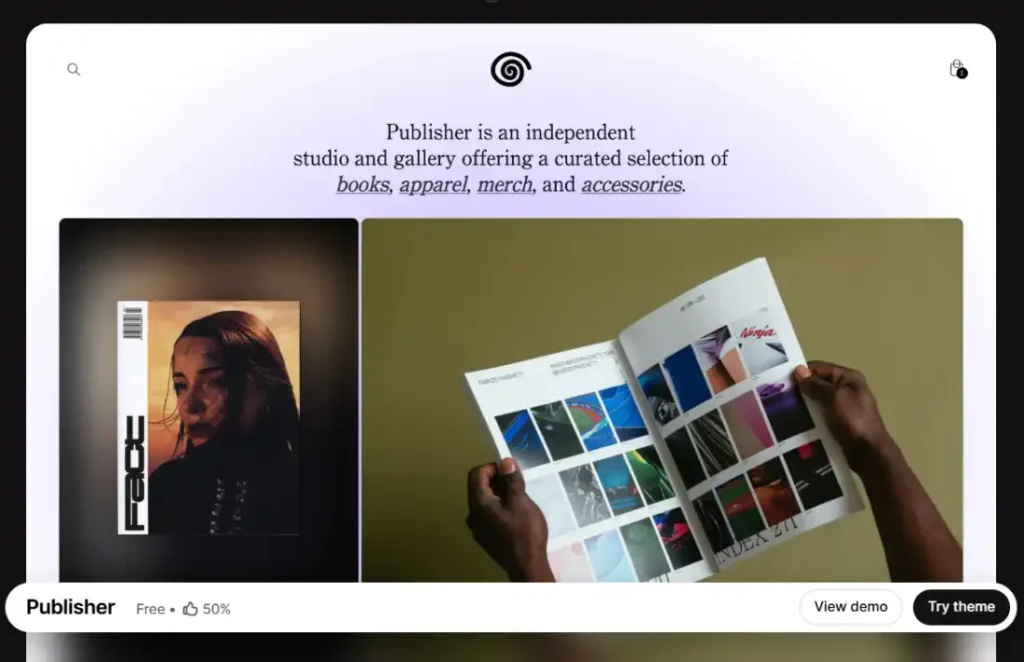
Publisher prioritizes long-form content alongside products, which suits brands selling books, art, music, or anything where education and storytelling drive the purchase decision more than a product grid alone.
Its editorial typefaces and generous content sections give brands room to explain, teach, or narrate around a product, rather than forcing every page into a standard commerce template.
This makes it a strong fit for independent publishers, musicians selling merchandise, and artists who need the store to double as a portfolio.
Key Features
Long-form content sections: Built specifically to support blog-style storytelling next to product listings.
Editorial typefaces: Contemporary design with generous room for brand narrative.
Portfolio-style collection layouts: Suited to displaying creative work alongside products for sale.
Same fast Dawn-based foundation: No speed penalty for the more content-heavy layout.
Flexible blog integration: Strong native support for pairing a content-first blog with product pages.
Pricing
Free.
Premium All-Purpose Flagships: For Growing DTC Brands
These themes typically cost $340 to $450 as a one-time purchase and are worth considering once a store generates consistent revenue, since their built-in features commonly replace three or more paid conversion apps.
Impulse: Best for High-Volume Fashion and Apparel
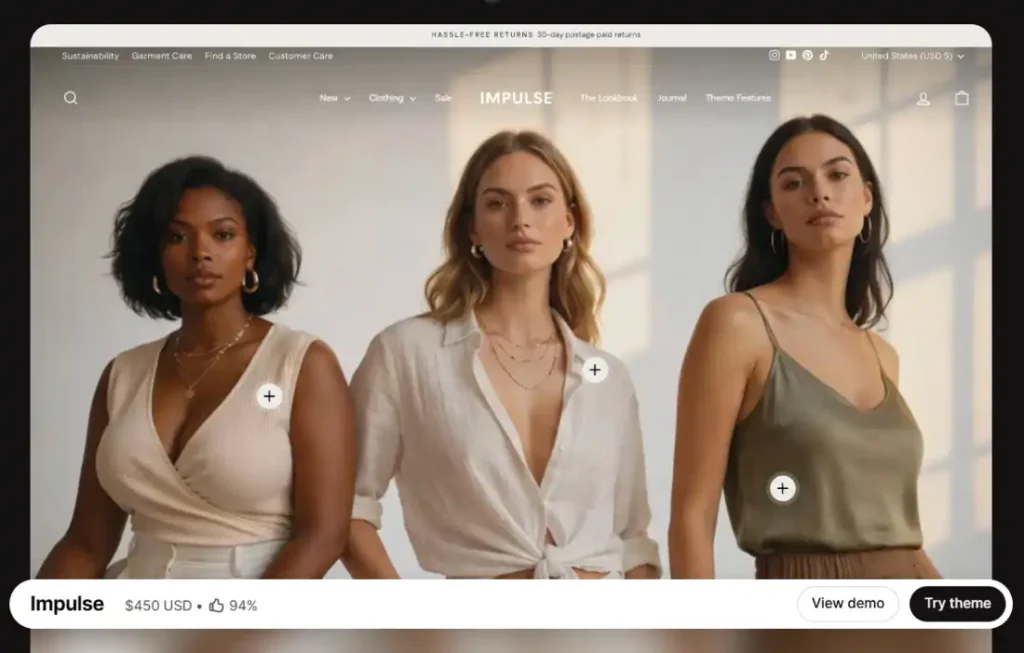
Impulse leans into editorial design with lookbooks, curated collection layouts, and a powerful promotion designer, which is why fashion brands relying on visual storytelling and frequent promotional campaigns consistently choose it over generic alternatives.
The Impulse theme mega menu supports rich media, including images and video inside navigation dropdowns, keeping large fashion catalogs browsable rather than overwhelming, and established brands with a seasonal marketing calendar tend to get the most value from its built-in merchandising tools.
Key Features
Promotion designer: Build promotional tiles and campaigns across the homepage and collection pages without a separate app.
Mega menu with rich media: Supports image and video content directly inside navigation dropdowns.
Advanced filtering: Size, price, and sub-collection filters built for large fashion catalogs.
Quick view and metafields: Reduces clicks to purchase and supports detailed product data display.
Lookbook-style collection templates: Curated, styled layouts for presenting seasonal or themed collections.
Pros
- Built-in promotional and merchandising tools commonly replace 2 to 3 separate paid apps.
- Proven track record specifically with high-volume, catalog-heavy fashion brands.
Cons
- The premium price and section depth create a real setup learning curve for a first-time Shopify merchant.
- Its visual style is specifically fashion-forward, a mismatch for technical or industrial product categories.
Who It’s Best For
Fashion and apparel brands with large, frequently updated catalogs and a marketing calendar built around seasonal promotions.
Pricing
Priced around $380 to $450 depending on current Theme Store listing; verify the current price before purchase since Theme Store pricing is updated periodically.
Prestige: Best for Luxury Brand Storytelling
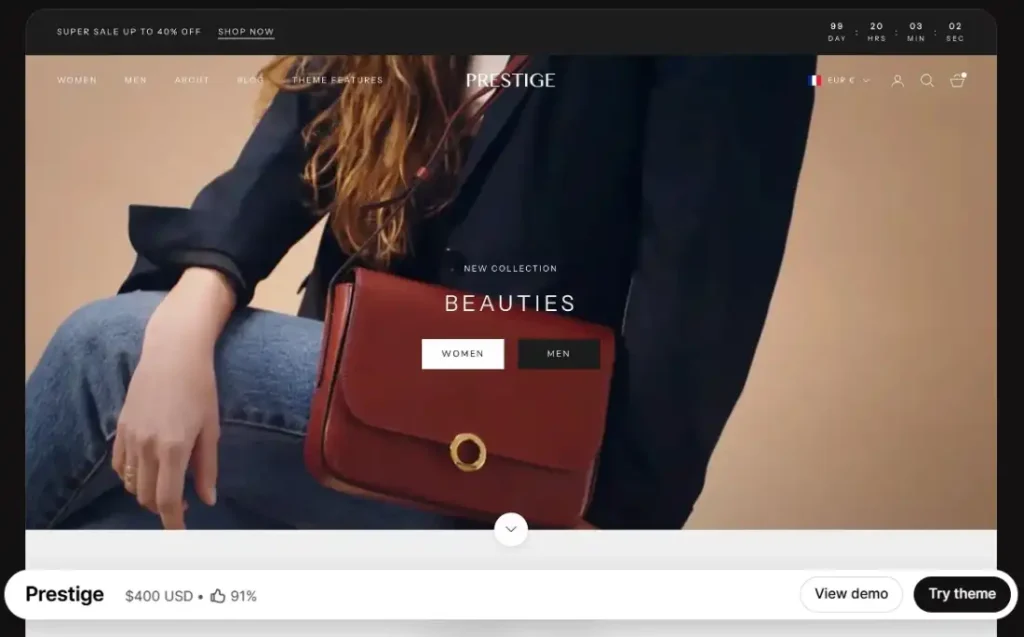
Prestige is built for brands that want a polished, high-end appearance, with over 30 configurable sections supporting immersive visual storytelling, image hotspot links, and integrated lookbooks that suit premium fashion, beauty, and lifestyle positioning.
Prestige editorial layout options let a brand build pages closer to a fashion magazine spread than a standard product grid, and hotspot links let merchants tag products directly within lifestyle photography, a natural fit for brands whose price point depends on presentation.
Key Features
30+ configurable sections: Extensive layout flexibility for editorial-style brand storytelling.
Image hotspot links: Tag specific products directly within lifestyle photography.
Integrated lookbooks: Native support for curated, styled product presentations.
Non-expiring license: Lifetime updates included with the one-time purchase.
EU translation support: Built-in support for multiple European languages to serve international luxury customers.
Pros
- The most editorial, high-end aesthetic among Shopify’s official premium themes.
- Genuinely deep customization without needing custom development work.
Cons
- The luxury-forward design is a poor fit for budget or high-volume, low-price catalogs, where the aesthetic can feel mismatched.
Who It’s Best For
High-end fashion, beauty, and lifestyle brands prioritizing brand storytelling and premium visual presentation over raw catalog size.
Pricing
Priced around $380 to $400 as a one-time purchase.
Motion: Best for Video-Forward, Visually Driven Brands
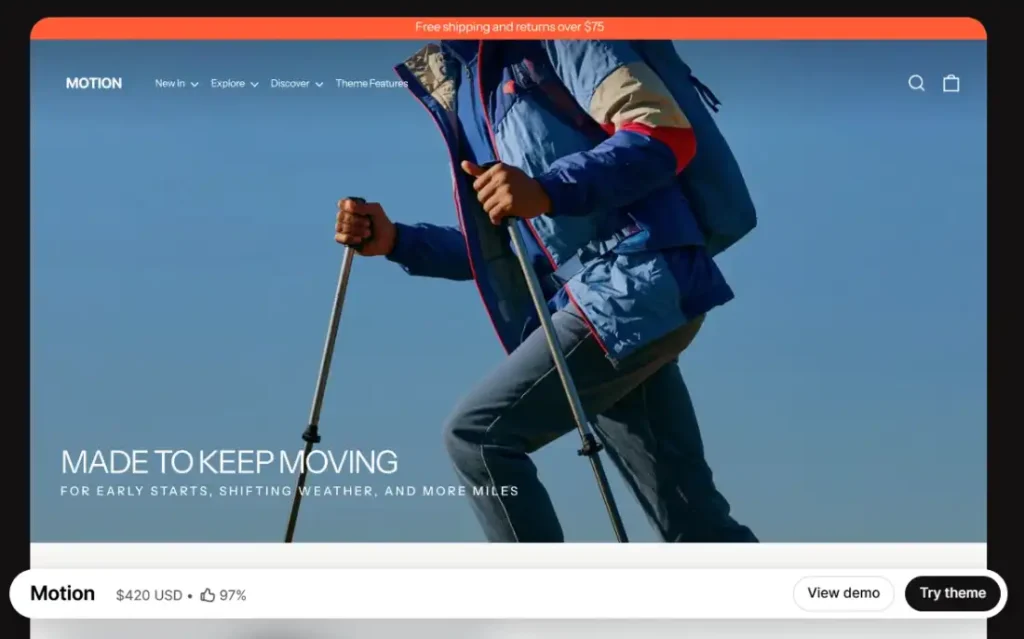
Motion brings a store to life with smooth built-in animations and native video support, making it a strong pick for high-volume, visually driven brands that want an interactive feel without stitching together multiple animation or video apps.
Content animates into view as a visitor scrolls, and product videos or brand stories play natively on the homepage, giving the store a more dynamic feel than a static theme, with fashion and lifestyle brands seeing the clearest benefit.
Key Features
Native video integration: Show product demos and brand videos directly on the homepage without a separate app.
Animated section transitions: Content animates into view as visitors scroll, without added page-weight from third-party scripts.
Flexible collection collages: Display evolving collections with unique, non-grid layouts.
20+ sections: Enough layout flexibility for most growing catalogs without becoming overwhelming.
Enhanced cart and checkout options: Built-in cart drawer and upsell-friendly checkout flow.
Pros
- Native animation and video reduce reliance on separate, often speed-costly, third-party apps.
- Strong mobile design that doesn’t sacrifice layout quality for animation effects.
Cons
- Heavy animation use can still add perceived load time if a merchant stacks too many effects on one page.
Who It’s Best For
High-volume fashion and lifestyle brands wanting an interactive, video-forward shopping experience without relying on multiple animation apps.
Pricing
Priced around $400 to $420 as a one-time purchase.
Symmetry: Best for Versatile Stores Pairing Online and In-Person Retail
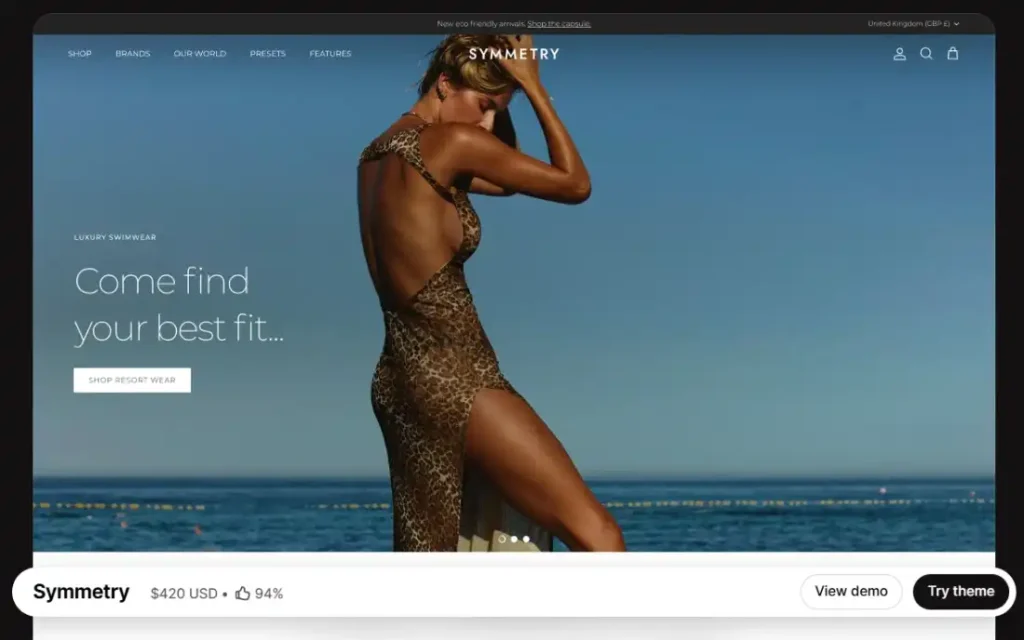
Symmetry combines flexible, drag-and-drop sections with strong support for pre-orders and in-store pickup, making it a natural fit for beauty, health, and general retail brands that operate both an online store and physical Shopify POS locations.
Symmetry theme built by an experienced theme studio with over a decade in the Shopify ecosystem, it organizes large product ranges cleanly while keeping the in-person and online experience consistent, a combination less common among competing premium themes.
Key Features
Shopify POS pairing: Built-in support for in-store pickup and pre-order flows alongside online sales.
Drag-and-drop sections: Extensive layout customization without developer involvement.
High-volume catalog support: Organizes large product ranges cleanly across collection pages.
Health and beauty presets: Default styling tuned for wellness and beauty product presentation.
Cross-channel consistency: Keeps the online and in-person shopping experience visually aligned for omnichannel brands.
Pricing
Priced around $380 to $420 as a one-time purchase.
Broadcast: Best for Content-Led Trust Building
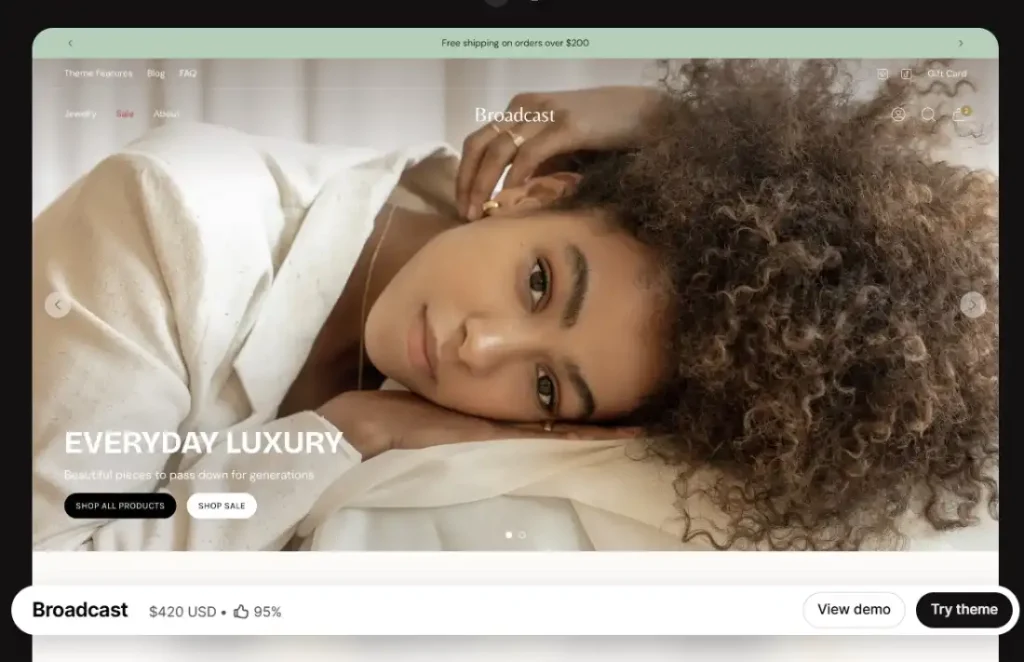
Broadcast stands out for its unusually deep settings, particularly its announcement bar, which supports multiple rotating slides or a continuously scrolling marquee, along with unique collection page layouts that help a store’s content feel more considered than a typical theme install.
Where most themes limit the announcement bar to one static message, Broadcast lets merchants build a genuinely dynamic top-of-page experience with page- and device-specific display rules, extending that granular control across most sections.
Key Features
Advanced announcement bar: Multiple slides or a scrolling marquee, limitable by page or device.
Calculated free-shipping progress bar: Shows customers how close they are to a free-shipping threshold in real time.
Distinctive collection layouts: Content-forward collection pages that stand out from grid-only competitors.
Granular display controls: Page- and device-specific visibility settings across most sections.
Trust-focused homepage blocks: Sections purpose-built for building credibility through content rather than discounts alone.
Pricing
Priced around $420 as a one-time purchase.
Niche: Large Catalogs and Marketplace-Style Stores
Empire: Best for Marketplace-Style, Large Catalogs
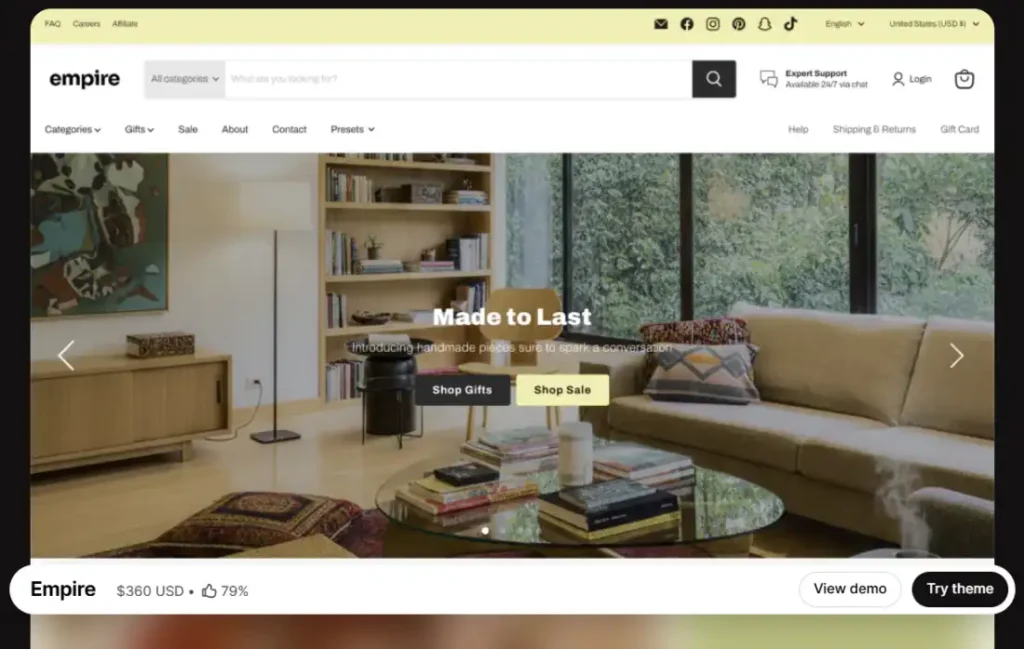
Empire is explicitly built in the mold of large marketplace storefronts, with the product discovery and comparison tools needed to keep hundreds or thousands of SKUs navigable, plus merchandising tools focused on cross-selling and upselling at scale.
Its search, filtering, and sorting logic handles inventory sizes that break most general-purpose themes, while shoppable image galleries let customers browse and buy from lifestyle photography, and its app-level adaptability suits wholesale, dropshipping, and general retail alike.
Key Features
Advanced product discovery: Search, filtering, and sorting built for catalogs too large for a standard collection grid.
Shoppable image galleries: Lets customers browse and buy directly from lifestyle imagery.
Cross-sell and upsell tools: Built-in merchandising features that push average order value at scale.
App-level adaptability: Flexible enough to suit a range of business models beyond a single niche.
Comparison-friendly product layouts: Structured to help customers evaluate similar products side by side at scale.
Pros
- Genuinely built for catalog sizes that break most other themes’ navigation.
- Built-in merchandising tools reduce reliance on separate upsell apps.
Cons
- The marketplace-style aesthetic can feel impersonal for a brand-forward, story-driven DTC label.
Who It’s Best For
Stores with large, frequently changing catalogs, wholesale operations, and dropshippers running broad product ranges rather than a tight, curated collection.
Pricing
Priced around $340 as a one-time purchase.
Warehouse: Best for Electronics and Technical Product Categories
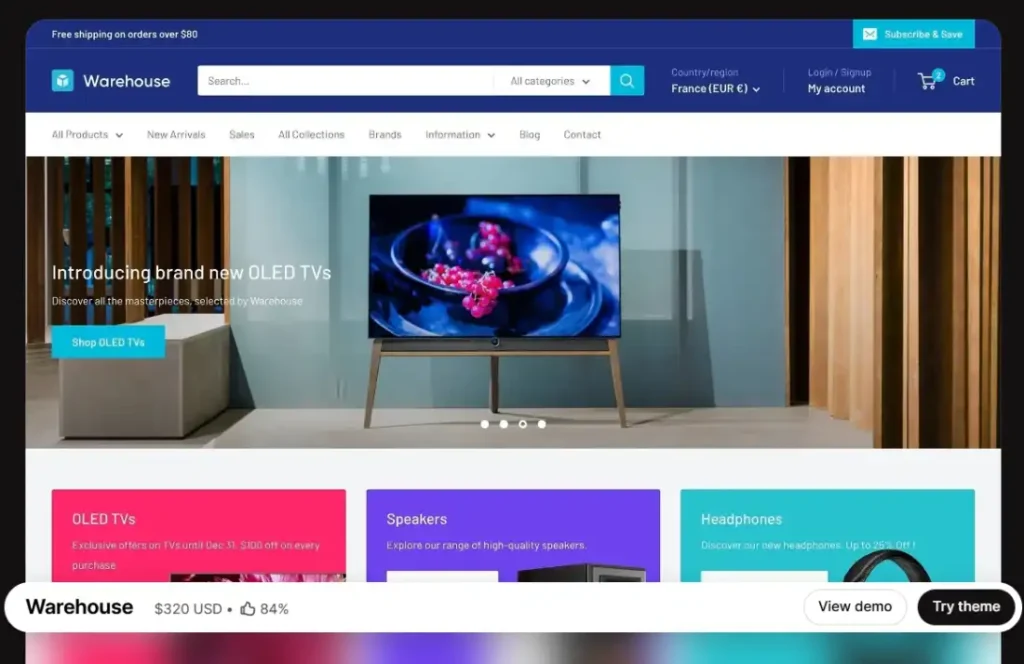
Warehouse is built around clear categorization and straightforward navigation, which suits electronics, hardware, and other technical product categories where customers need to compare specifications quickly rather than browse lifestyle imagery.
Its layout prioritizes structured product data, specification tables, and category-first browsing over large hero images, matching how customers actually shop for technical goods, and that lighter visual weight also keeps product pages loading quickly on large catalogs.
Key Features
Clear category-first navigation: Prioritizes specification-led browsing over lifestyle imagery.
Fast load on media-light pages: Suited to product pages where technical specs matter more than large hero images.
Comparison-friendly layout: Structured for customers evaluating similar technical products side by side.
Specification table support: Native layout options for displaying detailed technical product data.
Bulk and wholesale-friendly collection pages: Handles large SKU counts common in electronics and hardware catalogs.
Pricing
Priced in a similar range to comparable premium themes, roughly $300 to $400 as a one-time purchase; confirm the current listing price before purchase.
Niche: Luxury, Jewelry, and Editorial Fashion
Pipeline: Best for Luxury Clothing and Lookbook-Style Brands
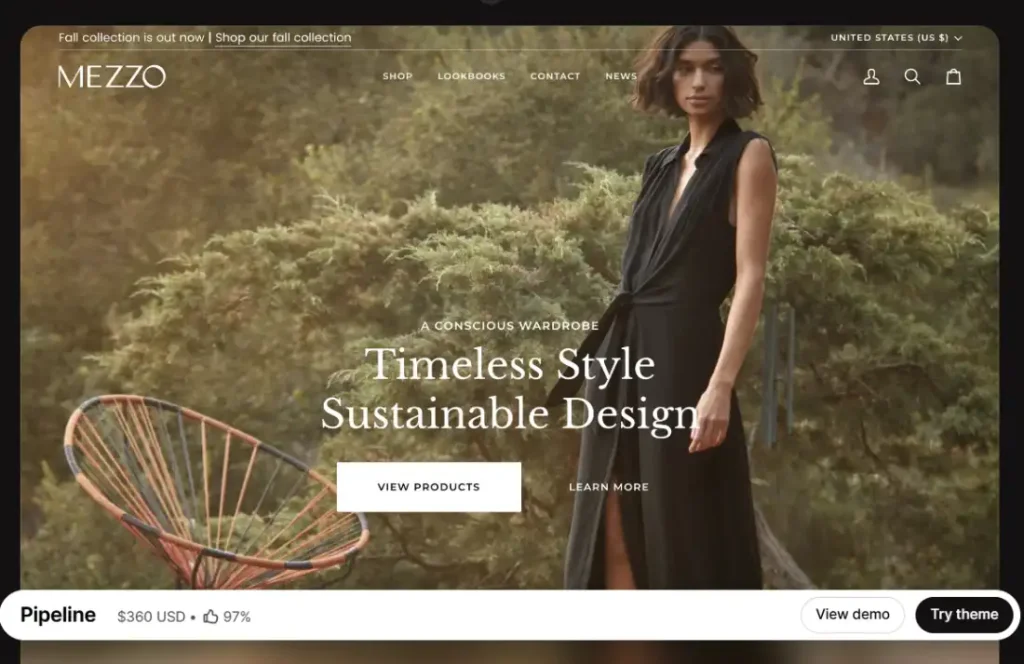
Pipeline is designed for luxury businesses with image-first layouts specifically suited to clothing brands and lifestyle photography, giving merchants premium customization options to match an exclusive brand identity.
The theme was built with mobile shoppers specifically in mind, since luxury fashion browsing increasingly happens on a phone, and its image-forward templates prioritize large-format photography over dense text or specification-heavy layouts. T
hat focus makes it a strong pick for brands whose product appeal is primarily visual and aspirational rather than feature-driven.
Key Features
Image-first layout: Prioritizes large lifestyle photography over dense product grids.
Mobile-optimized shopping experience: Built specifically to enhance the browsing experience for mobile shoppers.
Premium customization options: Deep control over look and feel to match an exclusive brand identity.
Lookbook-style collection pages: Curated, editorial presentation suited to seasonal fashion drops.
Clean, distraction-free checkout flow: Keeps the premium visual experience consistent through to purchase.
Pricing
Priced around $360 as a one-time purchase.
Niche: Single-Product and Budget Dropshipping
Xtra: Best for One-Product Stores and Small Catalogs
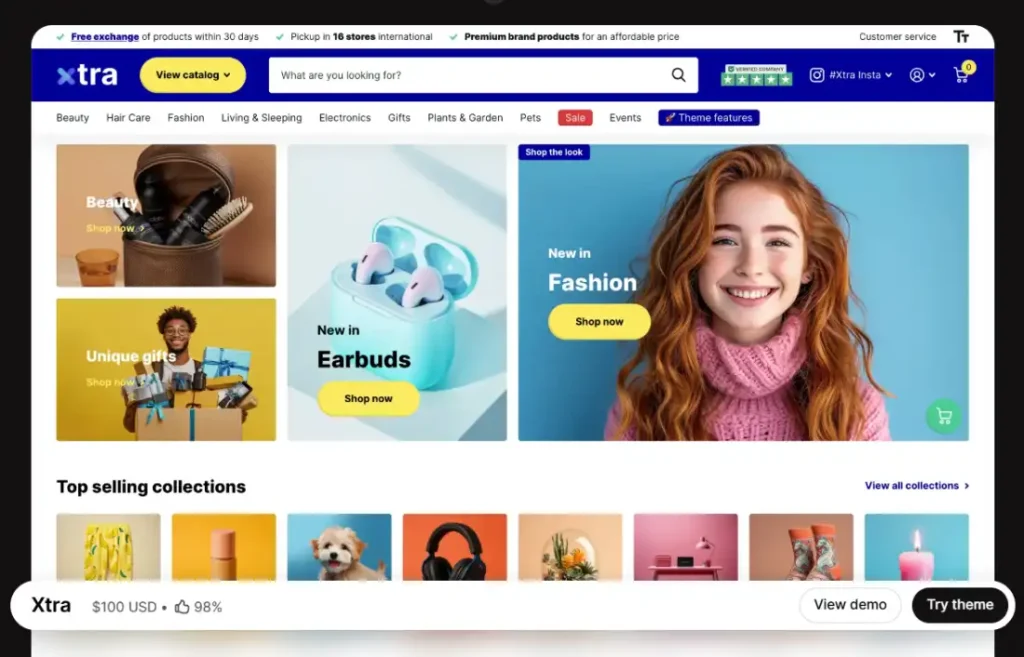
Xtra is purpose-built for merchants focused on a single product or a small catalog, with a customizable testimonials section designed to build trust around one hero product rather than a wide range.
Because a one-product store lives or dies on building trust and urgency around that single item, Xtra’s layout is structured entirely around that goal rather than adapting a general grid theme, and at roughly a quarter the price of most premium themes, it’s a low-risk starting point.
Key Features
Single-product focus: Layout built around highlighting one hero product rather than a broad catalog.
Customizable testimonials section: Built-in social proof specifically for a single-product store.
Low price point: One of the most affordable premium themes on the Shopify Theme Store.
Urgency and scarcity blocks: Built-in sections for stock counters and limited-time offers.
Streamlined single-page checkout flow: Reduces friction for a store built around one core purchase decision.
Pricing
Priced around $100 as a one-time purchase.
Debutify: Best for Dropshipping with Built-In Conversion Tools
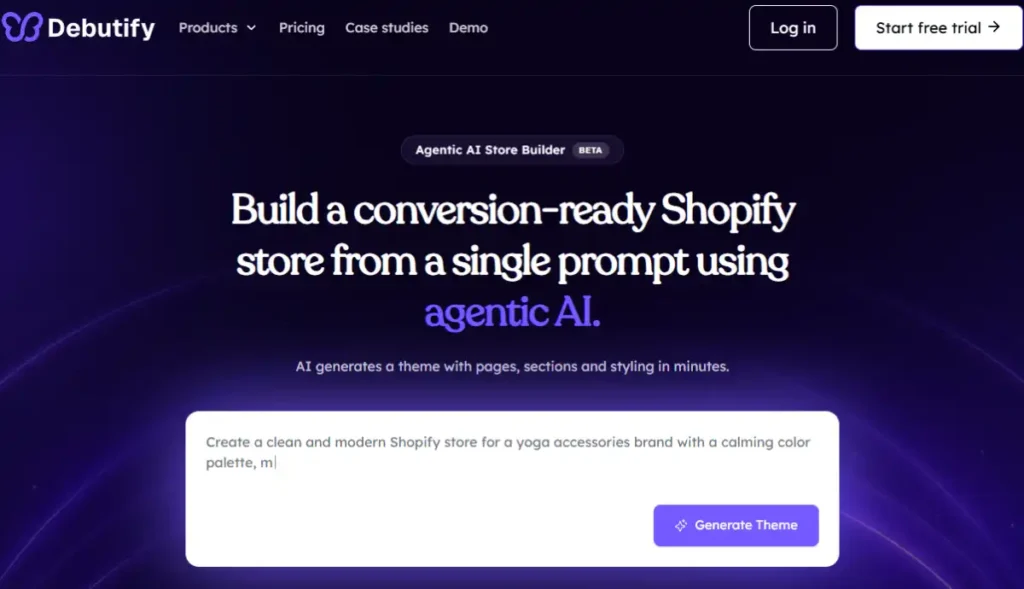
Debutify combines a theme with a bundled suite of conversion-focused features (trust badges, countdown timers, upsell widgets) marketed specifically at dropshippers who want conversion tooling without installing a stack of separate apps. Unlike Shopify Theme Store themes, Debutify runs on a subscription model rather than a one-time purchase, reflecting that its value comes from an ongoing suite of tools, and new stores that would otherwise piece together 5 or more separate apps see the clearest savings.
Key Features
Bundled conversion tool suite: Trust badges, countdown timers, and upsell widgets included rather than sold separately.
Dropshipping-specific templates: Layouts built around the fast-launch, low-catalog-depth dropshipping model.
Ongoing feature updates: New conversion tools added through the subscription rather than a one-time purchase.
Built-in add-to-cart upsells: Native upsell prompts at the cart stage without a separate app.
Countdown and urgency widgets: Native scarcity and urgency tools designed for direct-response dropshipping funnels.
Pros
- Reduces the number of separate paid apps a new dropshipping store needs to install.
- Built specifically around the dropshipping launch workflow, not adapted from a general-purpose theme.
Cons
- The subscription pricing model means an ongoing cost, unlike the one-time purchase price of Theme Store themes.
Who It’s Best For
New dropshipping stores that want bundled conversion tooling without managing a separate app stack from day one.
Pricing
Subscription-based; confirm current plan pricing directly, since it differs structurally from one-time Theme Store themes.
Booster: Best for Fast-Loading, Conversion-Optimized Dropshipping
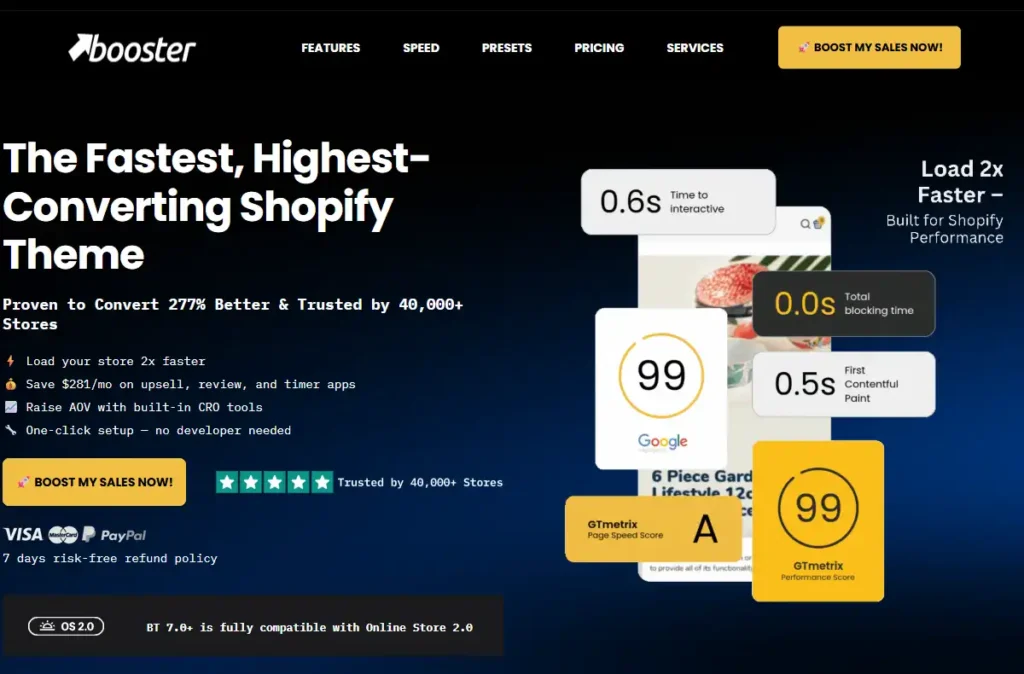
Booster bundles more than 30 conversion-optimized marketing tools directly into the theme, including promotion timers, currency converters, stock counters, and sales notifications, while maintaining genuinely fast load times, an unusual combination given how many similar bundled themes sacrifice speed for features. Independent speed testing has recorded desktop load times around 1.1 seconds, a strong result for a theme this feature-dense, and its recommended product widgets raise average order value without a separate upsell app.
Key Features
30+ built-in conversion tools: Promotion timers, currency converter, stock counters, and sales notifications without separate apps.
Recently viewed and recommended product widgets: Increases average order value by surfacing relevant products automatically.
Fast load times: Maintains sub-2-second desktop load times despite the large feature set, based on independent speed testing.
Currency converter: Built-in multi-currency display for stores selling to international dropshipping traffic.
Sales notification popups: Built-in social proof notifications without a separate app subscription.
Pros
- Genuinely fast despite the large bundled feature set, which is rare among all-in-one conversion themes.
- Reduces the number of separate conversion apps a dropshipping store needs to run.
Cons
- The feature-dense homepage can feel busy for brands wanting a minimalist aesthetic.
Who It’s Best For
Dropshipping and direct-response stores prioritizing built-in conversion tooling and speed over an editorial or minimalist design.
Pricing
Priced in the range of roughly $150 to $300 depending on the current plan; confirm current pricing before purchase.
Niche: Food, Local, and In-Person Retail
Local: Best for Food Brands and In-Person Retail
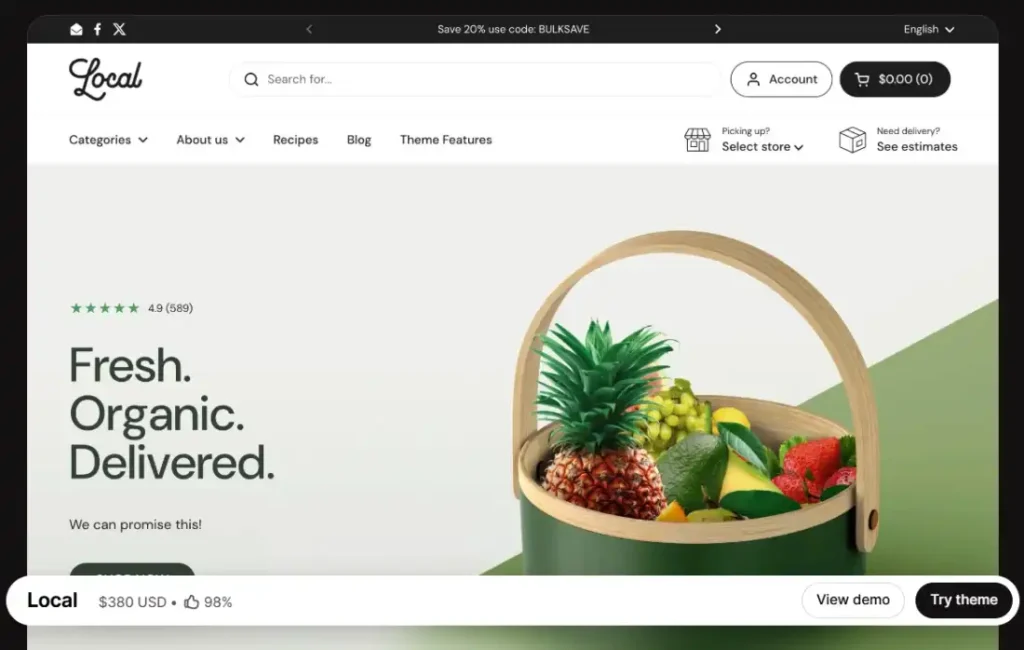
Local is packed with features to streamline both online and in-person selling, including 30-plus flexible sections, making it a strong fit for restaurants, food brands, and local shops that need online ordering to work alongside in-store pickup. Its navigation and layout options are built around the logistics of local commerce, things like store hours, pickup windows, and location details, that generic ecommerce themes tend to treat as an afterthought, making it stronger for hybrid businesses.
Key Features
In-person and online sync: Built to streamline order pickup and in-store selling alongside online orders.
30+ flexible sections: Enough layout range to cover a menu-style catalog or a broader food product range.
Local-business-friendly navigation: Suited to location details, hours, and pickup logistics that generic themes don’t handle well.
Pickup and delivery scheduling blocks: Native support for local fulfillment logistics.
Menu-style collection layouts: Adapts cleanly to restaurant and prepared-food catalog structures.
Pricing
Priced around $380 as a one-time purchase.
Niche: Wholesale, B2B, and Paid-Traffic Specialists
Shoptimized: Best for Paid-Traffic, Direct-Response Funnels
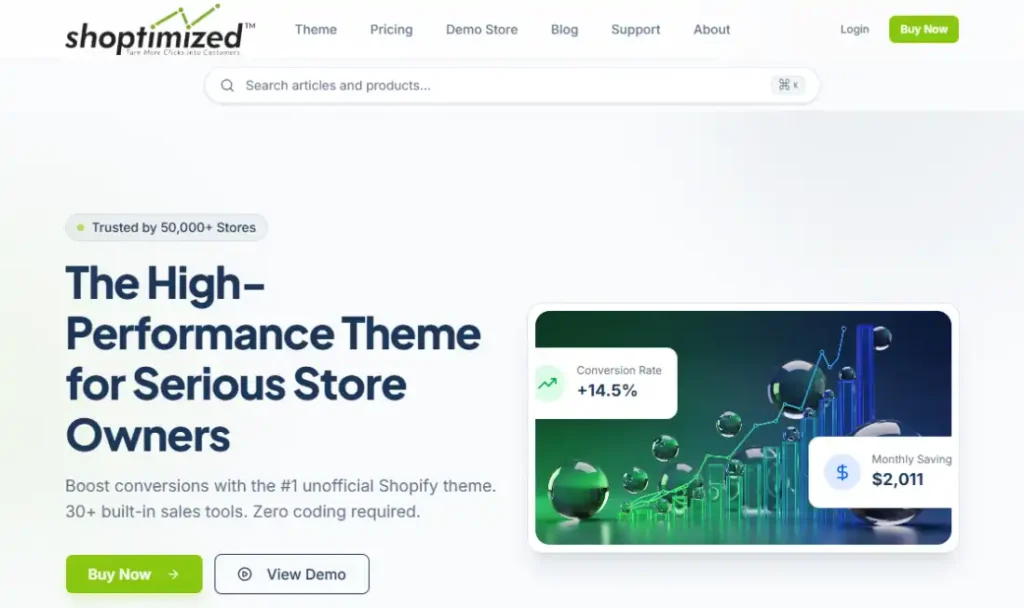
Shoptimized positions itself less as a template and more as a community of ecommerce professionals who built the theme specifically around conversion and growth tactics for stores running paid traffic, with a focus on direct-response funnel structure rather than general-purpose browsing. Its layout choices, urgency elements, and trust signals are built around the behavior of cold traffic from a paid ad, which differs from organic browsing, and updates are driven by the community’s own testing.
Key Features
Direct-response page structure: Layout choices built specifically around paid-traffic landing behavior rather than general browsing.
Built-in urgency and trust elements: Countdown timers and trust badges designed for conversion-first paid traffic funnels.
Community-driven updates: Maintained by a group focused specifically on conversion rate optimization, not general theme design trends.
Simplified checkout flow: Reduces friction points specifically for cold-traffic buyers unfamiliar with the brand.
Ad-traffic-tuned product page layout: Structured to answer objections quickly for a visitor with no prior brand awareness.
Pricing
Priced in the range of roughly $200 to $300; confirm current plan pricing before purchase.
Vision: Best for Video-Heavy Beauty, Tech, and Sporting Goods
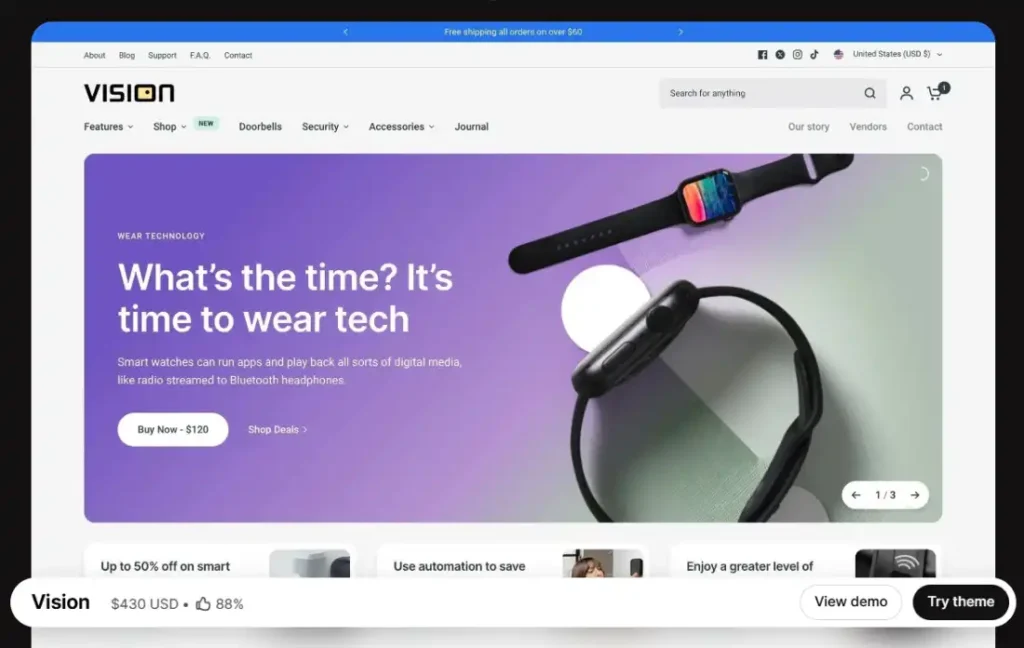
Vision lets merchants embed video directly into the online store, with presets specifically suited to selling beauty products, tech gadgets, and sporting goods where a product demonstration communicates value better than a static photo alone. Categories where a customer needs to see a product in motion, applying makeup, testing a gadget’s features, or demonstrating sports equipment, tend to convert better with native video, and Vision’s presets give merchants a head start without extensive customization.
Key Features
Native video embedding: Show product demonstrations directly on product and homepage sections.
Beauty, tech, and sporting goods presets: Default styling tuned to categories where demonstration matters.
Flexible product gallery layouts: Supports mixed photo and video galleries on a single product page.
Feature-comparison sections: Built-in layout options for comparing specifications across similar tech or sporting goods products.
Mobile-optimized video playback: Ensures embedded video loads smoothly on mobile connections, where much of this traffic arrives.
Pricing
Priced in a similar range to comparable premium themes, roughly $300 to $380 as a one-time purchase; confirm the current listing price before purchase.
Theme-Shopping Habits to Skip
Judging Speed by the Demo Store Alone
A theme’s demo store is lightly populated with optimized sample images and no apps installed. Real speed comes from what gets added afterward: uncompressed product photography, page-builder widgets, and stacked marketing apps. Test a theme’s speed on a duplicate of the actual store, with real product images and the apps you plan to run, not the polished demo.
Buying a Theme from an Unverified Third-Party Marketplace
Only themes listed directly in the official Shopify Theme Store are required to meet Shopify’s performance, accessibility, and code quality standards. Third-party marketplace themes are where most compatibility problems start, often due to messy code that breaks with Shopify platform updates or conflicts with common apps.
Switching Free Themes for a New Look
Since Craft, Sense, Refresh, Origin, Colorblock, and Taste share Dawn’s core code, switching from one to another to chase a different aesthetic is usually unnecessary. The same look can typically be achieved by adjusting presets and section settings within the currently installed theme, which avoids the setup time a full theme switch requires.
Buying a Premium Theme Before Validating the Product
Premium themes are worth it once a store generates consistent revenue, commonly cited around $10,000 per month, since they replace multiple paid apps and typically deliver a modest but real conversion lift. For a store still validating product-market fit, a free theme is the smarter investment; the money saved matters more than the aesthetic upgrade at that stage.
How to Choose the Right Theme for Your Store
The decision comes down to three questions, in this order: what store type are you (starter, growing, large-catalog), what niche or product category are you selling, and what does your actual catalog and traffic pattern look like once apps and real images are added.
If the store is under $10,000 a month in revenue or still validating product-market fit, start with a free theme matching the closest niche preset (Sense for beauty, Taste for food, Colorblock for large fashion catalogs) and revisit a premium theme once revenue is consistent.
If the store is an established, revenue-generating fashion or lifestyle brand, Impulse, Prestige, or Motion each replace several paid conversion apps and are worth the one-time cost.
If the catalog is unusually large or wholesale-facing, Empire or Warehouse are built specifically for navigation at that scale, where a general-purpose theme’s filtering and search will start to break down.
If the store runs paid traffic to a small, focused catalog, Booster, Debutify, or Shoptimized are purpose-built for that funnel structure, trading some design flexibility for built-in conversion tooling.
Our Shopify review covers how the platform’s broader economics fit into the dropshipping cost and margin picture.
FAQ’s
How many Shopify themes should I compare before choosing?
Comparing more than 4 or 5 candidates rarely changes the decision and mostly adds decision fatigue. Narrow to your store type and niche first (using the sections above), then compare 3 to 5 finalists on a duplicate store with real product images before committing.
Are free Shopify themes good enough for a serious store?
Yes. Many high-revenue Shopify Plus stores run on customized free themes. The theme is rarely the real bottleneck; the images, apps, and content layered on top of it usually matter more than which free theme was the starting point.
How much do premium Shopify themes cost?
Most Shopify Theme Store premium themes are a one-time purchase, typically $340 to $450, not a recurring subscription. A small number of theme-plus-app hybrids like Debutify use a subscription model instead, so check the pricing structure before assuming it’s a one-time cost.
Can I switch Shopify themes without losing my products or orders?
Yes. Products, orders, and customer data live in Shopify itself, not the theme, so switching themes never risks that data. What does take real time is re-styling and re-arranging content in the new theme’s section structure, so plan for that time cost separately from the theme’s price.
Do I need a different theme for each niche I sell in?
Not necessarily. Most Online Store 2.0 themes can be customized well beyond their default preset. Starting with the theme whose default aesthetic and built-in features are closest to your niche saves customization time, but it’s rarely a strict requirement.
What’s the fastest Shopify theme in 2026?
Among free themes, Dawn is typically the fastest on a clean install, though all Dawn-based free themes are within a small margin of each other, since they share the same core code. Among premium themes, Booster has been independently measured with sub-2-second desktop load times despite its large bundled feature set, an unusual result for a theme with that many built-in tools.
Final Thoughts
The right Shopify theme is rarely the one that looks best in a polished demo. It’s the one built for the actual product type being sold, at the actual catalog size the store will reach, that stays fast once real images and apps are layered on top.
Start with a free theme matching the closest niche preset if the store is still validating its product, move to a premium flagship like Impulse, Prestige, or Motion once revenue is consistent, and reach for a niche-specific pick like Empire, Booster, or Local when the catalog or business model calls for it specifically.
If you’re still deciding whether Shopify is the right platform before choosing a theme, the Shopify for small business guide and the Shopify’s transaction fees breakdown will help you make that foundational decision first.