
If you read that Shopify B2B requires a Plus subscription, that information is out of date. Native B2B features moved to every paid Shopify plan on April 2, 2026, which changes the real decision merchants face.
It is no longer whether you can run wholesale on Shopify at all. It is where the native feature set stops, and a third-party app or a Plus upgrade genuinely becomes necessary.
This guide organizes that decision into three honest buckets: what is native on every paid plan today, what remains locked to Shopify Plus specifically, and what is missing regardless of which plan you are on.
We reviewed Shopify’s own official B2B features overview alongside real merchant-reported gaps to separate genuine plan-tier limits from features the platform simply does not build natively at any tier.
In this guide, you will learn exactly where the real ceiling sits for a growing wholesale operation, and what it actually costs to push past it.
Table of Contents
Key Takeaways
- Native B2B expanded to every paid Shopify plan on April 2, 2026, including companies, catalogs, net payment terms, self-serve ordering, purchase order numbers, and Shopify Flow automations.
- The 3 active catalog limit on Basic, Grow, and Advanced is the first real ceiling most growing wholesale operations hit, and it applies across all B2B markets combined, not per market.
- Shopify has no native RFQ or quoting workflow on any plan, including Plus, a genuine gap for manufacturers and distributors running negotiated contract pricing.
- Certain B2B features, including some discount and checkout behaviors, are off by default and require contacting Shopify Support to activate, and once enabled in a blended store, they apply to both B2B and retail customers, not B2B alone.
- Shopify Plus starts at $2,300 to $2,500/month, while most dedicated third-party B2B apps that fill the remaining gaps start around $25/month, a real cost gap worth mapping against your specific missing feature before upgrading.
What Changed on April 2, 2026
Before this date, native company accounts, wholesale catalogs, and net payment terms required a Shopify Plus subscription starting at $2,300 a month.
Merchants on lower plans who wanted a wholesale program had two options: a third-party app, or the older Wholesale Channel, a separate password-protected storefront that never received the platform’s newer B2B updates.
As of April 2, 2026, most of those same features are included on Basic, Grow, and Advanced at no additional cost.
According to Shopify’s own B2B features by plan documentation, companies, catalogs, net payment terms, self-serve ordering, quick order lists, and Shopify Flow automations are now available across every paid plan. The real distinction moved from access to depth.
What’s Native on Every Paid Plan
Company accounts are the foundation. You can create a company profile for each wholesale account, add multiple locations under it, and assign buyers with specific permissions to each location, all without a third-party app.
Catalog and pricing tools cover most standard wholesale needs. Volume pricing, quantity rules, minimum and maximum order quantities, and purchase order number collection at checkout are all native.
Buyers get a genuine self-service portal: order history, tracking, and one-click reorder from past purchases, which reduces support load for distributors placing frequent repeat orders.
Payment flexibility on standard plans covers net terms specifically. Net 30, Net 60, and Net 90 are built in, and Shopify automatically applies a due date and sends payment reminders as it approaches.
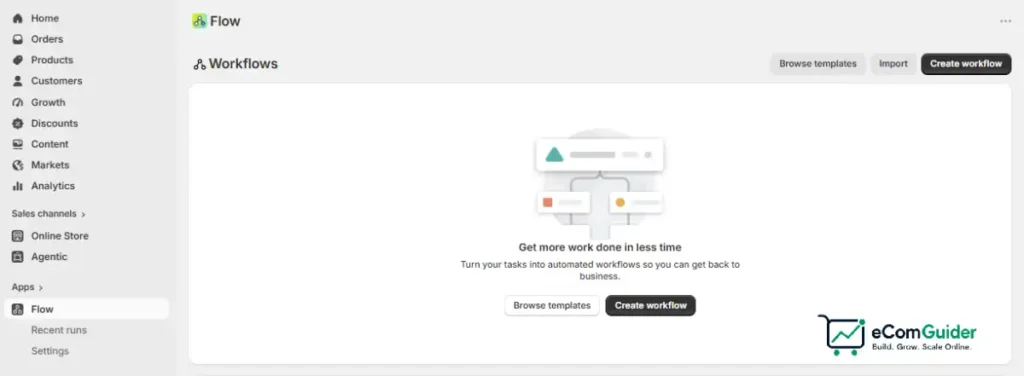
Shopify Flow automations extend this further, letting you trigger pricing catalog assignment, welcome emails, and sales team notifications automatically when a new company account is approved.
Quick order lists, a spreadsheet-style interface where buyers enter SKUs and quantities directly, are also native on every plan. This covers the most common bulk-ordering scenario, though it is worth distinguishing from CSV file upload, which is not part of the native feature set, covered further below.
What’s Still Shopify Plus Exclusive
The catalog ceiling is the clearest Plus-versus-everything-else line. Basic, Grow, and Advanced share 3 active catalog assignments across all B2B markets combined, not per market, which a merchant running even three simple buyer tiers, say Bronze, Silver, and Gold, can exhaust before touching international pricing at all.
Shopify Plus removes that cap entirely and additionally allows direct catalog assignment to a specific company or company location for true customer-level pricing.
Payment flexibility separates further at the Plus tier. Deposits, partial payments, and payment requests issued per fulfillment, useful for merchants shipping complex multi-part orders over several days, remain Plus-only according to Shopify’s own documentation.
Vaulted credit card storage, letting a repeat B2B buyer check out without re-entering payment details each time, is also part of this same Plus-exclusive payment tier.
Storefront separation is the other major Plus advantage. On Basic, Grow, and Advanced, retail and wholesale buyers share the same storefront and URL, differentiated only by whether the visitor is logged into a company account.
Plus, merchants can run a fully dedicated B2B storefront with its own domain, navigation, and theme customization by customer type, which matters specifically for brands that want retail and wholesale to feel like entirely separate experiences.
Contextual checkout and storefront customization through Shopify Markets sits on both Advanced and Plus, not Plus alone, which is a detail several competing guides get wrong by lumping it in as fully Plus-exclusive.
Where B2B Breaks Regardless of Plan
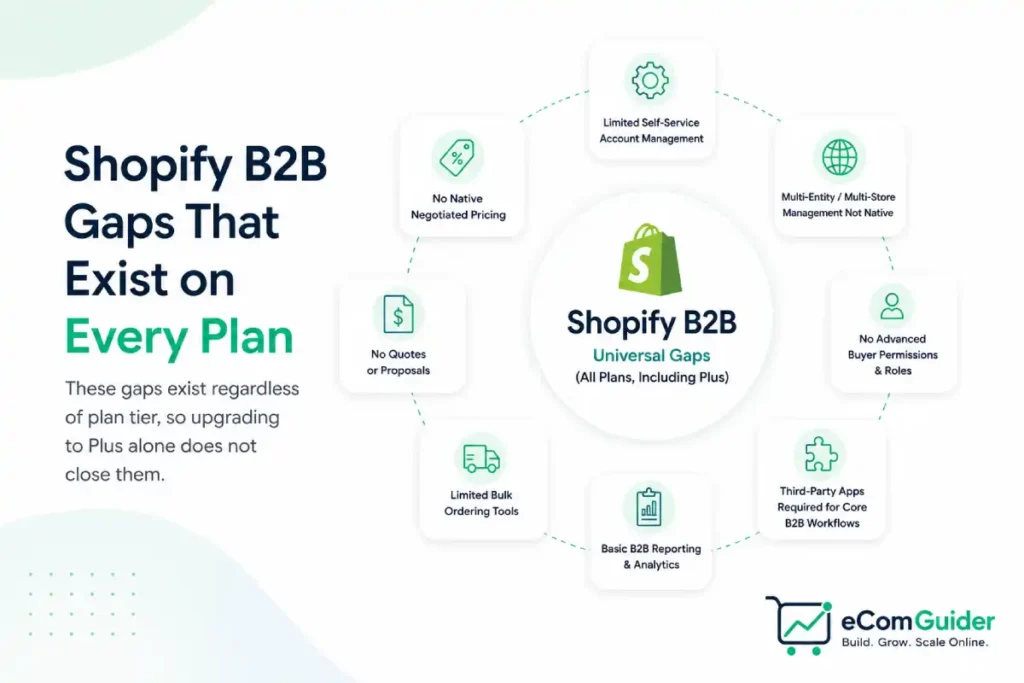
This is the section most Shopify B2B content skips entirely, and it matters more than the plan-tier comparison for a merchant with a genuinely complex wholesale operation. These gaps exist whether you are on Basic or paying $2,300 a month for Plus.
No native RFQ or quoting workflow exists on any plan. A request-for-quote process, where a buyer submits a custom pricing request that a sales team reviews, negotiates, and converts into an order, is not part of Shopify’s native B2B system at all.
Manufacturers and distributors running negotiated contract pricing need a third-party quoting app or a manual, email-based process regardless of which plan they are on.
There is no wholesale application or registration form with an approval queue. Shopify does not provide a way for a prospective buyer to apply for a B2B account and land in a review queue.
Every company account has to be created manually in the admin, which becomes a real bottleneck for brands actively recruiting new wholesale accounts at volume.
Native B2B cannot hide prices or products from logged-out visitors. A show wholesale pricing only after login message, or blocking specific collections from retail visitors entirely, requires a third-party app on every plan, including Plus.
There is no dedicated sales agent portal. A sales rep cannot log in and view a specific buyer’s exact pricing and catalog the way that buyer sees it, a capability sometimes called ghosting a customer account.
This gap applies at every plan tier and creates real friction for any business running an active outside sales team, since reps are working from incomplete pricing visibility during calls.
CSV bulk upload is not native, even though quick order lists are. A buyer entering SKUs and quantities manually into Shopify’s built-in quick order list is supported everywhere. Uploading a spreadsheet of SKUs and quantities as a file is not, which matters specifically for high-volume reorder buyers used to that exact workflow on other B2B platforms.
Some features are off by default and store-wide once enabled. Shopify’s own requirements and considerations documentation confirms that certain discount and checkout behaviors require contacting Shopify Support to activate.
In a blended store running both B2B and retail from one storefront, turning these on applies them to both customer types together, not to B2B buyers alone, which is worth testing carefully before assuming a setting only affects your wholesale accounts.
The Legacy Wholesale Channel Migration
Shopify Plus merchants who adopted the original Wholesale Channel before the newer B2B system launched are running a separate password-protected storefront with its own theme, isolated from the main store and disconnected from every B2B update released between 2022 and 2026. That channel does not benefit from any of the native improvements covered above.
Migrating off it involves recreating existing wholesale customers as companies, mapping old price lists to the new catalog structure, and redirecting URLs from the old wholesale subdomain to avoid losing bookmarked buyer links.
Merchants who have completed this migration commonly report a 4 to 8 week timeline done properly, which is worth budgeting for as a real project rather than a weekend task.
Real Cost: Plus vs. Third-Party App vs. Living With the Limit
Three genuinely different paths exist once you hit one of the gaps above, and the right one depends entirely on which specific gap you hit, not on B2B maturity in general.
If the gap is the 3-catalog ceiling and your pricing structure genuinely needs more segmentation, Shopify Plus at $2,300 to $2,500 a month is the only native path. No app can remove a platform-level catalog cap.
If the gap is something the platform simply does not build natively at any tier, RFQ workflows, gated pricing visibility, a sales agent portal, or CSV bulk ordering, a dedicated third-party B2B app, commonly starting around $25 a month, closes that gap on your current plan, without requiring a Plus upgrade at all.
Compare the cost of the specific gap against the cost of the fix before assuming Plus is the answer. A merchant considering Plus purely to add a quoting workflow is paying for a $2,300 monthly upgrade to solve a $25 to $50 monthly app problem, since RFQ tools are not native on Plus either.
Our best platform for B2B guide covers how Shopify’s B2B capabilities compare against BigCommerce and Adobe Commerce, specifically, useful if the gap you hit is significant enough to warrant a platform-level comparison rather than an app or upgrade.
FAQ’s
Do I need Shopify Plus for B2B in 2026?
Not automatically. As of April 2, 2026, core B2B features, company accounts, catalogs, net payment terms, and self-serve ordering, are available on Basic, Grow, and Advanced. Plus is genuinely required only if you need more than 3 active catalogs, a fully separate B2B storefront, or deposit and partial payment workflows.
What is the biggest limit on non-Plus B2B plans?
The 3 active catalog assignment limit, shared across all your B2B markets combined rather than per market. A wholesale operation with more than a few distinct pricing tiers or one that also needs international market pricing hits this ceiling quickly.
Does Shopify B2B support quote requests or negotiated pricing?
No, not natively on any plan including Plus. Request-for-quote workflows require a third-party app or a manual process, since Shopify’s native B2B system is built around fixed catalog pricing rather than a negotiation flow.
Can I hide wholesale pricing from retail customers on Shopify?
Not with native features alone. Restricting specific prices or collections to logged-in B2B buyers, while hiding them from retail visitors, requires a third-party app regardless of which plan you are on.
What happened to the Shopify Wholesale Channel?
It has been effectively replaced by the newer native B2B system and no longer receives feature updates. Merchants still running it should plan a migration to companies and catalogs, which commonly takes 4 to 8 weeks done properly.
Is native Shopify B2B cheaper than a third-party B2B app?
For core features like company accounts and net terms, yes, since those are now included at no extra cost on any paid plan. For specific gaps like RFQ workflows or gated pricing, a dedicated app is usually far cheaper than upgrading to Plus, since Plus does not natively solve those particular gaps either.
Final Thoughts
The real Shopify B2B question in 2026 is not whether you need Plus. It is whether your specific missing feature is a plan-tier limit, solvable only by upgrading, or a universal gap that no plan tier fixes natively, solvable with a targeted third-party app instead.
Confusing the two leads merchants to pay $2,300 a month for a Plus upgrade that does not actually include the feature they were missing.
Map your specific gap against the three buckets above before deciding. If the broader Shopify Plus decision involves more than B2B, our Shopify vs Shopify Plus comparison and full Shopify review cover the rest of that evaluation.