
For a new handmade shop with no existing audience, Etsy is usually the right place to start, its built-in buyer traffic solves the hardest problem a new seller has, which is getting anyone to see the product at all.
The real question isn’t Etsy or your own store, it’s when to add a store alongside Etsy, or move off it, once the fees start outweighing what that traffic is worth to you.
That point has an actual number, and it’s lower than most sellers assume.
This guide focuses specifically on that Etsy-versus-own-store decision, since it’s the comparison with real fee math behind it.
If you’re weighing other marketplaces like Amazon Handmade, Facebook Marketplace, Faire, or TikTok Shop, the fee structures and audience tradeoffs differ enough to need their own comparison.
Key Takeaways
- Etsy’s combined fees run about 9.5% of revenue plus roughly $0.45 per order. A $0.20 listing fee, a 6.5% transaction fee, and a 3% plus $0.25 payment processing fee stack on every sale.
- A self-hosted store’s math flips in your favor earlier than most sellers expect. Using the pricing assumptions in this guide, that’s around $600 a month in sales for a $39/month Shopify store, and closer to $300 a month for a bare-bones WooCommerce store, the point where the lower percentage fee starts outweighing the fixed monthly cost. Your own numbers will move with average order value, shipping, and payment processor.
- The fee math is only half the decision. Etsy’s traffic has real value that a new store has to replace with its own SEO, ads, or social following, and that replacement cost isn’t in the fee comparison at all.
- Etsy’s own seller policy restricts what you can do with buyer contact information. It’s built for on-platform communication, not for building an external mailing list without the buyer’s separate consent.
- Etsy’s transaction fee rose from 5% to 6.5% in a recent update. Fee structures change, this is one of the figures worth checking against Etsy’s current fee schedule before you build pricing decisions around it.
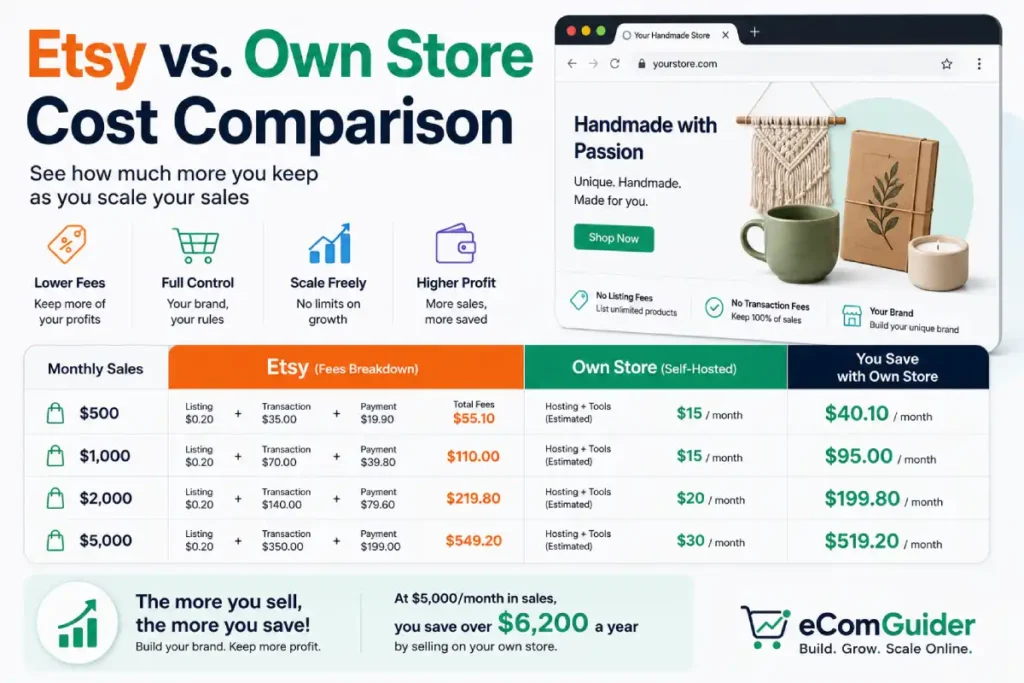
The Etsy vs Own Store Math
Here’s what each option actually costs, based on Etsy’s published fee schedule and each platform’s standard pricing.
Etsy, per Etsy’s own fee basics article, charges a $0.20 listing fee per item sold, a 6.5% transaction fee on the sale price plus shipping, and a 3% plus $0.25 payment processing fee for US sellers.
Combined, that’s roughly 9.5% of the order total plus about $0.45 per order, before anything else. Sellers earning over $10,000 in trailing 12-month sales also get charged a mandatory 12% to 15% Offsite Ads fee on any sale Etsy’s own ad network drives, which the table below doesn’t include.
Shopify Basic costs $39/month (or around $29/month billed annually, per Shopify’s own pricing page) plus 2.9% and $0.30 per transaction through Shopify Payments, no per-listing fee at any point.
A bare-bones WooCommerce store skips the platform fee, WooCommerce itself is free, but you’re paying for hosting, typically $10 to $30/month for a small store, plus a standard card processing rate around 2.9% and $0.30 per transaction through Stripe or a comparable processor.
Example using typical US pricing assumptions. The table below uses Shopify Payments (or an equivalent processor rate), excludes Etsy’s Offsite Ads fee and any paid Etsy Ads budget, excludes WooCommerce extensions or a paid theme beyond hosting, and uses a rounded hosting estimate that varies by provider.
Change any of those, average order value, shipping charged, country, or annual versus monthly billing, and the exact crossover point moves. As a rough formula: monthly Etsy fees are approximately (sales x 9.5%) plus ($0.45 x number of orders).
| Monthly handmade sales | Etsy (~9.5% + $0.45/order) | Shopify Basic ($39 + 2.9%) | WooCommerce (~$20 hosting + 2.9%) |
|---|---|---|---|
| $500 | ~$48 | ~$54 | ~$35 |
| $1,000 | ~$95 | ~$68 | ~$49 |
| $2,500 | ~$238 | ~$112 | ~$93 |
| $5,000 | ~$475 | ~$184 | ~$165 |
| $10,000 | ~$950 | ~$329 | ~$310 |
The crossover happens fast. Using these assumptions, Etsy is still the cheaper option below roughly $600 a month in sales, where Shopify’s flat $39 fee outweighs the roughly 6.6 percentage point gap between the two platforms’ cut.
Above that, Etsy gets more expensive every month you stay. A WooCommerce store’s lower fixed cost puts its own breakeven point closer to $300 a month under the same assumptions.
Etsy’s transaction fee is also a figure that has changed before, confirm the current rate in your own Shop Manager before you price around it.
What the Fee Math Doesn’t Capture
The number above tells you when Etsy’s cut costs more than a store’s fixed cost, it doesn’t tell you what it costs to replace Etsy’s foot traffic.
Etsy brings tens of millions of active buyers who are already searching for handmade goods, a new Shopify or WooCommerce store starts with none of that and has to earn it through SEO, paid ads, or an existing following.
For a shop with no outside audience, the real breakeven point for leaving Etsy is higher than the fee table suggests, because the marketing cost to replace that traffic has to get added to the store side of the comparison.
This is why most established handmade sellers run both: Etsy for discovery, a self-hosted store for the customers who already know their brand.
If you’re weighing the two platforms head to head rather than as a combination, our Shopify vs Etsy comparison goes deeper on that specific matchup.
Best Platform by Situation
- Just starting out with no existing audience: Etsy. The traffic advantage outweighs the fee gap until you have a customer base of your own to sell to directly.
- Already have a following on social media or elsewhere: your own store on Shopify or WooCommerce, since you don’t need Etsy’s discovery engine and can keep the full margin.
- Doing steady volume above roughly $600 to $1,000 a month on Etsy: worth testing a parallel Shopify or WooCommerce store for repeat buyers, without pulling listings off Etsy.
- Want the lowest ongoing platform cost while learning the ropes: WooCommerce can offer this if you already have or don’t mind managing basic hosting, though premium hosting, backups, or paid plugins can close that gap.
- Want to sell original art or one-off pieces rather than a repeatable product line: see our platform for artists breakdown, the calculus shifts when every listing is unique.
- Weighing more than just Etsy against one alternative: handmade sellers generally face the same Shopify, WooCommerce, and Squarespace tradeoffs worth comparing side by side before you lock in.
When Each Option Is the Wrong Choice
- Etsy is a weaker fit once your fees regularly clear a few hundred dollars a month and you already have a way to reach buyers directly. At that point you’re paying for traffic you no longer fully need.
- Shopify is harder to justify below a few hundred dollars a month in sales. The $39 monthly fee is real money for a shop still finding its buyers, and Etsy’s traffic is worth more than the fee gap costs at that stage.
- WooCommerce asks more of you if you’re not comfortable managing basic hosting and WordPress updates. It can offer the lowest ongoing platform cost of the three on a bare-bones setup, but premium hosting, backups, security, or paid plugins can erode that advantage, and there’s no vendor to call when something breaks.
- A pure marketplace approach struggles once you want your own brand identity, email list, or repeat-customer relationships. Etsy’s policies limit what you can do with buyer contact information outside the platform, see below.
Who Manages the Customer Relationship
This is where Etsy differs from a self-hosted store in a way that matters more than it looks like at first.
Etsy’s seller policy states that any buyer information you receive through a transaction may only be used for Etsy-related communications or Etsy-facilitated transactions, not for unsolicited marketing outside the platform.
You can still build an email list from Etsy buyers, but only with their separate, explicit opt-in, usually collected through a packaging insert or a link to your own signup page, not by exporting order data and emailing it directly.
On Shopify or WooCommerce, that customer relationship is yours by default, the email address, purchase history, and ability to run your own retention campaigns live in your own store rather than passing through a marketplace’s rules.
This is one more reason a growing shop eventually adds its own store alongside Etsy: it’s the only way to build a direct line to repeat buyers rather than re-earning their attention through Etsy search every time.
Setting Up Shop on Etsy
- Go to Etsy.com and select Sell on Etsy, then create a shop name, this can be changed later but not without some friction, so pick something you’re willing to keep
- Set your shop preferences: language, country, and currency
- Create your first listing with photos, a title, description, price, and shipping details, remember the $0.20 listing fee applies per item
- Set up Etsy Payments to receive buyer payments, this is mandatory in most countries
- Publish your shop and listings
A mistake worth watching for: pricing items without factoring in the full ~9.5% plus $0.45 per order fee stack. A seller who prices based on the sale price alone, then gets surprised by the payment processing and transaction fees on payout, is pricing at a loss without realizing it until the numbers catch up.
Setting Up Your Own Store on Shopify
- Sign up for Shopify and select the Basic plan for a new small store
- Choose a theme, Shopify’s free themes are a reasonable starting point for a handmade shop before you invest in a paid one
- Add your products with photos, descriptions, pricing, and shipping weights
- Set up Shopify Payments to avoid the additional third-party gateway fee
- Connect a custom domain if you have one, or use the free Shopify subdomain to start
An easy-to-miss detail: shipping costs eat into handmade margins fast, since items are often irregular shapes and weights.
Set up accurate shipping profiles by product before you publish, rather than using a flat rate that undercharges on bulkier pieces.
Setting Up Your Own Store on WooCommerce
- Install WordPress with your host, then add the WooCommerce plugin from the WordPress plugin directory
- Run the WooCommerce setup wizard, per WooCommerce’s own documentation, to configure currency, shipping zones, and tax settings
- Add your products, WooCommerce handles physical products natively, no extra plugin required for this part
- Connect Stripe or another payment gateway
- Choose a theme suited to a visual, image-heavy catalog, handmade shops lean on product photography more than most categories
A real, easy-to-miss detail: your hosting plan’s server resources affect image-heavy product pages more than a typical WooCommerce store, budget for hosting that handles a photo-heavy catalog without slowing down, not the cheapest shared plan available.
Which Option Actually Wins
- Best for discovery with zero existing audience: Etsy, nothing else here puts a new shop in front of ready buyers as fast.
- Best margin once you have steady volume: WooCommerce, its lower fixed cost on a bare-bones setup clears the breakeven point earliest of the three, though that edge shrinks if you add premium hosting or paid plugins.
- Best balance of ease and margin for a growing shop: Shopify, more setup polish than WooCommerce with a lower long-run cost than staying on Etsy alone.
- Best answer for most established sellers: run both. Etsy for new-buyer discovery, a self-hosted store for the customers who already know the brand and don’t need to be found again.
Getting Started
The real mistake isn’t picking Etsy or your own store first, it’s staying on whichever one you started with past the point where the math has already flipped.
Start on Etsy if you have no audience yet, track your monthly fees against the numbers above, and add a Shopify or WooCommerce store once volume and repeat buyers justify it. You don’t have to choose permanently, and most sellers who do well long-term don’t.
Frequently Asked Questions: How to Sell Handmade Products Online
How much does Etsy actually take from a sale?
Roughly 9.5% of the order total plus about $0.45 per order, combining the $0.20 listing fee, 6.5% transaction fee, and 3% plus $0.25 payment processing fee. Sellers over $10,000 in trailing 12-month sales also pay a mandatory 12% to 15% fee on Offsite Ads-driven sales.
At what point does running my own store beat Etsy on fees?
Using typical US pricing assumptions, around $600 a month in sales for a Shopify Basic store, and closer to $300 a month for a bare-bones WooCommerce store, based on where the lower percentage fee overtakes the fixed monthly cost. Your exact number moves with average order value, shipping, and payment processor, the traffic you’d be replacing is a separate cost the fee math doesn’t capture.
Which platform is best for a brand-new handmade shop?
Etsy, for most sellers with no existing audience. Its built-in buyer traffic solves the hardest early problem, getting the product seen at all, which a new self-hosted store cannot do on its own.
Can I collect email addresses from Etsy buyers for my own marketing?
Only with the buyer’s separate, explicit consent. Etsy’s seller policy limits use of transaction-based buyer information to Etsy-related communications, most sellers build their own list through a packaging insert or signup link rather than emailing order data directly.
Should I sell on Etsy and my own store at the same time?
Many established handmade sellers do. Etsy handles new-buyer discovery, and a self-hosted store captures repeat buyers directly without the marketplace fees or contact restrictions.
Does Shopify or WooCommerce charge a listing fee like Etsy?
No, neither charges a per-listing fee. Shopify’s cost is a flat monthly plan fee plus payment processing, and WooCommerce’s is hosting plus payment processing, both independent of how many products you list.